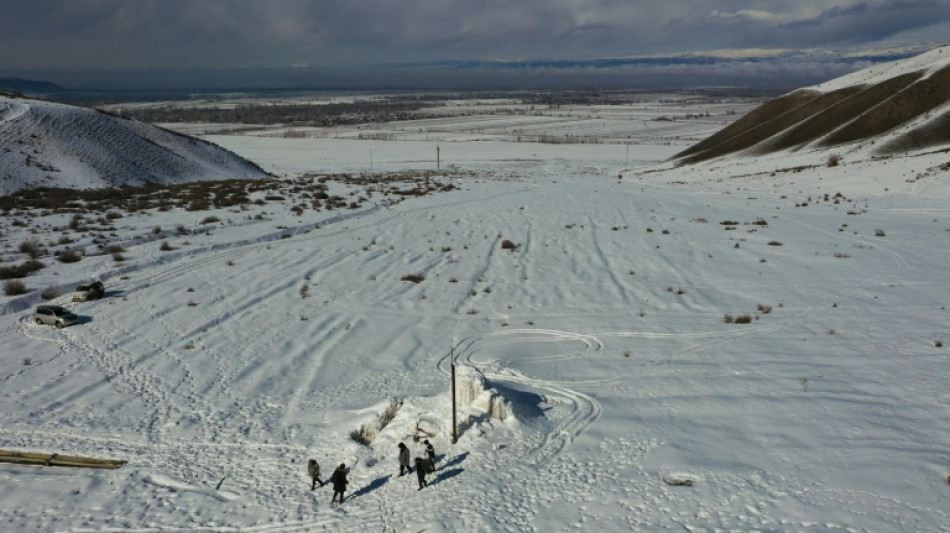
Artificial glaciers stave off drought in Kyrgyzstan / Photo: © AFP

 Justice Alito steps aside from major US climate case

 Willis happy with England exile after retains Top 14 player award

 Spain housing protests keep heat on government as PM seeks new law

 Wissa spoils Zimbabwe homecoming as DR Congo win AFCON qualifier

 UK police release on bail five men held over airbase incident

 Ex-All Black Plummer 'sure' New Zealand will find Super Rugby solution

 Shein sees 1% revenue growth in first half of 2026
 Netherlands regrets Israel retaliation in settlements row

 Moscow seizes Russian assets of German food retailer Metro

 Bulgarian spirits inflamed by new rakia rules

 Documentary turns camera on architect Peter Zumthor

 UK police say releasing on bail five men held over airbase incident

 Trump admin finalizes reversal of US fuel economy standards

 US says no China arms sale plans after envoy cites Trump offer

 Dozens kidnapped in two weekend attacks in northern Nigeria

 Next stop the world: Pathirage wins Asian Games javelin gold

 Aster Launches Perpetual Grid Trading 2.0 with Up to 140,000 $ASTER Liquidity Mining Campaign

 Seoul says North Korean mines 'highly suspected' as cause of DMZ blast

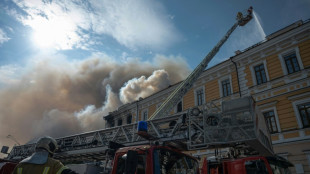 Russia pummels Kyiv in latest deadly daytime attack

 Wartime Ukraine works to keep its railways on track

 Boy among 3 dead in migrant Channel crossing accident: French authorities

 SGFX Creates a Standout Brand Experience at Forex Expo Dubai 2026

 Pope urges Europe to help combat 'deceit and lies' in international ties

 Injured Buttler to miss England ODI series in Pakistan
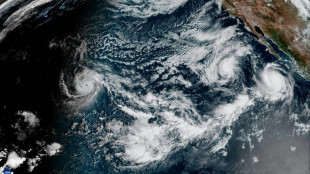
 Madrid housing protesters vow to maintain pressure on government

In the Tian-Shan mountains of Kyrgyzstan, villagers have made an artificial glacier to provide water for their drought-hit farms.
Standing on the ice hillock, farmer Erkinbek Kaldanov said he was optimistic about harnessing nature to counteract climate change.
"We won't have any more problems with water," said the farmer, who was worried for his sheep last year after some unusual temperature spikes.
"When the glacier melts, there will be enough water for the livestock and to water the land in Syn-Tash," the surrounding district, he said.
The glacier currently measures five metres (16 feet) high and about 20 metres long. At the height of winter it was 12 metres tall.
Local residents made it over a period of two weeks in autumn by re-directing water from the peaks of Tian-Shan, which tower more than 4,000 metres high in northern Kyrgyzstan.
Kaldanov and others are being forced to adapt since natural glaciers in Central Asia -- the main water source for the region -- are slowly disappearing due to global heating.
A 2023 study in the journal Science predicted that the acceleration in the melting of the glaciers would peak only between 2035 and 2055.
The lack of snow, also due to higher temperatures, does not allow them to regenerate.
- 'Less and less water' -
The extent of the problem can be seen in satellite images of Central Asia and in the regular warnings issued by the United Nations.
The problem has a knock-on effect on the lowlands of Central Asia, in more arid countries like Kazakhstan, Turkmenistan and Uzbekistan.
This in turn feeds into existing tensions between the different countries, which still share water resources under a complex and obsolete scheme inherited from the Soviet era.
"There is less and less water every year. The water tables are emptying out, the springs are drying up and we have problems with grazing," said Aidos Yzmanaliyev, a spokesman for the Syn-Tash farmers.
Finding solutions is urgent, particularly as farming represents around 10 percent of the fragile Kyrgyz economy and two thirds of its inhabitants live in rural areas.
In the north of Kyrgyzstan, a country accustomed to revolutions and uprisings, the lack of water has already stoked social tensions in previous periods of drought.
"Our main aim is to provide water for livestock since the majority of the 8,400 inhabitants of the Syn-Tash district are farmers," said district chief Maksat Dzholdoshev.
"We expect to create two or three additional artificial glaciers for farmland," he said.
- Simple concept -
The idea and its implementation are relatively simple. Each glacier costs around 550,000 som (around $6,200) to create.
"The water comes from a mountain source three kilometres away through underground piping. It gushes out and freezes, forming a glacier," said Yzmanaliyev.
"Apart from providing water when it melts, the glacier also helps lower the ambient temperature and create humidity.
"(That) helps the surrounding vegetation, which is grazed by cattle from spring to autumn," Yzmanaliyev said.
Artificial glaciers were first created in the Indian Himalayas in 2014 and have gone global -- cropping up in Chile and Switzerland.
In Kyrgyzstan, their introduction was spearheaded by Abdilmalik Egemberdiyev, head of the Kyrgyz association of pasture users.
Egemberdiyev pointed to an additional benefit.
The glaciers allow farmers to keep livestock on spring pastures for longer before sending them to summer pastures, thus slowing soil erosion.
"We now have 24 artificial glaciers around the country and more still to be created," he said.
K.Brown--BTB


