
February marks 9th straight month of record-smashing global heat: climate monitor / Photo: © AFP

 Justice Alito steps aside from major US climate case

 Willis happy with England exile after retains Top 14 player award

 Spain housing protests keep heat on government as PM seeks new law

 Wissa spoils Zimbabwe homecoming as DR Congo win AFCON qualifier

 UK police release on bail five men held over airbase incident

 Ex-All Black Plummer 'sure' New Zealand will find Super Rugby solution

 Shein sees 1% revenue growth in first half of 2026

 Netherlands regrets Israel retaliation in settlements row

 Moscow seizes Russian assets of German food retailer Metro

 Bulgarian spirits inflamed by new rakia rules

 Documentary turns camera on architect Peter Zumthor

 UK police say releasing on bail five men held over airbase incident

 Trump admin finalizes reversal of US fuel economy standards

 US says no China arms sale plans after envoy cites Trump offer

 Dozens kidnapped in two weekend attacks in northern Nigeria

 Next stop the world: Pathirage wins Asian Games javelin gold

 Aster Launches Perpetual Grid Trading 2.0 with Up to 140,000 $ASTER Liquidity Mining Campaign

 Seoul says North Korean mines 'highly suspected' as cause of DMZ blast

 Russia pummels Kyiv in latest deadly daytime attack

 Wartime Ukraine works to keep its railways on track

 Boy among 3 dead in migrant Channel crossing accident: French authorities

 SGFX Creates a Standout Brand Experience at Forex Expo Dubai 2026

 Pope urges Europe to help combat 'deceit and lies' in international ties

 Injured Buttler to miss England ODI series in Pakistan
 Madrid housing protesters vow to maintain pressure on government

Last month was the warmest February on record globally, the ninth straight month of historic high temperatures across the planet as climate change steers the world into "uncharted territory", Europe's climate monitor said Thursday.
The last year has seen an onslaught of storms, crop-withering drought and devastating fires, as human-caused climate change -- intensified by the naturally-occurring El Nino weather phenomenon -- stoked warming to likely the hottest levels in over 100,000 years.
Copernicus Climate Change Service (C3S) service last month said the period from February 2023 to January 2024 marked the first time Earth had endured 12 consecutive months of temperatures 1.5 degrees Celsius hotter than the pre-industrial era.
That trend has continued, it confirmed in its latest monthly update, with February as a whole 1.77C warmer than the monthly estimate for 1850-1900, the pre-industrial reference period.
Temperatures spiked across swathes of the planet in February, from Siberia to South America, with Europe also registering its second warmest winter on record.
In the first half of the month, daily global temperatures were "exceptionally high", Copernicus said, with four consecutive days registering averages 2C higher than pre-industrial times -- just months after the world registered its first single day above that limit.
This was the longest streak over 2C on record, said C3S director Carlo Buontempo, adding the heat was "remarkable".
But it does not mark a breach of the 2015 Paris climate deal limit of "well below" 2C and preferably 1.5C, which is measured over decades.
Copernicus' direct data from across the planet goes back to the 1940s, but Buontempo said that taking into account what scientists know about historical temperatures "our civilization has never had to cope with this climate".
"In that sense, I think the definition of uncharted territory is appropriate," he told AFP, adding global warming posed an unprecedented challenge to "our cities, our culture, our transport system, our energy system".
- Ocean records -
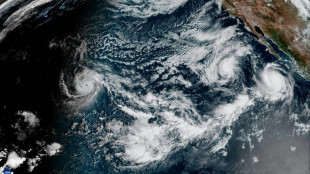
Sea surface temperatures were the highest for any month on record, Copernicus said, smashing the previous heat extremes seen in August 2023 with a new high of just over 21C at the end of the month.
Oceans cover 70 percent of the planet and have kept the Earth's surface liveable by absorbing 90 percent of the excess heat produced by the carbon pollution from human activity since the dawn of the industrial age.
Hotter oceans mean more moisture in the atmosphere, leading to increasingly erratic weather, like fierce winds and powerful rain.
The cyclical El Nino, which warms the sea surface in the southern Pacific leading to hotter weather globally, is expected to fizzle out by early summer, Buontempo said.
He added that the transition to the cooling La Nina phenomenon may happen faster than expected, potentially decreasing the chances that 2024 will be another record-breaking year.
- Fossil fuelled heat-
While the El Nino and other effects have played a role in the unprecedented recent heat, scientists stressed that the greenhouse gas emissions that humans continue to pump into the atmosphere were the main culprit.
The UN's IPCC climate panel has warned that the world will likely crash through 1.5C in the early 2030s.
Planet-heating emissions, mainly from the burning of fossil fuels, continue to rise when scientists say they need to fall by almost half this decade.
Countries at UN climate negotiations in Dubai last year agreed to triple global renewables capacity this decade and "transition away" from fossil fuels.
But the deal lacked important details, with governments now under pressure to strengthen their climate commitments in the short term and for beyond 2030.
"We know what to do -- stop burning fossil fuels and replace them with more sustainable, renewable sources of energy," said Friederike Otto, of the Grantham Institute for Climate Change and the Environment, Imperial College London.
"Until we do that, extreme weather events intensified by climate change will continue to destroy lives and livelihoods."
L.Janezki--BTB


