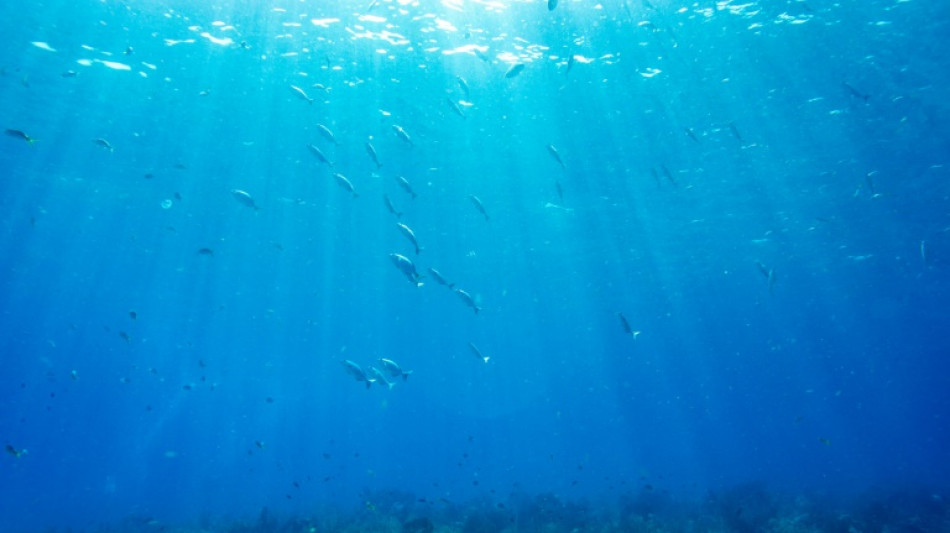
Adagio in sea: Coral larvae 'settle near sounds of healthy reefs' / Photo: © AFP/File

 Dodgers eye three-peat, Red Sox face Yankees as MLB playoffs begin

 Certification of Boeing 737 MAX delayed by software bug

 Celine Dion wows Paris Fashion Week with surprise gig

 AMD buys firm founded by AI 'godmother' Fei-Fei Li

 Italy rebound in Turkey as France win late in Belgium

 Pope says concerns about AI 'should be taken seriously'

 Hurricanes to hoist title banner as NHL season begins

 Justice Alito steps aside from major US climate case

 Willis happy with England exile after retains Top 14 player award

 Spain housing protests keep heat on government as PM seeks new law

 Wissa spoils Zimbabwe homecoming as DR Congo win AFCON qualifier

 UK police release on bail five men held over airbase incident

 Ex-All Black Plummer 'sure' New Zealand will find Super Rugby solution

 Shein sees 1% revenue growth in first half of 2026

 Netherlands regrets Israel retaliation in settlements row

 Moscow seizes Russian assets of German food retailer Metro

 Bulgarian spirits inflamed by new rakia rules

 Documentary turns camera on architect Peter Zumthor

 UK police say releasing on bail five men held over airbase incident

 Trump admin finalizes reversal of US fuel economy standards

 US says no China arms sale plans after envoy cites Trump offer

 Dozens kidnapped in two weekend attacks in northern Nigeria

 Next stop the world: Pathirage wins Asian Games javelin gold

 Aster Launches Perpetual Grid Trading 2.0 with Up to 140,000 $ASTER Liquidity Mining Campaign

 Seoul says North Korean mines 'highly suspected' as cause of DMZ blast

Audio recordings of healthy reefs -- an underwater chorus of fish songs and crackles from snapping shrimp -- may help efforts to restore coral ecosystems harmed by climate and human impacts, scientists said Wednesday.
With the future of the world's biodiversity-rich coral reefs threatened by climate change, some experts are looking for rehabilitation strategies to go alongside broader efforts to slash planet-heating pollution.
Researchers at Woods Hole Oceanographic Institution say one such method to help reefs rebuild could be sound, after they broadcast audio from a healthy reef to entice coral larvae to settle on the seabed at a degraded reef.
Coral larvae use a range of signals from reefs, including chemical cues, as they swim through the open water in their first stage of life looking for a permanent home, said Nadege Aoki, lead author of the study published in the journal Royal Society Open Science.
"Now we have also demonstrated that the local sound environment is very important for these corals, and that playing reef sounds can potentially be a vital tool in the effort to restore coral reefs," she told AFP.
Researchers had been listening to coral reefs in the US Virgin Islands for over a decade, gaining insights into the distinct sounds that separate lively habitats from those that have been damaged by bleaching, disease or direct human impacts.
"A healthy coral reef will typically feature many low-frequency sounds of croaks, purrs, and grunts produced by fishes against a near-constant background of crackles and pops produced by snapping shrimp," said Aoki. A degraded reef, with fewer species, "will be much quieter".
- Under threat -
The team collected specimens from a hardy species known as mustard hill coral -- named for its lumpy shape and yellow hue.
They then distributed them in cups at three reefs in the US Virgin Islands -- one healthy and two more degraded, with patchy coral growth and fewer fish.
Researchers then set up underwater speakers to broadcast their back catalogue of healthy reef sounds at one of the degraded reefs.
They found that the coral larvae at this location settled at rates 1.7 times higher on average -- and up to seven times more -- than the other two reefs, where no sound was played.
There was still much more to learn about how corals respond to sound, Aoki said, including whether different species behave in the same ways and how they are able to "hear".
But she added the finding suggests audio could become part of efforts to rebuild damaged reefs, although this would need to be monitored and protected, since settlement is just one step in a coral's life.
"At the rate that coral reefs are disappearing, human intervention will be absolutely essential to preserving reefs in anything close to their current states," she said.
Coral reefs support about a quarter of all marine life, as well as the millions of people who rely on them for food and income.
But human-driven climate change is spurring mass coral bleaching as the oceans heat and scientists warn that up to 90 percent of reefs could be lost if warming reaches 1.5 degrees Celsius above pre-industrial levels.
O.Bulka--BTB