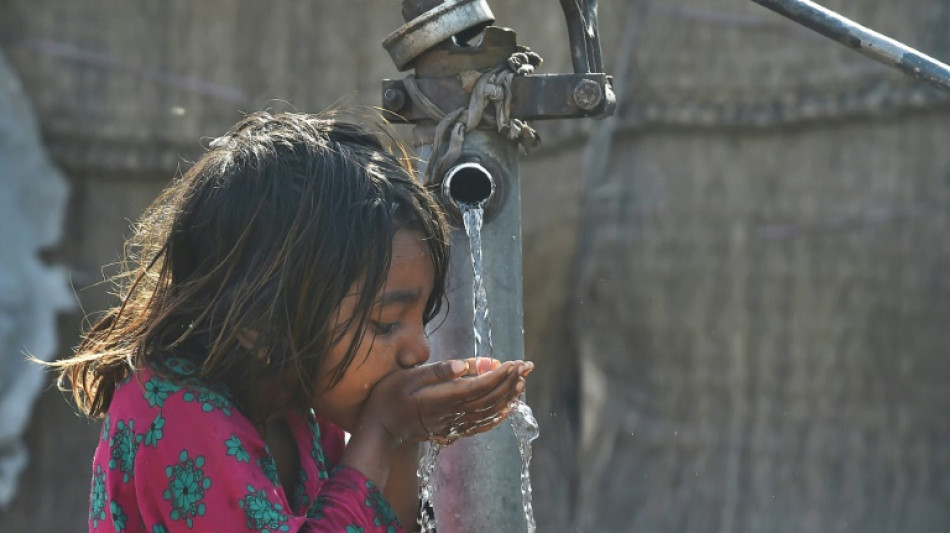
UN warns against thirsty tech to solve water crisis / Photo: © AFP/File

 Dodgers eye three-peat, Red Sox face Yankees as MLB playoffs begin

 Certification of Boeing 737 MAX delayed by software bug

 Celine Dion wows Paris Fashion Week with surprise gig

 AMD buys firm founded by AI 'godmother' Fei-Fei Li

 Italy rebound in Turkey as France win late in Belgium

 Pope says concerns about AI 'should be taken seriously'

 Hurricanes to hoist title banner as NHL season begins

 Justice Alito steps aside from major US climate case

 Willis happy with England exile after retains Top 14 player award

 Spain housing protests keep heat on government as PM seeks new law

 Wissa spoils Zimbabwe homecoming as DR Congo win AFCON qualifier

 UK police release on bail five men held over airbase incident

 Ex-All Black Plummer 'sure' New Zealand will find Super Rugby solution

 Shein sees 1% revenue growth in first half of 2026

 Netherlands regrets Israel retaliation in settlements row

 Moscow seizes Russian assets of German food retailer Metro

 Bulgarian spirits inflamed by new rakia rules

 Documentary turns camera on architect Peter Zumthor

 UK police say releasing on bail five men held over airbase incident

 Trump admin finalizes reversal of US fuel economy standards

 US says no China arms sale plans after envoy cites Trump offer

 Dozens kidnapped in two weekend attacks in northern Nigeria

 Next stop the world: Pathirage wins Asian Games javelin gold

 Aster Launches Perpetual Grid Trading 2.0 with Up to 140,000 $ASTER Liquidity Mining Campaign
 Seoul says North Korean mines 'highly suspected' as cause of DMZ blast

The world needs to better manage its freshwater resources but thirsty new technologies touted as solutions could lead to "serious problems" if left unchecked, a UN report warned Friday.
Roughly half of the planet's population is facing grave water shortages, with climate change-linked droughts affecting more than 1.4 billion people between 2002 and 2021, the report for the UN cultural agency UNESCO said.
As of 2022, more than 2 billion people were without access to safely managed drinking water, while 3.5 billion people lacked access to decent toilets, it added.
On top of that, pharmaceuticals, hormones and industrial chemicals are seeping into the world's rivers.
The report, titled "Water for prosperity and peace", called for more water education, data collection and investment to address the crisis.
It also highlighted the limits of new computer-led solutions.
"An array of technologies is available to improve both water supply, water use efficiency and the quality and extension of" sanitation services, it said.
But "several rapidly emerging technologies are highly water-intensive and, if left unchecked, could lead to serious problems in the near future."
Artificial intelligence (AI) had "the potential to enhance (river) basin management, emergency response, and the operation and maintenance of water supply and wastewater treatment plants," said the report.
But "AI and related technologies require large volumes of water for computer cooling systems, in addition to the (often water-intensive) energy required to power the equipment."
- Flawed solutions -
While climate change is projected to intensify patterns of record rainfall and drought in coming years, solutions to tackle that problem were also using up too much water, it added.
One such technique, called carbon capture and storage, syphons off CO2 from the exhaust of fossil fuel-fired power plants and heavy industry such as steel and cement factories in a bid to reduce planet-heating carbon pollution.
But "carbon capture and storage systems... are extremely energy- and water-intensive," the report said.
Energy production accounts for between 10 and 15 percent of global water withdrawals, both to extract fossil fuels and cool thermal and nuclear power stations, it said.
While wind, solar and geothermal energy systems are more water-efficient, they still require lithium batteries for power storage.
Yet the extraction of lithium and other critical minerals for solar panels "is usually highly water-intensive, with significant risks to water quality" especially groundwater, ecosystems and local populations, the report said.
R.Adler--BTB