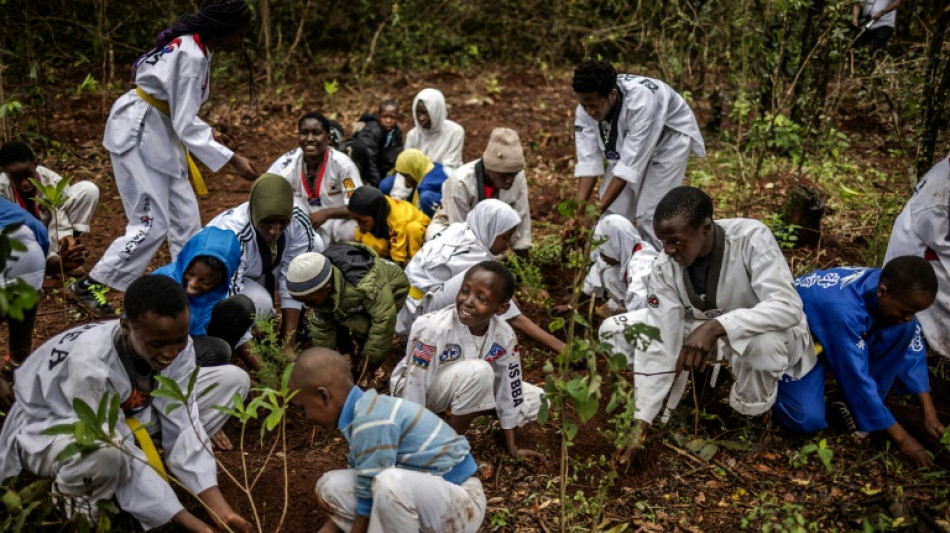
Planting trees in wrong places heats the planet: study / Photo: © AFP

 Dodgers eye three-peat, Red Sox face Yankees as MLB playoffs begin
 Certification of Boeing 737 MAX delayed by software bug

 Celine Dion wows Paris Fashion Week with surprise gig

 AMD buys firm founded by AI 'godmother' Fei-Fei Li

 Italy rebound in Turkey as France win late in Belgium

 Pope says concerns about AI 'should be taken seriously'

 Hurricanes to hoist title banner as NHL season begins

 Justice Alito steps aside from major US climate case

 Willis happy with England exile after retains Top 14 player award

 Spain housing protests keep heat on government as PM seeks new law

 Wissa spoils Zimbabwe homecoming as DR Congo win AFCON qualifier

 UK police release on bail five men held over airbase incident

 Ex-All Black Plummer 'sure' New Zealand will find Super Rugby solution

 Shein sees 1% revenue growth in first half of 2026
 Netherlands regrets Israel retaliation in settlements row

 Moscow seizes Russian assets of German food retailer Metro

 Bulgarian spirits inflamed by new rakia rules

 Documentary turns camera on architect Peter Zumthor

 UK police say releasing on bail five men held over airbase incident

 Trump admin finalizes reversal of US fuel economy standards

 US says no China arms sale plans after envoy cites Trump offer

 Dozens kidnapped in two weekend attacks in northern Nigeria

 Next stop the world: Pathirage wins Asian Games javelin gold

 Aster Launches Perpetual Grid Trading 2.0 with Up to 140,000 $ASTER Liquidity Mining Campaign
 Seoul says North Korean mines 'highly suspected' as cause of DMZ blast

Planting trees in the wrong places can actually contribute to global warming, scientists said on Tuesday, but a new map identifies the best locations to regrow forests and cool the planet.
Trees soak up carbon dioxide and restoring areas of degraded woodlands or planting saplings to boost forest cover is one tool in the fight against climate change.
But in some cases, more trees means less sunlight is reflected back from the earth's surface and more heat is absorbed by the planet, according to a study in the journal Nature Communications.
"There are some places where putting trees back leads to net climate negative outcomes," Susan Cook-Patton, one of the study's co-authors, told AFP.
Scientists had already understood that restoring tree cover led to changes in albedo -- the amount of solar radiation bounced back off the planet's surface -- but didn't have the tools to account for it, she said.
Using new maps, researchers were able to consider, for the first time, the cooling effect from trees and the warming caused by decreased albedo.
They found that projects that didn't factor albedo into the equation overestimated the climate benefit of additional trees by between 20 to 80 percent.
But the maps also provide the tools to help policymakers identify where best to funnel scarce resources for maximum climate impact, said Cook-Patton, senior forest restoration scientist at The Nature Conservancy.
"There's also lots of places still where restoring tree cover is a great idea for climate change. We're just trying to help people find those spots," she said.
- Return on investment -
Albedo is highest in the frozen areas of the world, and mirror-like clean snow and ice with high levels of albedo reflect up to 90 percent of the sun's energy.
It is one of Earth's major cooling agents, along with lands and oceans that absorb excess heat and planet-warming greenhouse gas emissions.
Many countries have promised to plant billions of trees as a bulwark against global warming but not all efforts deliver for the planet equally, this study showed.
Moist, tropical environments like the Amazon and Congo Basin boasted high carbon storage and low changes in albedo, making them ideal locations for restoring forest cover.
The opposite was true in temperate grasslands and savanna, Cook-Patton said.
Even projects in the best locations were probably delivering 20 percent less cooling than estimated when changes to albedo were taken into account, she said.
But she stressed that restoring forests delivered undeniable benefits for people and the planet, such as supporting ecosystems and providing clean air and water, among many.
"We really don't want our work to be a critique of the movement writ large," she said.
"(But) we can't put trees everywhere. We don't have enough money or time or resources or people or seedlings.
"And so it's really about making the most of limited investments and getting the greatest climate return per hectare of investment," she added.
B.Shevchenko--BTB