Israel's war budget leaves top scientists in limbo / Photo: © AFP

 Dodgers eye three-peat, Red Sox face Yankees as MLB playoffs begin

 Certification of Boeing 737 MAX delayed by software bug

 Celine Dion wows Paris Fashion Week with surprise gig
 AMD buys firm founded by AI 'godmother' Fei-Fei Li

 Italy rebound in Turkey as France win late in Belgium

 Pope says concerns about AI 'should be taken seriously'

 Hurricanes to hoist title banner as NHL season begins

 Justice Alito steps aside from major US climate case

 Willis happy with England exile after retains Top 14 player award

 Spain housing protests keep heat on government as PM seeks new law

 Wissa spoils Zimbabwe homecoming as DR Congo win AFCON qualifier

 UK police release on bail five men held over airbase incident

 Ex-All Black Plummer 'sure' New Zealand will find Super Rugby solution

 Shein sees 1% revenue growth in first half of 2026
 Netherlands regrets Israel retaliation in settlements row

 Moscow seizes Russian assets of German food retailer Metro

 Bulgarian spirits inflamed by new rakia rules

 Documentary turns camera on architect Peter Zumthor

 UK police say releasing on bail five men held over airbase incident

 Trump admin finalizes reversal of US fuel economy standards

 US says no China arms sale plans after envoy cites Trump offer

 Dozens kidnapped in two weekend attacks in northern Nigeria

 Next stop the world: Pathirage wins Asian Games javelin gold

 Aster Launches Perpetual Grid Trading 2.0 with Up to 140,000 $ASTER Liquidity Mining Campaign

 Seoul says North Korean mines 'highly suspected' as cause of DMZ blast

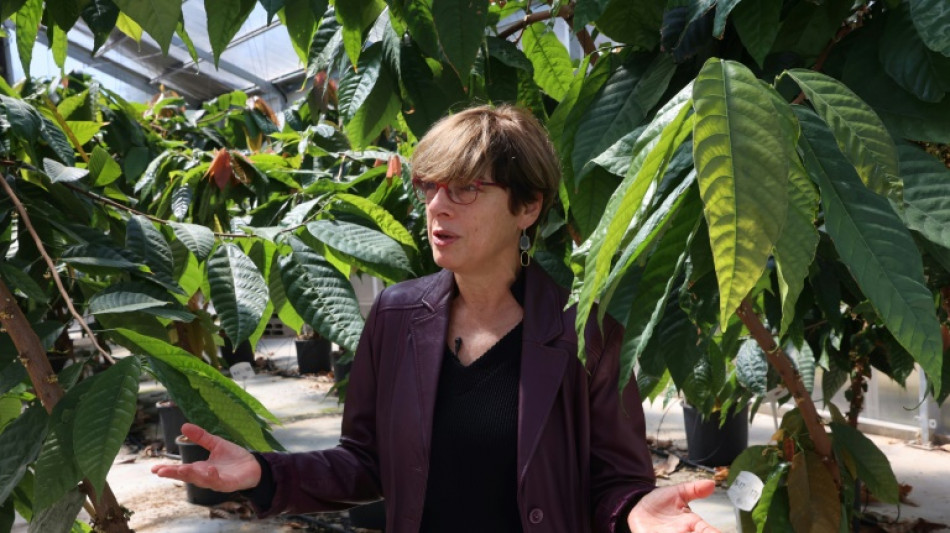
Israeli scientist Ellen Graber has spent years researching ways to save chocolate crops from climate change. But with the government slashing spending to fund the war in Gaza, her project is one of hundreds now hanging in the balance.
Graber's research had already been hit by the war -- she had to abandon her cacao plants when the area where they were grown was evacuated after the October 7 Hamas attack.
They survived weeks of drought-like conditions in a greenhouse.
But the state-funded Volcani Institute where she works is now facing huge budget cuts.
The institute specialises in arid and desert environments, increasingly vital areas of study for a planet wracked by extreme weather caused by climate change.
Now the government's war budget means hundreds of the institute's projects are under threat.
- 'Functionally stagnant' -
Israeli politicians approved sweeping cuts to ministry budgets earlier this month to pay for an 82 percent rise in defence spending and some key demands of Prime Minister Benjamin Netanyahu's coalition allies.
They included controversial measures to boost financing of ultra-Orthodox education programmes and Israeli settlements in the occupied West Bank.
The ministry of agriculture was one of the hardest hit, facing a 12 percent cut.
The Volcani Institute is set to lose a fifth of its state money, which it says will effectively bring its research to a halt.
The warning comes days after Israel's state auditor criticised the government's "functionally stagnant" handling of the climate crisis.
Opposition leader Yair Lapid called the budget "the most sectarian, disconnected and reckless" in the country's history.
And economist Itai Ater, a senior fellow at the Israel Democracy Institute think tank, said the budget "will certainly harm... education, health, welfare and infrastructure".
- 'Whole thing will dry up' -
Volcani's acting director Shmuel Assouline warned lawmakers its revised budget would only cover basic running costs.
He said halting its research could mean a loss of around 100 million shekels ($27 million) in its partnerships with other institutions and corporate partners.
"If we lose our good name, private companies won't come to invest," he added.
Graber, a soil scientist, started growing tropical cacao plants four years ago to devise ways "to increase yields, to increase quality, to deal with pests and pathogens and diseases" plaguing the cacao industry globally.
"I can't buy important chemicals, the equipment that I need, the materials I need to work and to continue this study," Graber said.
"Within one year, this whole thing will dry up."
Volcani's sprawling campus in central Israel has the atmosphere of a kibbutz crossed with a top-secret research facility.
Cows low in barns metres from laboratories where researchers are trying to isolate fungus-killing bacterial strains they hope will replace chemical pesticides.
Its researchers are at the forefront of climate change solutions for agriculture.
They collaborate with universities, governments and private companies around the globe on subjects as diverse as meteorology and water-use to gene-editing and environmental microbiology.
Eddie Cytryn, director of Volcani's Institute of Soil, Water and Environmental Sciences, said the cuts would have "tremendous impacts" on field research and international collaboration -- and the grants that fund them.
- Cell growth research stunted -
Scientists Hinanit Koltai and Guy Mechrez head a team studying a novel method to accelerate and control cell growth in cows.
Their research, carried out in partnership with an Israeli firm called Nanomeat, aims to overcome a major hurdle for the lab-grown meat industry.
But Koltai echoed Graber and Assouline in saying her team was no longer able to buy materials for their research and warning they could lose their corporate partners.
"Nanomeat will go to somebody else no doubt," she said.
Agriculture Minister Avi Dichter told Kan public radio that he had "a serious disagreement with the finance ministry" over funds for the Volcani Institute.
He said Netanyahu "promised to intervene" but for the time being the scientists are left in limbo.
M.Furrer--BTB