Sweden aims to boost plastic recycling with giant plant / Photo: © AFP/File

 Dodgers eye three-peat, Red Sox face Yankees as MLB playoffs begin

 Certification of Boeing 737 MAX delayed by software bug

 Celine Dion wows Paris Fashion Week with surprise gig
 AMD buys firm founded by AI 'godmother' Fei-Fei Li

 Italy rebound in Turkey as France win late in Belgium

 Pope says concerns about AI 'should be taken seriously'

 Hurricanes to hoist title banner as NHL season begins

 Justice Alito steps aside from major US climate case

 Willis happy with England exile after retains Top 14 player award

 Spain housing protests keep heat on government as PM seeks new law

 Wissa spoils Zimbabwe homecoming as DR Congo win AFCON qualifier

 UK police release on bail five men held over airbase incident

 Ex-All Black Plummer 'sure' New Zealand will find Super Rugby solution

 Shein sees 1% revenue growth in first half of 2026

 Netherlands regrets Israel retaliation in settlements row

 Moscow seizes Russian assets of German food retailer Metro

 Bulgarian spirits inflamed by new rakia rules

 Documentary turns camera on architect Peter Zumthor

 UK police say releasing on bail five men held over airbase incident
 Trump admin finalizes reversal of US fuel economy standards
 US says no China arms sale plans after envoy cites Trump offer

 Dozens kidnapped in two weekend attacks in northern Nigeria

 Next stop the world: Pathirage wins Asian Games javelin gold

 Aster Launches Perpetual Grid Trading 2.0 with Up to 140,000 $ASTER Liquidity Mining Campaign

 Seoul says North Korean mines 'highly suspected' as cause of DMZ blast

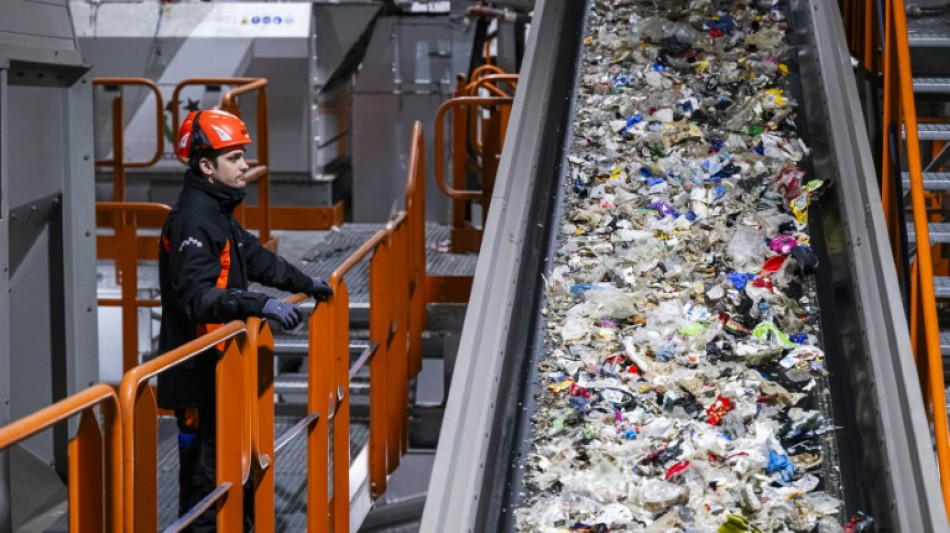
Discarded crisp bags, ketchup bottles and Tupperware containers speed along conveyer belts at a massive high-tech sorting plant dubbed "Site Zero", which Sweden hopes will revolutionise its plastic recycling.
Infrared lights, lasers, cameras and even artificial intelligence are used to sort the piles of plastic waste, Mattias Philipsson, CEO of Swedish Plastic Recycling, a non-profit organisation owned by the plastic industry, explains as he gives a tour of the plant.
Located outside the town of Motala, some 200 kilometres (124 miles) southwest of Stockholm, the site has been in operation since late 2023 and is described by the organisation as "the world's largest and most modern facility for plastic recycling".
Capable of processing 200,000 tonnes of waste a year, the fully automated plant can isolate 12 different types of plastic, compared to only four in conventional facilities.
Its operator hopes upcoming EU legislation requiring new packaging to include a certain amount of recycled plastic will give a boost to the recycling industry.
"We receive all the collected plastic packaging which people have sorted in Swedish households," Philipsson told AFP at the site, adding that they "have the capacity to handle the equivalent of all of Sweden's plastic waste."
Thousands of plastic items make their way through an intricate maze of different machines which identify and separate the items into distinct categories, called "fractions."
On one of the conveyor belts, infrared light is used to scan the packaging as it zooms past, and a strong blast of air whooshes the pieces in different directions depending on the type of plastic.
- Room for improvement -
Among other things, the facility is able to sort out PVC and polystyrene, two fractions that have not previously been able to be reused in new products as such.
"The idea is to be part of a circular economy and to reduce the use of fossil fuels," Philipsson says.
"With our old sorting plant, over 50 percent of the plastic packaging was eventually incinerated because it couldn't be sorted. Now it's less than five percent," he adds.
The Scandinavian country is not at the top of the class when it comes to plastic recycling.
In 2022, only 35 percent of plastic waste was recycled, according to the Swedish Environmental Protection Agency (EPA), under the EU average of 40 percent.
The incineration of plastic waste, which is used to produce both heat and electricity, accounts for about seven percent of Sweden's greenhouse gas emissions, according to the agency.
"Swedes are good at recycling in general -- metals, paper and glass -- because we have been doing this for a long time and have an industry that wants the paper for example," EPA expert Asa Stenmarck told AFP.
But "when it comes to plastics we are not so good," she added.
"A lot is not even sorted, which is a big problem and this goes for both households and businesses. So we really need to work on sorting."
- More waste coming -
Recycled plastic is still struggling to be widely adopted, as it is on average 35 percent more expensive than newly produced plastic.
Stenmarck noted that some of the fractions sorted by Site Zero are still unusual on the recycling market.
"So in a sense, it's kind of brave since there probably aren't customers yet," she explained.
Stenmarck said one way of speeding up its adoption is to legislate, and noted this was underway in Europe with the new Packaging and Packaging Waste Regulation (PPWR).
The 27 EU member states agreed on March 4 that plastic packaging must contain between 10 and 35 percent recycled content, depending on whether it is used for food, by 2030.
"It will be a welcome game-changer for the market," Philipsson told AFP, adding that "the only way to achieve that is through efficient sorting."
Still, the OECD anticipates that the amount of plastic packaging will triple by 2060.
Some environmentalists argue that increased recycling does not address the root problem.
"We have the feeling that this talk of an improvement in the technical performance reinforces the idea that we can continue (making plastic), that there is nothing to worry about," Henri Bourgeois-Costa, a plastic waste expert at the Tara Ocean Foundation, told AFP.
"The challenge with these plastics is not to sort them better, to better recycle them... The challenge is to replace them and eliminate them," he added.
Other projects based on the Site Zero model are being designed elsewhere in Europe, with two in Germany and one in Norway.
D.Schneider--BTB