In Canada's Quebec, residents miffed over mining boom / Photo: © AFP

 Dodgers eye three-peat, Red Sox face Yankees as MLB playoffs begin

 Certification of Boeing 737 MAX delayed by software bug

 Celine Dion wows Paris Fashion Week with surprise gig

 AMD buys firm founded by AI 'godmother' Fei-Fei Li
 Italy rebound in Turkey as France win late in Belgium

 Pope says concerns about AI 'should be taken seriously'
 Hurricanes to hoist title banner as NHL season begins

 Justice Alito steps aside from major US climate case

 Willis happy with England exile after retains Top 14 player award

 Spain housing protests keep heat on government as PM seeks new law

 Wissa spoils Zimbabwe homecoming as DR Congo win AFCON qualifier

 UK police release on bail five men held over airbase incident

 Ex-All Black Plummer 'sure' New Zealand will find Super Rugby solution

 Shein sees 1% revenue growth in first half of 2026
 Netherlands regrets Israel retaliation in settlements row

 Moscow seizes Russian assets of German food retailer Metro
 Bulgarian spirits inflamed by new rakia rules

 Documentary turns camera on architect Peter Zumthor

 UK police say releasing on bail five men held over airbase incident

 Trump admin finalizes reversal of US fuel economy standards

 US says no China arms sale plans after envoy cites Trump offer

 Dozens kidnapped in two weekend attacks in northern Nigeria
 Next stop the world: Pathirage wins Asian Games javelin gold

 Aster Launches Perpetual Grid Trading 2.0 with Up to 140,000 $ASTER Liquidity Mining Campaign
 Seoul says North Korean mines 'highly suspected' as cause of DMZ blast

Canada's Quebec province is rich with minerals needed for everything from electric cars to cell phones, but residents living atop the potential windfall are worried their backyards will be dug up -- and they won't get a dime.
In recent months, tens of thousands of mining exploration permits have been issued in the province amid a global rush for critical and strategic minerals such as graphite, lithium, zinc, nickel and cobalt.
But under provincial mining exploration rules, subsoil in Quebec does not belong to landowners.
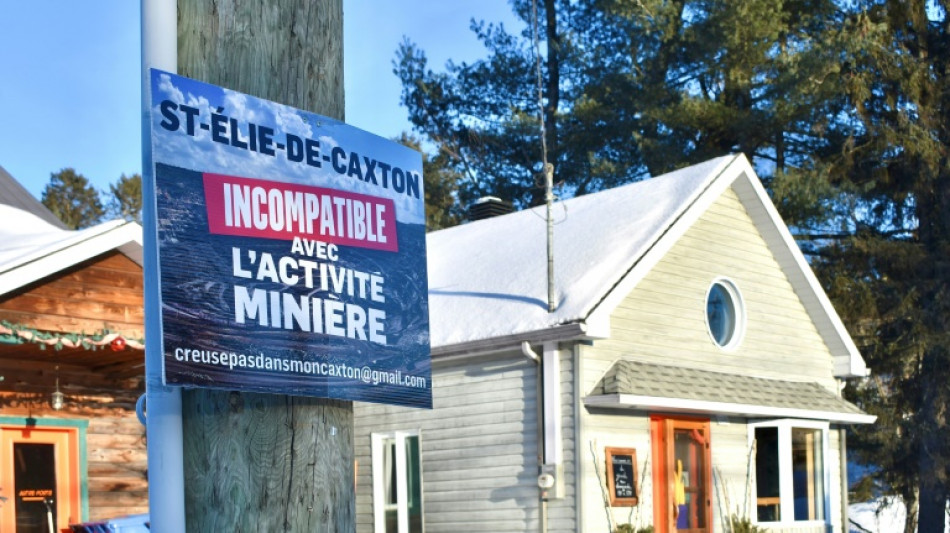
In Saint-Elie-de-Caxton, a town of 2,000 people about halfway between Montreal and Quebec City, residents are fed up. Signs around town proclaim "Saint-Elie, incompatible with mining activity" or "Don't Dig in my Caxton."
"We are at war, says Gilbert Guerin, spokesman for the "Don't Dig in my Caxton" committee, pointing to a map delineating exploration claims that have effectively parceled off the town for future mines.
In Quebec, it only takes a few clicks on a website and about Can$75 (US$55) to stake a mining claim covering up to 100 hectares (250 acres) -- an opportunity open to locals and foreigners alike.
"I bought here. I thought I would be sovereign in my own home, but I came to understand that what's underground did not belong to me," says Yvan Lafontaine, surveying his property in the neighboring village of Saint-Mathieu-du-Parc from atop an observation tower he had built.
When Lafontaine learned that a company had acquired the mining rights to the subsoil beneath his land, what the nature lover calls his little "paradise," he fought back by staking 12 claims surrounding the property.
Currently, more than 350,000 claims have been registered, covering 10 percent of Quebec. The southern areas of the province -- where most of the population lives -- is the most sought after.
According to an AFP analysis of government data, the number of claims issued significantly increased from September 2022 to the end of February 2024, with about 160,000 granted -- a 140 percent increase over the previous 18-month period.
- 'Wild West' -
For Saint-Elie resident Julie Hamelin, the mining exploration regulations in Quebec are "outdated."
"It's something out of the Wild West, this way of staking claims," she said, urging provincial authorities to protect inhabited lands from mining.
Guerin, a former civil servant, says he is worried about the "irreversible consequences" that a mining project would have, particularly on the region's groundwater.
To try to discourage mining companies from moving in, residents of Saint-Elie-de-Caxton spent thousands of dollars to buy up more than 220 exploration claims around the village.
Faced with growing public discontent, the Quebec government has announced it intends to modernize its mining law, and insisted in an email to AFP "that no exploration can be carried out without the consent of the owner of private land."
But mining companies definitely are eyeballing Quebec's potential for resources extraction.
"There is a lot of graphite in Quebec. It could be the most important reserve in the world," says Hugues Jacquemin, chief executive of Northern Graphite.
"We absolutely must develop this sector because it is essential for the manufacture of batteries and electric vehicles," he told AFP during a visit to a mine at Lac-des-Iles, 260 kilometers (160 miles) north of Montreal.
Canada is seeking to develop a battery supply chain independent from China, which has until now dominated the market in these critical minerals.
The development of the electric vehicle sector is a priority for both Quebec and Canada, which boasts of being one of the only countries in the world to have all of the necessary minerals to produce batteries.
But in Saint-Elie-de-Caxton and its surrounding areas, not all citizens are on board with the official plans.
"I don't think we should go in this direction," says Hamelin. "The solution is downscaling by using what we already have."
B.Shevchenko--BTB