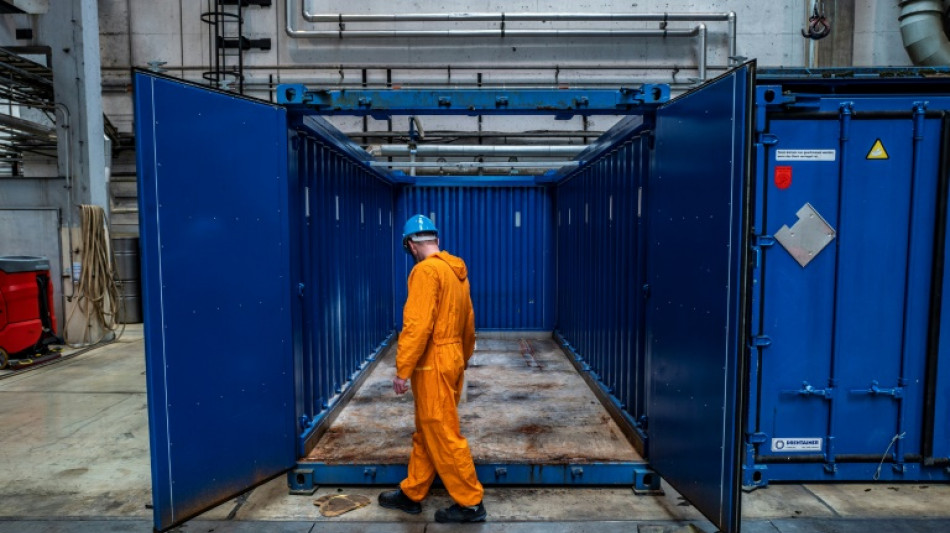
US nuclear industry upbeat on small reactors, despite setback / Photo: © AFP

 Dodgers eye three-peat, Red Sox face Yankees as MLB playoffs begin

 Certification of Boeing 737 MAX delayed by software bug

 Celine Dion wows Paris Fashion Week with surprise gig

 AMD buys firm founded by AI 'godmother' Fei-Fei Li
 Italy rebound in Turkey as France win late in Belgium

 Pope says concerns about AI 'should be taken seriously'

 Hurricanes to hoist title banner as NHL season begins

 Justice Alito steps aside from major US climate case

 Willis happy with England exile after retains Top 14 player award

 Spain housing protests keep heat on government as PM seeks new law

 Wissa spoils Zimbabwe homecoming as DR Congo win AFCON qualifier

 UK police release on bail five men held over airbase incident

 Ex-All Black Plummer 'sure' New Zealand will find Super Rugby solution

 Shein sees 1% revenue growth in first half of 2026

 Netherlands regrets Israel retaliation in settlements row

 Moscow seizes Russian assets of German food retailer Metro

 Bulgarian spirits inflamed by new rakia rules

 Documentary turns camera on architect Peter Zumthor

 UK police say releasing on bail five men held over airbase incident

 Trump admin finalizes reversal of US fuel economy standards

 US says no China arms sale plans after envoy cites Trump offer

 Dozens kidnapped in two weekend attacks in northern Nigeria

 Next stop the world: Pathirage wins Asian Games javelin gold

 Aster Launches Perpetual Grid Trading 2.0 with Up to 140,000 $ASTER Liquidity Mining Campaign

 Seoul says North Korean mines 'highly suspected' as cause of DMZ blast

Despite the recent cancellation of a next-generation US nuclear plant, backers of the carbon-free power source remain hopeful new projects will come on line by the end of the decade.
Late last year, the US energy company NuScale announced it was pulling the plug on a small modular reactor (SMR) project in the western state of Idaho.
The project -- the sole SMR design yet to be approved by the US Nuclear Regulatory Commission -- faced exploding costs that took the estimated price from $5.3 billion up to $9.3 billion.
The "collapse of NuScale's project should spell the end for small modular nuclear reactors," MV Ramana, a professor at the University of British Columbia, predicted.
But according to Mason Lester, an analyst at S&P Global Commodity Insights, there are "a lot of positives that have been coming over the last year" for US nuclear prospects.
He pointed to Darlington in Ontario, Canada, where GE Hitachi aims for its new SMR design, the BWRX-300, to begin producing power in 2029.
"Pending regulatory approval, nuclear construction work will begin in 2025," Ontario Power Generation told AFP.
The Tennessee Valley Authority, a federally-owned US power company covering several southern states, has also invested in the BWRX-300.
"At the end of the day, it was one project," John Kotek of the Nuclear Energy Institute, an industry group, said of NuScale's Idaho venture.
In that case, the initial estimated costs "weren't the problem," said Kotek, a former Department of Energy official.
"The problem was the potential for the upside risk."
He said the takeaway is to improve "risk sharing" across the first new models before the industry can "get to the place where we're building these with some repeatability."
- Proof still needed -
Some of the reason for swelling costs are not particular to nuclear power but the result of higher prices for steel and other commodities, said Marcia Burkey, chief financial officer at TerraPower.
She noted that uranium prices have also risen.
TerraPower plans to begin construction on a nuclear reactor in June in Kemmerer, Wyoming at a retired coal plant.
"I could see people saying, 'There goes nuclear, again' when it's really very different," Burkey said of the cost pressures, which are "common to any area of infrastructure."
"We're hoping innovation can help to solve that," Burkey said.
TerraPower, which is also partnering with GE Hitachi and is supported by an investor group that includes Bill Gates, is focusing on a novel "molten chloride" technology that it says can operate at higher temperatures than conventional reactors, enabling greater efficiency.
Burkey said the US nuclear industry realizes it needs to "standardize" across multiple projects to lower costs.
Another project in development is by Ultra Safe Nuclear Corporation, which has selected Gadsden, Alabama for its Micro-Modular Reactor (MMR) assembly plant, which is supposed to go on line in 2027.
While China and Russia already have operational small reactors, the United States is ahead of Europe in this area of nuclear, said Sylvain Cognet-Dauphin of S&P Global Insights.
"My impression is that Europe is lagging behind the US in the SMRs," said Cognet-Dauphin.
"There are some discussions taking place. And there are some new designs being proposed, but nothing as advanced" as the projects in the United States, he added.
In Washington, the US House of Representatives approved a bill in late February to speed up the licensing of advanced nuclear power. The Senate has also passed similar legislation.
Lester called the move a "great step."
The efforts come amid increased recognition of the need to address rising energy demand, due in part to swelling use by data centers.
In March, Google, Microsoft and steel company Nucor announced a joint venture to boost clean energy, including by using advanced nuclear power.
PacificCorp, an energy utility in the western United States, is also studying adding nuclear capacity through a partnership with TerraPower.
"There is that appetite now and people are really interested in nuclear," said Cognet-Dauphin.
But "you still need to convince the client," he said. "You need to prove your product."
O.Bulka--BTB