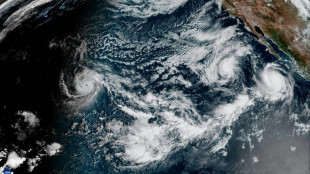
Europe suffered record number of 'extreme heat stress' days in 2023: monitors / Photo: © AFP/File

 8.3 mn refugees at risk due to 'severe' funding cuts: UN

 Stocks drop and oil rises as Hormuz hopes fade

 OpenAI cancels release of newest model due to safety concerns

 AI bosses head to White House as safety pressure builds

 Batista sacked as Costa Rica coach after six months

 Flooding, power cuts and evacuations as Hurricane Polo slams Mexico

 Dodgers eye three-peat, Red Sox face Yankees as MLB playoffs begin

 Certification of Boeing 737 MAX delayed by software bug

 Celine Dion wows Paris Fashion Week with surprise gig

 AMD buys firm founded by AI 'godmother' Fei-Fei Li

 Italy rebound in Turkey as France win late in Belgium

 Pope says concerns about AI 'should be taken seriously'

 Hurricanes to hoist title banner as NHL season begins

 Justice Alito steps aside from major US climate case

 Willis happy with England exile after retains Top 14 player award

 Spain housing protests keep heat on government as PM seeks new law

 Wissa spoils Zimbabwe homecoming as DR Congo win AFCON qualifier

 UK police release on bail five men held over airbase incident

 Ex-All Black Plummer 'sure' New Zealand will find Super Rugby solution

 Shein sees 1% revenue growth in first half of 2026

 Netherlands regrets Israel retaliation in settlements row

 Moscow seizes Russian assets of German food retailer Metro

 Bulgarian spirits inflamed by new rakia rules

 Documentary turns camera on architect Peter Zumthor

 UK police say releasing on bail five men held over airbase incident

Europe endured a record number of "extreme heat stress" days in 2023, two leading climate monitors said Monday, underscoring the threat of increasingly deadly summers across the continent.
In a year of contrasting extremes, Europe witnessed scorching heatwaves but also catastrophic flooding, withering droughts, violent storms and its largest wildfire.
These disasters inflicted billions of dollars in damages and impacted more than two million people, the EU's Copernicus Climate Change Service and the UN's World Meteorological Organization (WMO) said in a new joint report.
The consequences for health were particularly acute, with heat singled out by these agencies as the biggest climate-related threat as global warming drives ever-hotter European summers.
"We're seeing an increasing trend in the number of days with heat stress across Europe and 2023 was no exception, with Europe seeing a record number of days with extreme heat stress," said Rebecca Emerton, a climate scientist at Copernicus.
For this study, Copernicus and WMO used the Universal Thermal Climate Index, which measures the effect of the environment on the human body.
It takes into account not just high temperatures but also humidity, wind speed, sunshine, and heat emitted by the surroundings.
The index has 10 different categories of heat and cold stress, with units of degrees Celsius representing a 'feels-like' temperature.
Extreme heat stress "is equivalent to a feels-like temperature of more than 46 degrees Celsius, at which point it's imperative to take actions to avoid health risks such as heat stroke", said Emerton.
- 'Extended summer' -
Prolonged exposure to heat stress is particularly dangerous for vulnerable people such as the elderly or those with pre-existing health conditions.
The effect of heat is stronger in cities, the report said.
Twenty-three of the 30 worst heatwaves on record in Europe have occurred this century and heat-related deaths have soared around 30 percent in the past 20 years, the report said.
2023 was not the hottest summer in Europe -- in fact, it was the fifth -- but that doesn't mean it wasn't blazing.
Much of Europe sweltered from heatwaves during an "extended summer" between June and September, Emerton said.
September was the warmest on record for Europe as a whole, she added.
On July 23, an unprecedented 13 percent of Europe was experiencing high levels of heat stress, with southern Europe the worst affected.
The data on deaths in Europe from extreme heat in 2023 is not available yet.
But tens of thousands of people are estimated to have died due to heatwaves during equally sweltering European summers in 2003, 2010 and 2022, the report said.
"We see that there is excess mortality when we see such extreme heatwaves like was the case in 2023," said Alvaro Silva, a climatologist from WMO.
"This increase in mortality... is affecting (the) big majority of European regions. This is a big concern."
- Serious consequences -
Scientists agree that greenhouse gas emissions are warming the planet, causing more intense and frequent extreme weather events.
Europe is warming twice as fast as the global average and heatwaves will become longer and more powerful in future, the report said.
This -- coupled with ageing populations and more people moving to cities -- will have "serious consequences for public health", it added.
"Current heatwave interventions will soon be insufficient to deal with the expected heat-related health burden."
2023 was the hottest year globally on record and oceans, which absorb 90 percent of excess heat produced by carbon dioxide emissions, also warmed to new highs.
Average sea surface temperatures in Europe were the warmest on record, the report said, with a severe marine heatwave in part of the Atlantic Ocean described as "beyond extreme".
Glaciers in all parts of Europe saw a loss of ice, while Greece suffered the largest wildfire in the history of the EU.
2023 was also one of Europe's wettest years, with major flooding affecting 1.6 million people, and storms another 550,000.
Emerton said that economic cost of these extreme events was 13.4 billion euros ($14.3 billion) -- about 80 percent attributed to flooding.
H.Seidel--BTB