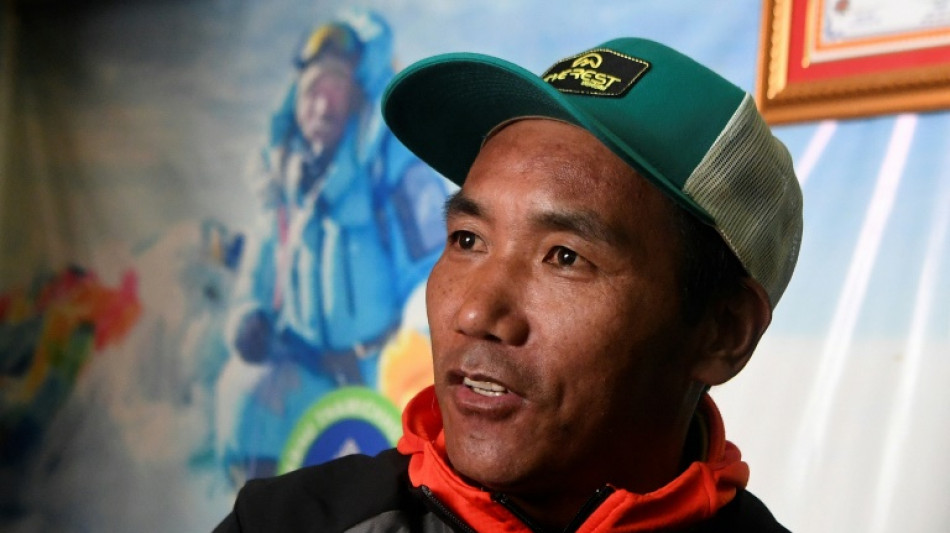
Everest? All in a day's work for record climber Kami Rita Sherpa / Photo: © AFP

 Dodgers eye three-peat, Red Sox face Yankees as MLB playoffs begin

 Certification of Boeing 737 MAX delayed by software bug

 Celine Dion wows Paris Fashion Week with surprise gig

 AMD buys firm founded by AI 'godmother' Fei-Fei Li

 Italy rebound in Turkey as France win late in Belgium

 Pope says concerns about AI 'should be taken seriously'

 Hurricanes to hoist title banner as NHL season begins

 Justice Alito steps aside from major US climate case

 Willis happy with England exile after retains Top 14 player award

 Spain housing protests keep heat on government as PM seeks new law

 Wissa spoils Zimbabwe homecoming as DR Congo win AFCON qualifier

 UK police release on bail five men held over airbase incident

 Ex-All Black Plummer 'sure' New Zealand will find Super Rugby solution

 Shein sees 1% revenue growth in first half of 2026
 Netherlands regrets Israel retaliation in settlements row

 Moscow seizes Russian assets of German food retailer Metro

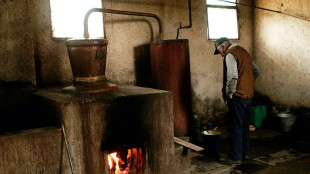 Bulgarian spirits inflamed by new rakia rules

 Documentary turns camera on architect Peter Zumthor

 UK police say releasing on bail five men held over airbase incident

 Trump admin finalizes reversal of US fuel economy standards

 US says no China arms sale plans after envoy cites Trump offer

 Dozens kidnapped in two weekend attacks in northern Nigeria

 Next stop the world: Pathirage wins Asian Games javelin gold

 Aster Launches Perpetual Grid Trading 2.0 with Up to 140,000 $ASTER Liquidity Mining Campaign

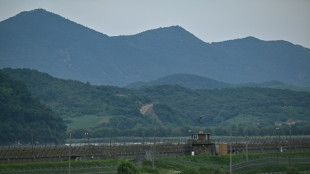 Seoul says North Korean mines 'highly suspected' as cause of DMZ blast

Scaling the world's highest peak is all in a day's work for 54-year-old Nepali mountaineer Kami Rita Sherpa, a man breezily modest about having set foot on the summit of Everest more times than any other person.
On Wednesday morning, Sherpa scaled Everest for the 30th time in three decades of climbing the mountain, extending his own record just 10 days after his last successful ascent.
"I am glad for the record, but records are eventually broken," Sherpa told AFP last week after his 29th successful climb.
"I am happier that my climbs help Nepal be recognised in the world."
Dubbed the "Everest Man", he has held the record since 2018 and his closest rival is now three summits back.
"I did not climb for world records, I was just working," he said in a 2019 interview. "I did not even know you could set records earlier."
A living legend of mountaineering, Sherpa was born in 1970 in Thame, a village in the Himalayas famed as a breeding ground of successful mountaineers.
The community's most famous son, Tenzing Norgay, made the first successful climb of Everest's 8,849-metre (29,029-foot) peak alongside New Zealand's Edmund Hillary in 1953.
Growing up, Sherpa watched his father and then his brother don climbing gear to join expeditions as mountain guides, and was soon following in their footsteps.
A guide for about four decades, he first reached the summit in 1994 while working for a commercial expedition, and has repeated the feat almost every year since.
In 2018, he ascended Everest for the 22nd time, breaking the previous record he shared with two other Sherpa climbers -- both of whom have retired.
The following year, aged 49, he conquered Everest twice in six days.
- 'The risk we take' -
He briefly shared the record last year when another guide, Pasang Dawa Sherpa, equalled his then total of 27 summits.
But he quickly reclaimed it on his own that season with his 28th summit.
Sherpa has reached the top of four other of the highest Himalayan mountains -- K2, Lhotse, Manaslu, and Cho Oyu -- and has a world record 44 summits of peaks higher than 8,000 metres.
As a senior climber, he has on numerous occasions led the team that fixes ropes leading up to Everest's summit, an annual practice before the climbing season begins that makes the ascent safer.
In recent years, he has recounted his own observations of the impact of climate change on the weather patterns on the mountains.
"We now see rock exposed in areas where there used to be snow before. Not just on Everest, other mountains are also losing their snow and ice. It is worrying," he told AFP in 2022.
He has also been a regular advocate of the importance of Nepali mountain guides and the need for more action to recognise their contributions.
Ethnic Sherpas from the valleys around Everest are a crucial component of Nepal's lucrative mountaineering industry, which nets the Himalayan republic millions every year.
With their unique ability to work in a low-oxygen, high-altitude atmosphere, they are the backbone of climbing expeditions, helping clients and hauling equipment up Himalayan peaks.
"It would not be possible for many foreign climbers to summit mountains without our help and the risk we take," Sherpa said in a 2021 interview.
I.Meyer--BTB