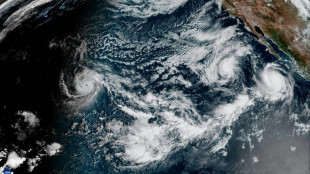
UN forecasts La Nina could help lower temperatures this year / Photo: © AFP

 Dodgers eye three-peat, Red Sox face Yankees as MLB playoffs begin

 Certification of Boeing 737 MAX delayed by software bug

 Celine Dion wows Paris Fashion Week with surprise gig

 AMD buys firm founded by AI 'godmother' Fei-Fei Li

 Italy rebound in Turkey as France win late in Belgium

 Pope says concerns about AI 'should be taken seriously'

 Hurricanes to hoist title banner as NHL season begins

 Justice Alito steps aside from major US climate case

 Willis happy with England exile after retains Top 14 player award

 Spain housing protests keep heat on government as PM seeks new law

 Wissa spoils Zimbabwe homecoming as DR Congo win AFCON qualifier

 UK police release on bail five men held over airbase incident

 Ex-All Black Plummer 'sure' New Zealand will find Super Rugby solution

 Shein sees 1% revenue growth in first half of 2026

 Netherlands regrets Israel retaliation in settlements row

 Moscow seizes Russian assets of German food retailer Metro

 Bulgarian spirits inflamed by new rakia rules

 Documentary turns camera on architect Peter Zumthor

 UK police say releasing on bail five men held over airbase incident

 Trump admin finalizes reversal of US fuel economy standards

 US says no China arms sale plans after envoy cites Trump offer

 Dozens kidnapped in two weekend attacks in northern Nigeria

 Next stop the world: Pathirage wins Asian Games javelin gold

 Aster Launches Perpetual Grid Trading 2.0 with Up to 140,000 $ASTER Liquidity Mining Campaign
 Seoul says North Korean mines 'highly suspected' as cause of DMZ blast

The return of the cooling La Nina weather phenomenon this year should help lower temperatures somewhat after months of global heat records, the United Nations' weather agency said Monday.
The impact is likely to be felt in the next few months because the warming El Nino weather pattern -- which has helped fuel a spike in global temperatures and extreme weather around the world since mid-2023 -- "is showing signs of ending", the UN's World Meteorological Organization said in its latest update.
The WMO warned, however, that global temperatures would continue to rise in the long term due to human-induced climate change, which continues to make extreme weather worse and upend seasonal rainfall and temperature patterns.
La Nina refers to the cooling of the ocean surface temperatures in large swathes of the tropical Pacific Ocean, coupled with winds, rains and changes in atmospheric pressure.
In many locations, especially in the tropics, La Nina produces the opposite climate impacts to El Nino, which heats up the surface of the oceans, leading to drought in some parts of the world and triggering heavy downpours elsewhere.
The WMO said there was a "60 percent" chance of La Nina conditions in the period from July to September and a "70 percent" likelihood during August-November.
The chances of El Nino redeveloping are negligible, it added.
Every month since June 2023, when El Nino returned, has set a new high temperature record, and 2023 was by far the warmest year on record globally.
The WMO said the planet would continue to heat up overall from the use of fossil fuels that produce greenhouse gases.
- Man-made global heating -
"The end of El Nino does not mean a pause in long-term climate change, as our planet will continue to warm due to heat-trapping greenhouse gases," WMO deputy secretary general Ko Barrett stressed.
"Exceptionally high sea surface temperatures will continue to play an important role during next months."
Much of the planet's excess heat from climate change is stored in the oceans.
In the United States, the National Oceanic and Atmospheric Administration has already factored the expected La Nina into its forecasts for this year's Atlantic hurricane season.
The NOAA said it expected four to seven major hurricanes in the Atlantic between June and November.
"The upcoming Atlantic hurricane season is expected to have above-normal activity due to a confluence of factors, including near-record warm ocean temperatures in the Atlantic Ocean, development of La Nina conditions in the Pacific, reduced Atlantic trade winds and less wind shear," the NOAA said on May 23.
The WMO noted that the past nine years had been the warmest on record, even with the cooling influence of a La Nina event that lasted from 2020 to early 2023.
The latest El Nino, which peaked in December, was one of the five strongest on record.
"Our weather will continue to be more extreme because of the extra heat and moisture in our atmosphere," Barrett said.
The WMO has made it a priority to ensure that all regions of the world are covered by early warning systems by 2027, particularly the least well-equipped, such as Africa.
"Seasonal forecasts for El Nino and La Nina, and the anticipated impacts on the climate patterns globally, are an important tool to inform early warnings and early action," Barrett said.
F.Pavlenko--BTB