What looming La Nina means for global temperatures / Photo: © AFP/File

 Dodgers eye three-peat, Red Sox face Yankees as MLB playoffs begin

 Certification of Boeing 737 MAX delayed by software bug

 Celine Dion wows Paris Fashion Week with surprise gig

 AMD buys firm founded by AI 'godmother' Fei-Fei Li

 Italy rebound in Turkey as France win late in Belgium

 Pope says concerns about AI 'should be taken seriously'

 Hurricanes to hoist title banner as NHL season begins

 Justice Alito steps aside from major US climate case

 Willis happy with England exile after retains Top 14 player award

 Spain housing protests keep heat on government as PM seeks new law

 Wissa spoils Zimbabwe homecoming as DR Congo win AFCON qualifier

 UK police release on bail five men held over airbase incident

 Ex-All Black Plummer 'sure' New Zealand will find Super Rugby solution

 Shein sees 1% revenue growth in first half of 2026

 Netherlands regrets Israel retaliation in settlements row

 Moscow seizes Russian assets of German food retailer Metro

 Bulgarian spirits inflamed by new rakia rules

 Documentary turns camera on architect Peter Zumthor

 UK police say releasing on bail five men held over airbase incident

 Trump admin finalizes reversal of US fuel economy standards

 US says no China arms sale plans after envoy cites Trump offer

 Dozens kidnapped in two weekend attacks in northern Nigeria

 Next stop the world: Pathirage wins Asian Games javelin gold

 Aster Launches Perpetual Grid Trading 2.0 with Up to 140,000 $ASTER Liquidity Mining Campaign
 Seoul says North Korean mines 'highly suspected' as cause of DMZ blast

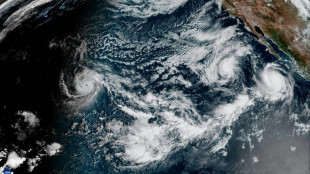
El Nino, the natural weather phenomenon that contributed to 2023 being the hottest year on record, has recently subsided, paving the way for its opposing, cooling La Nina phase to begin.
But in the context of a warming planet due to human-caused climate change, scientists say that cooling effect may be miniscule.
Here is how the cycle called El Nino-Southern Oscillation (ENSO) works to affect global weather:
- El Nino -
El Nino can weaken consistent trade winds that blow east to west across the tropical Pacific, influencing weather by affecting the movement of warm water across this vast ocean.
This weakening warms the usually cooler central and eastern sides of the ocean, altering rainfall over the equatorial Pacific and wind patterns that change temperature and rain around the world.
The extra heat at the surface of the Pacific releases energy into the atmosphere that can temporarily drive up global temperatures, which is why El Nino years are often among the warmest on record.
It occurs every two to seven years, and lasts nine to 12 months.
The latest El Nino, which began in June 2023, peaked among the five strongest such events on record, according to the World Meteorological Organization (WMO).
It typically results in drier conditions across southeast Asia, Australia, southern Africa, and northern South America, and conversely much wetter conditions in the Horn of Africa and the southern United States.
While it is unclear what impact climate change may be having on ENSO, it is affecting how these events play out, said Michelle L'Heureux, lead ENSO forecaster for the US NOAA weather agency.
Climate change is making extreme events more frequent and intense, and when colliding with ENSO can cause its associated drier or wetter conditions to "become more amplified", she added.
The elevated global temperatures ENSO causes also served as a "portal" into the future of climate change, L'Heureux said.
"It gives you... a bit of a preview of what a warmer world looks like because it is giving you a temporary boost. So we're now at a new level we haven't seen before," she said.
- Neutral period -
Although El Nino has been dissipating, the first four months of 2024 have continued to break heat records -- unsurprisingly as the cycle typically drives up temperatures the year after it develops.
ENSO is "not an on-off switch", L'Heureux explained. "It takes a while for the global atmospheric circulation to adjust."
Scientists anticipate that the neutral period between the two cycles will begin between May and July.
Above-normal temperatures are forecast to persist through July across the northern and southern hemispheres, with just equatorial regions anticipated to see near-to-below normal temperatures, according to WMO.
The neutral period is not likely to last long, L'Heureux explained.
Typically, after a strong El Nino as the world just experienced, La Nina soon follows.
- La Nina -
La Nina sees the eastern Pacific Ocean cool for a period of about one to three years, generating the opposite effects to El Nino on global weather.
It leads to wetter conditions in parts of Australia, southeast Asia, India, southeast Africa and northern Brazil, while causing drier conditions in parts of South America.
It can also contribute to more severe Atlantic hurricanes, and NOAA has forecast an "extraordinary" storm season ahead this year.
La Nina tends to bring down global temperatures, although L'Heureux warned against hopes of relief in areas like southeast Asia that have recently be battered by scorching heatwaves.
"The world is warming and ENSO is acting secondary to that," she said.
"Even this year with La Nina potentially developing, we're still expecting basically a top-five global mean temperature record," she said.
NOAA says there is a 69 percent chance of La Nina beginning sometime between July and September.
K.Brown--BTB