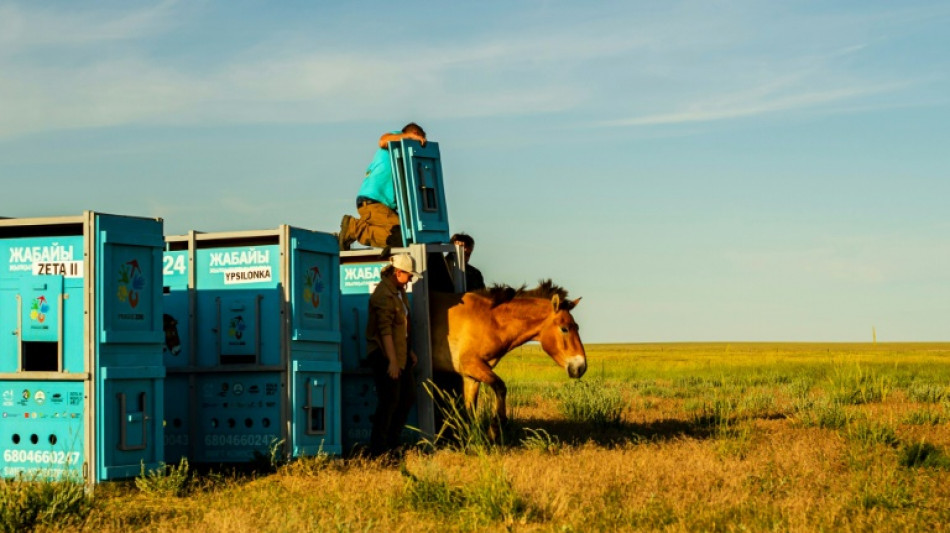
Wild horse species returns to the Kazakh steppes / Photo: © AFP

 Dodgers eye three-peat, Red Sox face Yankees as MLB playoffs begin

 Certification of Boeing 737 MAX delayed by software bug

 Celine Dion wows Paris Fashion Week with surprise gig

 AMD buys firm founded by AI 'godmother' Fei-Fei Li

 Italy rebound in Turkey as France win late in Belgium

 Pope says concerns about AI 'should be taken seriously'

 Hurricanes to hoist title banner as NHL season begins

 Justice Alito steps aside from major US climate case

 Willis happy with England exile after retains Top 14 player award

 Spain housing protests keep heat on government as PM seeks new law

 Wissa spoils Zimbabwe homecoming as DR Congo win AFCON qualifier

 UK police release on bail five men held over airbase incident

 Ex-All Black Plummer 'sure' New Zealand will find Super Rugby solution

 Shein sees 1% revenue growth in first half of 2026

 Netherlands regrets Israel retaliation in settlements row

 Moscow seizes Russian assets of German food retailer Metro

 Bulgarian spirits inflamed by new rakia rules

 Documentary turns camera on architect Peter Zumthor

 UK police say releasing on bail five men held over airbase incident

 Trump admin finalizes reversal of US fuel economy standards

 US says no China arms sale plans after envoy cites Trump offer

 Dozens kidnapped in two weekend attacks in northern Nigeria

 Next stop the world: Pathirage wins Asian Games javelin gold

 Aster Launches Perpetual Grid Trading 2.0 with Up to 140,000 $ASTER Liquidity Mining Campaign

 Seoul says North Korean mines 'highly suspected' as cause of DMZ blast

After a few hesitant steps following a long flight from Prague, three Przewalski horses galloped off for the first time into the Kazakh steppe -- the native habitat of this endangered species.
The horses emerged after being locked in containers for 20 hours and are the first of 40 which are to be released into the wild in this vast Central Asian country over the next five years.
"We have been waiting for this moment for a very long time," Albert Salemgareyev from the Association for the Conservation of Biodiversity in Kazakhstan told AFP.
"A lot of work has been carried out in recent months in order for the Przewalski horses to come to Kazakhstan."
The project run by the Prague and Berlin zoo is aimed at preserving this species of stockily built horse with large heads which share a common ancestry with modern domestic horses but are genetically different.
Przewalski horses are commonly referred to as one of the world's last breeds of wild horse.
"We know that the Przewalski horses are suited to this steppe," said Salemgareyev.
The horses are capable of resisting harsh winters like the ones in Kazakhstan where temperatures can drop below minus 30 degrees Celsius (minus 22 Fahrenheit) and food runs scarce.
The three first specimens -- Zorro, Ypsilonka and Zeta II -- arrived earlier this month. Four more landed in Kazakhstan from Berlin on Thursday morning and were released in the afternoon.
They will initially be under observation in the Golden Steppe nature reserve before being left in the wild.
"This year we will follow their health and see how they acclimatise," Salemgareyev said.
- Perilous journey -
The 5,000 kilometre (3,000-mile) journey -- first by plane to the town of Arqalyk and then by truck along bumpy roads into the heart of the steppe -- was not without risks.
Despite monitoring by experts, one of the horses sat down in his container even before taking off, raising the risk of stopping the blood flow to his legs.
"The journey could have been dangerous so we decided to leave him alone," said Miroslav Bobek, the director of Prague Zoo.
First documented by Russian scientist Nikolai Przhevalsky in 1881, the species was nearly extinct in the 1960s and is still listed as endangered by the International Union for Conservation of Nature.
Prague Zoo, which has bred the horses since 1932 and keeps the world genealogy book for the species tracking all new births, launched a project to reintroduce them to Mongolia in 2011.
It transported 34 horses on Czech army planes there between 2011 and 2019, before the pandemic halted the project co-funded by zoos from across the globe.
There are now 2,000 Przewalski horses around the world, mainly in China and Mongolia but also in France, Russia and even living in the wild in the Chernobyl exclusion zone between Belarus and Ukraine.
Following the April 1986 Chernobyl disaster, 30 specimens were introduced there in 1998. The population has flourished and is now at 210.
In Kazakhstan, the Przewalski horse is not the only endangered species to have received special attention.
The round-snouted Saiga antelope, once on the brink of extinction, has also seen its population grow to about two million thanks to conservation policies by Kazakh authorities and non-governmental organisations.
I.Meyer--BTB