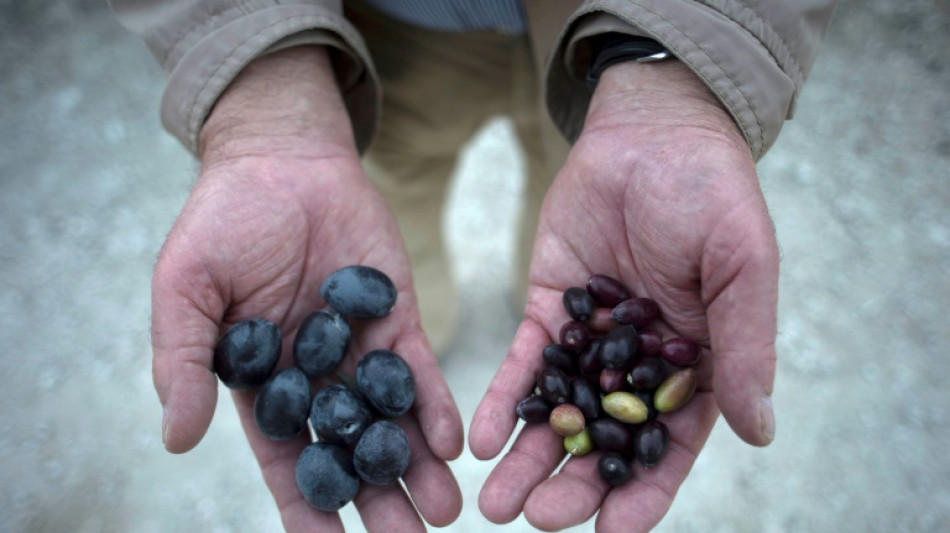
'Stress test': Olive oil producers adapt to climate change / Photo: © AFP/File

 Justice Alito steps aside from major US climate case

 Willis happy with England exile after retains Top 14 player award

 Spain housing protests keep heat on government as PM seeks new law

 Wissa spoils Zimbabwe homecoming as DR Congo win AFCON qualifier

 UK police release on bail five men held over airbase incident

 Ex-All Black Plummer 'sure' New Zealand will find Super Rugby solution

 Shein sees 1% revenue growth in first half of 2026
 Netherlands regrets Israel retaliation in settlements row

 Moscow seizes Russian assets of German food retailer Metro

 Bulgarian spirits inflamed by new rakia rules

 Documentary turns camera on architect Peter Zumthor

 UK police say releasing on bail five men held over airbase incident

 Trump admin finalizes reversal of US fuel economy standards

 US says no China arms sale plans after envoy cites Trump offer

 Dozens kidnapped in two weekend attacks in northern Nigeria

 Next stop the world: Pathirage wins Asian Games javelin gold

 Aster Launches Perpetual Grid Trading 2.0 with Up to 140,000 $ASTER Liquidity Mining Campaign

 Seoul says North Korean mines 'highly suspected' as cause of DMZ blast

 Russia pummels Kyiv in latest deadly daytime attack

 Wartime Ukraine works to keep its railways on track

 Boy among 3 dead in migrant Channel crossing accident: French authorities

 SGFX Creates a Standout Brand Experience at Forex Expo Dubai 2026

 Pope urges Europe to help combat 'deceit and lies' in international ties
 Injured Buttler to miss England ODI series in Pakistan
 Madrid housing protesters vow to maintain pressure on government

Olive oil producers are improving irrigation and seeking new varieties of olives to safeguard production as climate change upends harvests, causing prices of the staple of the Mediterranean diet to soar.
"Climate change is already a reality and we need to adapt to it," according to the executive director of the International Olive Council (IOC) Jaime Lillo.
He spoke at the opening of the three-day olive oil congress in Madrid which brings together 300 participants from around the globe.
The gathering came as the world's top olive oil producers, including Spain, Italy and Greece, have recorded an unprecedented drop in production over the past two years due to extreme drought and repeated heatwaves.
Global production of olive oil fell from 3.42 million tonnes in the 2021-2022 season to 2.57 million tonnes in 2022-2023, IOC figures show.
And according to data supplied by the organisation's 37 member states, it is set to fall again in 2023-2024 to 2.41 million tonnes.
This has caused prices to soar by between 50 percent and 70 percent over the past year, depending on the variety concerned.
Prices in Spain, which supplies around half of the world's olive oil, have tripled since 2021, to the dismay of consumers.
- 'Complex scenarios' -
Olive oil has been an essential part of the Mediterranean diet for thousands of years. Spaniards for instance use it to cook and to season fish, salads, vegetables and other dishes.
"The rise in prices has been a particularly demanding stress test for our sector. We have never experienced anything like this before," said Pedro Barato, the head of the Spanish Olive oil Interprofessional Organisation.
"We have to prepare ourselves for increasingly complex scenarios that will allow us to face up to the climate crisis," he added, likening the "turbulence" faced by olive producers to that experienced by the banking sector during the 2008 financial crisis.
The outlook is not encouraging.
Over 90 percent of the world's olive oil production comes from the Mediterranean basin.
The United Nations Intergovernmental Panel on Climate Change (IPCC) has said this region is warming 20-percent faster than the global average.
This situation could affect world production in the long term.
"We are facing a delicate situation" which implies "changing the way we treat trees and soil", said Georgios Koubouris, a researcher at the Greek Olive Institute.
"The olive tree is one of the plants best adapted to a dry climate. But in an extreme drought, it activates mechanisms to protect itself and no longer produce anything. To grow olives, you need a minimum amount of water," said Lillo.
- 'Find solutions' -
Among the possible solutions raised at the Madrid congress is genetic research.
In recent years hundreds of varieties of olive trees have been tested to identify the species best adapted to higher temperatures.
The goal is to find "varieties that need fewer hours of cold in winter and that are more resistant to stress caused by lack of water at certain key times" of the year, such as spring, said Juan Antonio Polo, head of technology at the IOC.
The sector is also looking to improve water use by storing rainwater, recycling wastewater and employing technology to use less water to irrigate trees.
This means abandoning "surface irrigation" and instead using "drip systems" which bring water "directly to the roots of the trees" to avoid water loss, said Kostas Chartzoulakis of the Greek Olive Institute.
Farmers are abandoning production in certain areas that could become unsuitable for olive trees because they are too dry and moving it to other regions.
There has been a rise in new olive tree plantations, although on a small scale, in regions previously not used to grow the crop, said Lillo, adding that he was "optimistic" about the future.
"With international cooperation, we will gradually find solutions," he said.
T.Bondarenko--BTB


