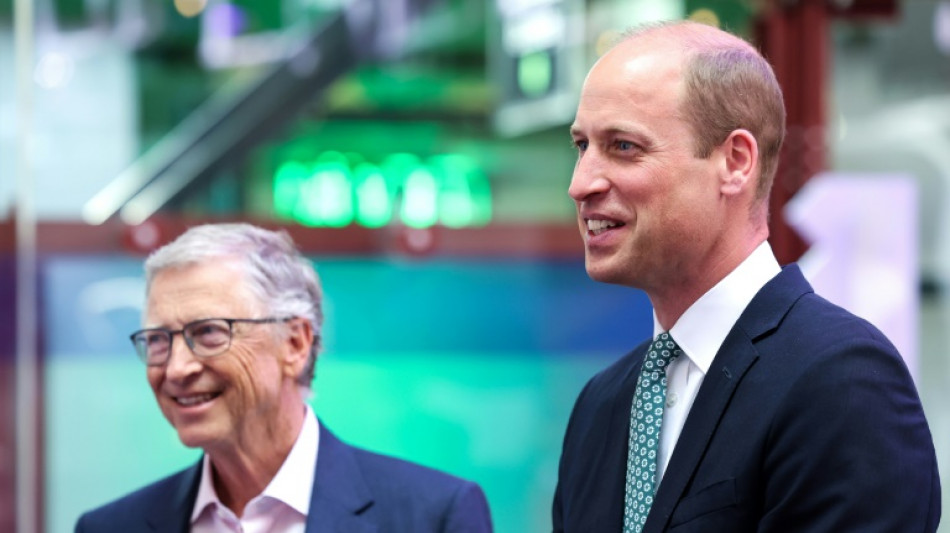
'Not crazy to be optimistic' on climate tech, Gates tells investors / Photo: © POOL/AFP

 Justice Alito steps aside from major US climate case

 Willis happy with England exile after retains Top 14 player award

 Spain housing protests keep heat on government as PM seeks new law

 Wissa spoils Zimbabwe homecoming as DR Congo win AFCON qualifier

 UK police release on bail five men held over airbase incident

 Ex-All Black Plummer 'sure' New Zealand will find Super Rugby solution

 Shein sees 1% revenue growth in first half of 2026

 Netherlands regrets Israel retaliation in settlements row

 Moscow seizes Russian assets of German food retailer Metro

 Bulgarian spirits inflamed by new rakia rules

 Documentary turns camera on architect Peter Zumthor

 UK police say releasing on bail five men held over airbase incident
 Trump admin finalizes reversal of US fuel economy standards

 US says no China arms sale plans after envoy cites Trump offer

 Dozens kidnapped in two weekend attacks in northern Nigeria

 Next stop the world: Pathirage wins Asian Games javelin gold

 Aster Launches Perpetual Grid Trading 2.0 with Up to 140,000 $ASTER Liquidity Mining Campaign

 Seoul says North Korean mines 'highly suspected' as cause of DMZ blast

 Russia pummels Kyiv in latest deadly daytime attack

 Wartime Ukraine works to keep its railways on track

 Boy among 3 dead in migrant Channel crossing accident: French authorities

 SGFX Creates a Standout Brand Experience at Forex Expo Dubai 2026
 Pope urges Europe to help combat 'deceit and lies' in international ties

 Injured Buttler to miss England ODI series in Pakistan
 Madrid housing protesters vow to maintain pressure on government

Microsoft co-founder Bill Gates on Thursday urged investors to get behind cutting-edge climate technologies he says would drive a "green industrial revolution" and a next wave of global prosperity.
Over three days in an upmarket London venue, Gates showcased more than 100 companies making ground on cutting planet-heating emissions from carbon-intensive sectors most responsible for climate change.
Gates is a firm believer in the power of innovation to drive breakthroughs in heavily polluting industries like manufacturing, energy and transport.
He is the single largest investor in a fund he established in 2015 that has ploughed around $2.2 billion into early-stage technologies like low-carbon cement, zero-emissions aviation and sustainable building materials.
But in the quest to deploy these technologies more quickly at scale, Gates is seeking to widen the investor base from venture capitalists to pension and sovereign wealth funds.
Many of the innovations he has bankrolled are still at the lab level and not making a dent on the heat-trapping gases that drive global warming, let alone a return on investment.
Critics say climate technology is a costly distraction when deep reductions in emissions are needed today, as well as money to help the developing world cope with climate change.
Gates acknowledged that innovation alone would not solve the problem, but said there were several reasons to be optimistic.
Some of these companies are already rolling out innovations, he said, while others are showing great progress in short time.
"I think the clock is moving forward because of human ingenuity," he told reporters at the close of his Breakthrough Energy summit at a 19th-century dockyard in London.
"I do think we can provide all services that mankind wants with zero emissions without making the cost of those services higher... I don't think I am crazy to be optimistic."
- 'Green industrial revolution' -
Less than a decade ago, Gates said, there was very little investor interest in climate technologies.
He raised an initial $1 billion with other ultra-wealthy investors including Amazon's Jeff Bezos and Alibaba's Jack Ma, and their first summit in 2022 attracted a few hundred attendees.
But investors beyond deep-pocketed philanthropists are starting to pay attention to climate start-ups long deemed too risky a bet, industry figures show.
At the London event, Gates brought together around 1,500 executives from banks, state-backed investment funds and major businesses.
In one pavilion, potential investors inspected hydrogen-electric aircraft engines designed by ZeroAvia, hunks of low-carbon steel manufactured by Boston Metal, and an enormous magnet used by Commonwealth Fusion Systems to test fusion power.
Source, a company that uses a "hydropanel" to harvest water from vapour in the atmosphere, quenched thirsts on a hot summer's night.
The fast rise in investor interest was obvious and understandable, said Tim Heidel, CEO at Veir, a company backed by Gates that is exploring high-temperature conduction to improve electricity transmission.
"They have an opportunity to build some of the largest companies on the planet," Heidel told AFP at a reception night where attendees drank cocktails with names such as "electricity elixir" and listened to a string quartet.
Gates told investors that "if you're helping to solve climate, the chance of building very large, very profitable companies" would follow.
"I think it's fair to say that what you're seeing... (with) those companies is the foundation for this green industrial revolution," he said in an opening pitch after walking on stage to the sound of "Revolution" by the Beatles.
- 'Life or death' -
The optimism stood in stark contrast to the diplomatic climate meetings hosted by the United Nations.
Crucial negotiations in June toward a new target on climate finance ended in bitter disagreement over how much rich countries should pay poorer ones for their emissions.
Veteran US diplomat John Kerry said it would be the private sector -- not governments -- that would raise the trillions of dollars needed every year to confront the challenge, and new technology would drive that progress.
"It's not your average technology mission. This is life or death, literally," the former American climate envoy said Thursday.
This year is shaping up as the hottest on record, with floods devastating swathes of the globe while many parts of Europe, Asia and Latin America are sweltering under record-breaking heatwaves.
Without urgent emission cuts this decade, the world risks breaching 1.5 degrees Celsius of warming above industrial levels, the benchmark limit of the Paris climate accord.
Julia Reinaud, a senior director at Breakthrough Energy, said it was time to "double down" and get early-stage technologies from prototype to power grid.
"We don't have the 30 years that it took to develop solar to where it is today," she told AFP.
B.Shevchenko--BTB


