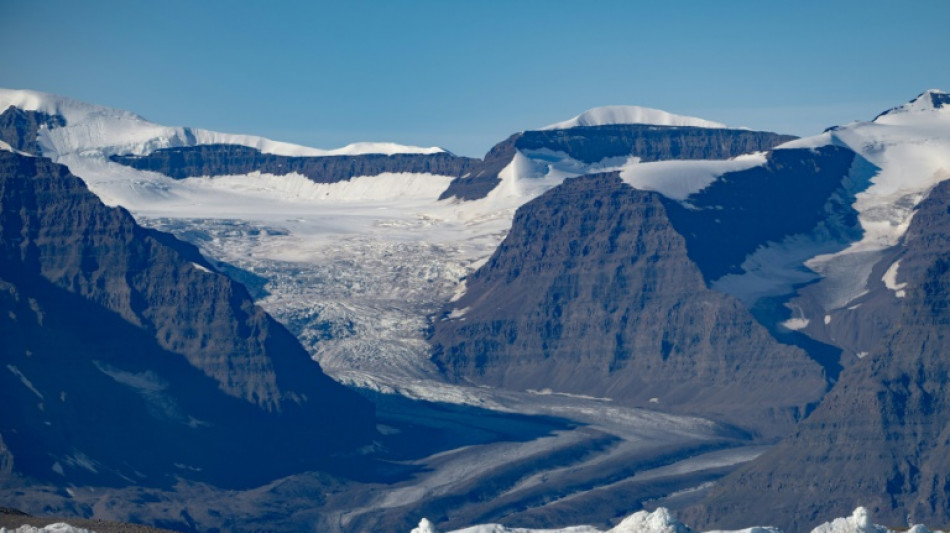
Oh my (long) days: Melting ice caps slow Earth's spin / Photo: © AFP/File

 Rose, Scott among 2027 World Golf Hall of Fame finalists

 Brunson says NBA champion Knicks can't get satisfaction

 France puts out largest wildfire since 1949

 Real Madrid's Perez summoned over Barcelona referee payments comments

 Oil takes off again, Wall Street dips after Trump rejects Iran truce offer

 AlgoQuant Asset Management Selects Liquid Mercury to Enhance Digital Asset Trading Infrastructure

 UK to reopen refugee resettlement scheme to push 'safe' migration

 Pope urges Europe to help combat 'lies and deceit' in world affairs
 Iranian lawyer Nasrin Sotoudeh wins Council of Europe's rights prize

 French far-right's Bardella denies alleged 2013 antisemitic comments

 Oil up, Wall Street dips after Trump rejects Iran truce offer

 Gakpo withdraws from Netherlands squad

 SpaceX puts Starship megarocket in orbit for first time
 Iran denies link to suspected bomb plot at UK airbase used by US

 Ex-boss Mancini says City charges 'not my concern'

 Berlin Marathon winner Assefa finished race with torn Achilles

 Comedian convicted for Erdogan 'insult' but freed pending appeal

 French prosecutors seek two-year sentence for ex-minister Dati in graft case

 Eala makes fast start as weather and transport woes hit Asian Games

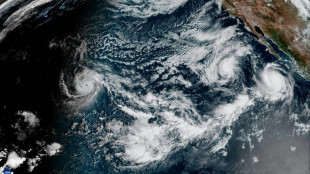 Hurricane Polo approaches Mexico, threatens severe damage

 Energy markets rally after Trump rejects Iran truce offer

 Japanese convenience store enlists Lady Gaga to bolster recruitment

 Seoul summons Ukraine envoy in row over North Korean POWs

 Ireland 'raised awareness worldwide' in Israel game: Hallgrimsson

 Colombian police capture wife, daughter of Ecuador drug lord

It's well known that as far as the climate crisis goes, time is of the essence.
Now a study out Monday shows that the melting of the polar ice caps is causing our planet to spin more slowly, increasing the length of days at an "unprecedented" rate.
The paper, published in Proceedings of the National Academy of Sciences, shows that water flowing from Greenland and Antarctica is resulting in more mass around the equator, co-author Surendra Adhikari of NASA's Jet Propulsion Laboratory told AFP.
"It's like when a figure skater does a pirouette, first holding her arms close to her body and then stretching them out," added co-author Benedikt Soja of ETH Zurich.
"The initially fast rotation becomes slower because the masses move away from the axis of rotation, increasing physical inertia."
Earth is commonly thought of as a sphere, but it's more accurate to call it an "oblate spheroid" that bulges somewhat around the equator, a bit like a satsuma.
What's more, its shape is constantly changing, from the impacts of the daily tides that affect the oceans and crusts, to longer term effects from drift of tectonic plates, and abrupt, violent shifts caused by earthquakes and volcanoes.
The paper relied on observational techniques like Very Long Baseline Interferometry, where scientists can measure the difference in how long it takes for radio signals from space to reach different points on Earth, and use that to infer variations in the planet's orientation and length of day.
It also used the Global Positioning System, which measures Earth's rotation very precisely, to about one-hundredth of a millisecond, and even looked at ancient eclipse records going back millenia.
- Implications for space travel -
If the Earth turns more slowly, then the length of day increases by a few milliseconds from the standard measure of 86,400 seconds.
A currently more significant cause of slowdown is the gravitational pull of the Moon, which pulls on the oceans in a process called "tidal friction" that has caused a gradual deceleration of 2.40 milliseconds per century over millions of years.
But the new study comes to a surprising conclusion that, if humans continue to emit greenhouse gases at a high rate, the effect of a warming climate will be greater than that of the Moon's pull by the end of the 21st century, said Adhikari.
Between the year 1900 and today, climate has caused days to become around 0.8 milliseconds longer -- and under the worst-case scenario of high emissions, climate alone would be responsible for making days 2.2 milliseconds longer by the year 2100, compared to the same baseline.
That might not sound like a great deal, and certainly not something that humans are able to perceive.
But "there are definitely a lot of implications for space and Earth navigation," said Adhikari.
Knowing the exact orientation of Earth at any given moment is crucial when attempting to communicate with a spaceship, such as the Voyager probes that are now well beyond our solar system, where even a slight deviation of a centimeter can end up being kilometers off by the time it reaches its destination.
M.Ouellet--BTB


