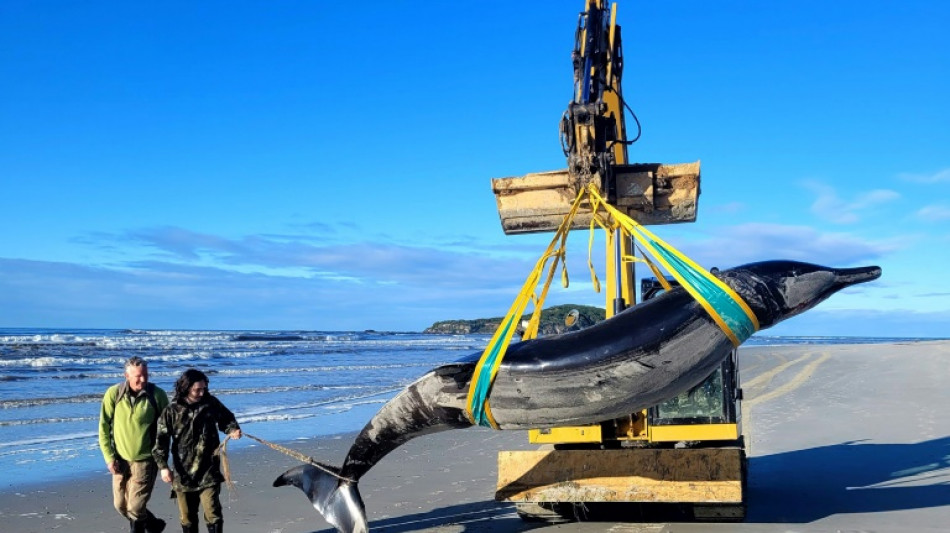
World's rarest whale washes up on New Zealand beach / Photo: © New Zealand Department of Conservation/AFP

 Rose, Scott among 2027 World Golf Hall of Fame finalists

 Brunson says NBA champion Knicks can't get satisfaction

 France puts out largest wildfire since 1949

 Real Madrid's Perez summoned over Barcelona referee payments comments

 Oil takes off again, Wall Street dips after Trump rejects Iran truce offer

 AlgoQuant Asset Management Selects Liquid Mercury to Enhance Digital Asset Trading Infrastructure

 UK to reopen refugee resettlement scheme to push 'safe' migration

 Pope urges Europe to help combat 'lies and deceit' in world affairs

 Iranian lawyer Nasrin Sotoudeh wins Council of Europe's rights prize

 French far-right's Bardella denies alleged 2013 antisemitic comments

 Oil up, Wall Street dips after Trump rejects Iran truce offer

 Gakpo withdraws from Netherlands squad

 SpaceX puts Starship megarocket in orbit for first time
 Iran denies link to suspected bomb plot at UK airbase used by US

 Ex-boss Mancini says City charges 'not my concern'

 Berlin Marathon winner Assefa finished race with torn Achilles

 Comedian convicted for Erdogan 'insult' but freed pending appeal

 French prosecutors seek two-year sentence for ex-minister Dati in graft case

 Eala makes fast start as weather and transport woes hit Asian Games

 Hurricane Polo approaches Mexico, threatens severe damage

 Energy markets rally after Trump rejects Iran truce offer
 Japanese convenience store enlists Lady Gaga to bolster recruitment

 Seoul summons Ukraine envoy in row over North Korean POWs

 Ireland 'raised awareness worldwide' in Israel game: Hallgrimsson

 Colombian police capture wife, daughter of Ecuador drug lord

The body of a spade-toothed whale -- a species so rare it has never been seen alive -- appears to have washed up on a New Zealand beach, scientists say.
The remains of the obscure, five-metre (16.4 foot) long, beaked creature were found near a river mouth in southern Otago province on July 4, government researchers said.
It was identified by marine-mammal experts from New Zealand's Department of Conservation and the national museum, Te Papa, as a male spade-toothed whale.
A DNA investigation has been launched to confirm its classification, the scientists said.
"Spade-toothed whales are one of the most poorly known large mammalian species of modern times," said the conservation department's coastal Otago operations manager, Gabe Davies.
"Since the 1800s, only six samples have ever been documented worldwide, and all but one of these was from New Zealand," Davies said in a statement Monday.
"From a scientific and conservation point of view, this is huge."
The find was fresh enough to offer the first opportunity for a spade-toothed whale to be dissected, the conservation department said.
The species is "so rare next to nothing is known about them", it said.
- 'International importance' -
The body of the whale has been placed in cold storage and genetic samples have been sent to the University of Auckland as curators of the New Zealand Cetacean Tissue Archive.
It may take several weeks or months for the DNA to be processed and a final identification confirmed.
"The rarity of the whale means conversations around what to do next will take more time because it is a conversation of international importance," the conservation department said.
The species was first described in 1874 from just a lower jaw and two teeth collected from the Chatham Islands off the east coast of New Zealand.
That sample, along with skeletal remains of two other specimens found in New Zealand and Chile, enabled scientists to confirm a new species.
Marine scientist Vanessa Pirotta said researchers would study the whale's stomach contents, genetics, and how this sample compared to previous ones.
This could shine light on the whales' behaviour, their population and why they are so rare, Pirotta told AFP, describing the discovery as "like hitting the jackpot".
Because so few specimens have been found and there have been no live sightings, little is known about the spade-toothed whale and it is classified as "data deficient" under New Zealand's Threat Classification System.
The first intact specimen was from a mother and calf stranding in Bay of Plenty in 2010, the New Zealand conservation department said.
A further stranding in 2017 in Gisborne added one more specimen to the collection.
D.Schneider--BTB