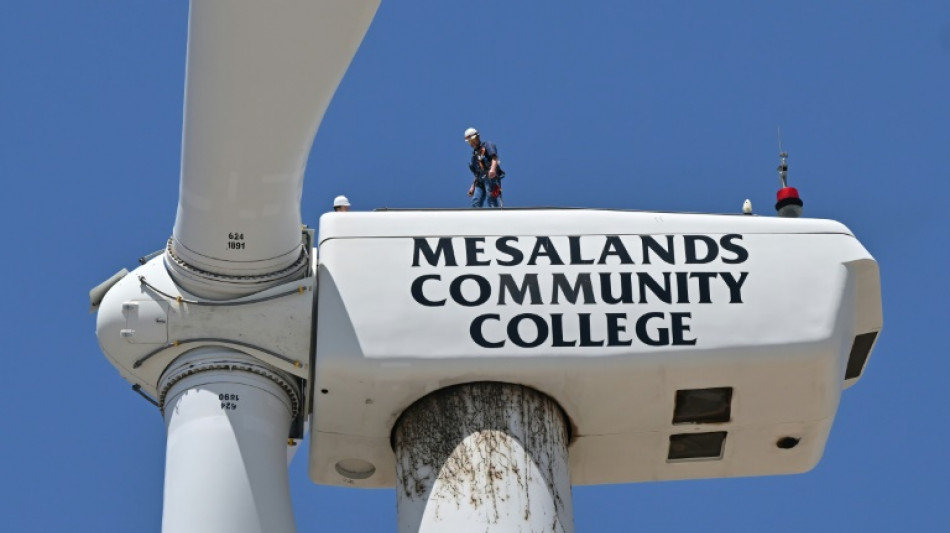
Don't look down: fearless trainees propel wind turbine boom / Photo: © AFP

 Rose, Scott among 2027 World Golf Hall of Fame finalists

 Brunson says NBA champion Knicks can't get satisfaction

 France puts out largest wildfire since 1949

 Real Madrid's Perez summoned over Barcelona referee payments comments

 Oil takes off again, Wall Street dips after Trump rejects Iran truce offer
 AlgoQuant Asset Management Selects Liquid Mercury to Enhance Digital Asset Trading Infrastructure

 UK to reopen refugee resettlement scheme to push 'safe' migration
 Pope urges Europe to help combat 'lies and deceit' in world affairs

 Iranian lawyer Nasrin Sotoudeh wins Council of Europe's rights prize

 French far-right's Bardella denies alleged 2013 antisemitic comments
 Oil up, Wall Street dips after Trump rejects Iran truce offer

 Gakpo withdraws from Netherlands squad

 SpaceX puts Starship megarocket in orbit for first time
 Iran denies link to suspected bomb plot at UK airbase used by US
 Ex-boss Mancini says City charges 'not my concern'
 Berlin Marathon winner Assefa finished race with torn Achilles
 Comedian convicted for Erdogan 'insult' but freed pending appeal
 French prosecutors seek two-year sentence for ex-minister Dati in graft case

 Eala makes fast start as weather and transport woes hit Asian Games
 Hurricane Polo approaches Mexico, threatens severe damage
 Energy markets rally after Trump rejects Iran truce offer
 Japanese convenience store enlists Lady Gaga to bolster recruitment
 Seoul summons Ukraine envoy in row over North Korean POWs

 Ireland 'raised awareness worldwide' in Israel game: Hallgrimsson

 Colombian police capture wife, daughter of Ecuador drug lord
Perched almost 300 feet (90 meters) above the New Mexico plains, strapped to the sheer-edged roof of a wind turbine's generator by a single safety harness, Terrill Stowe is in his element.
"I've never had anyone fall in 14 years. Hopefully today's not the first," jokes the technician instructor to AFP journalists who struggled up the 260-rung ladder beneath him.
The giant, solitary wind turbine towers improbably over the tiny city of Tucumcari, just a half hour drive from the Texas border along the historic Route 66 highway.
Built in 2008 on the campus of Mesalands Community College, the structure is one of the few working turbines in the US where new technicians can train to join the booming wind industry.
The sector's growth has been staggering. Today, the United States has around 75,000 large turbines, pumping out enough electricity to power roughly 40 million American homes.
National wind capacity has more than doubled over the last decade -- an expansion that has left the industry struggling to train enough skilled workers to keep the blades whirring.
"They're putting up more wind farms, and they don't have as many technicians as what they do wind farms," says Stowe.
He trains 10 to 20 students per semester. They first practice on the ground with a replica generator and gearbox, eventually ascending to the turbine's "nacelle," or engine room, high up at the center of its three giant blades.
Stowe warns students it is not a career for the faint of heart.
"I tell them if they're deathly afraid of heights, then they might not want to try this," he says.
In windy conditions, being up on a tower is "like riding on a boat, back and forth... 100 meters in the air," says Stowe.
- 'Conspiracy theories' -
The wind industry's acceleration has been propelled by falling technology costs, improved generating efficiency and government incentives like President Joe Biden's Inflation Reduction Act.
Among recent recruits are Nathaniel Alexander and Kevin Blea, two young men from Tucumcari who trained under Stowe and recently returned to their old college as instructors.
"I'm all for clean energy," said Alexander, 28, who signed up straight after high school.
But his main reasons for joining were a desire to do a "man's man's job" and to receive good wages.
A two-year degree costs $6,000 to $10,000 and opens the path to jobs that can pay $50,000 to $90,000 per year.
In this rural part of eastern New Mexico -- a conservative region in a largely blue state -- many are reluctant to give the Democrats credit for the boom.
The last few years have been "kind of an upward trend," admits Stowe.
But the Republican voter believes "we had more of an upward trend" when Trump was in the White House.
Alexander says recent tax credits "definitely helped" the industry, but he is "not too passionate" about green politics.
He enjoys reading Facebook posts "with conspiracy theories on how much diesel it takes to run" a wind turbine.
"It's not true at all, it's just kind of funny to me," he says.
- Wind, ice, lightning -
Safety conditions have changed dramatically in recent decades.
Before becoming an instructor, Stowe worked in wind fields and recalls having to crawl on a "frozen sheet of ice" atop turbines, through 90 mile per hour winds.
Towers are frequently struck by lightning -- often requiring technicians to climb and fix it.
"Back when I first started climbing, it didn't matter what the weather was like," he says, nostalgically.
Nowadays, "if the weather is any kind of iffy at all, they won't climb."
Even these days, Blea recalls how wind rocked the turbine so hard during his training that a fellow student "threw up in his hard hat."
"It was pretty gross, honestly," the 27-year-old says, laughing.
Those hazards aside, the work is unlike any office job, he says.
"Being the first one up that tower, and seeing the views in the morning is just awesome," adds Alexander.
"It's a good way to wake up."
G.Schulte--BTB


