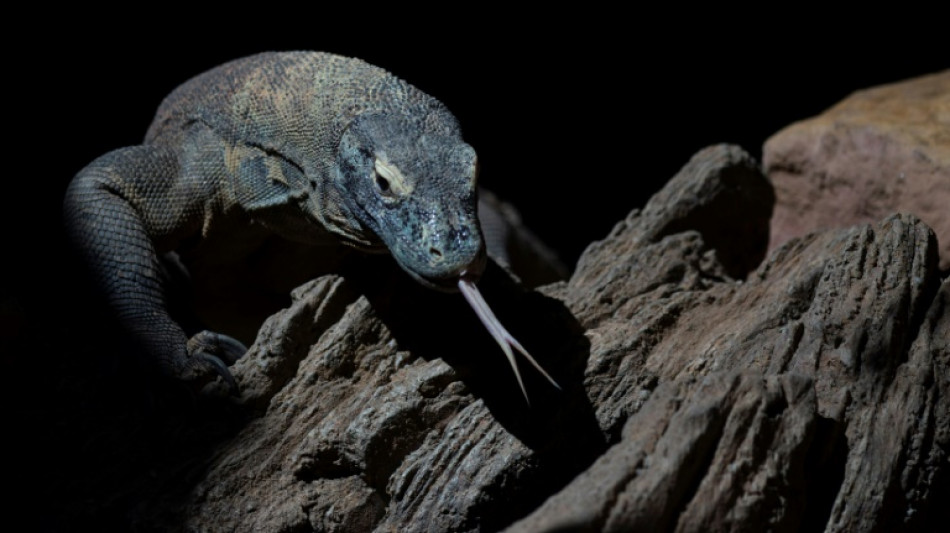
Komodo dragons have teeth coated in iron to kill prey: study / Photo: © AFP/File

 Trump admin finalizes reversal of US fuel economy standards

 US says no China arms sale plans after envoy cites Trump offer

 Dozens kidnapped in two weekend attacks in northern Nigeria

 Next stop the world: Pathirage wins Asian Games javelin gold

 Aster Launches Perpetual Grid Trading 2.0 with Up to 140,000 $ASTER Liquidity Mining Campaign

 Seoul says North Korean mines 'highly suspected' as cause of DMZ blast

 Russia pummels Kyiv in latest deadly daytime attack

 Wartime Ukraine works to keep its railways on track

 Boy among 3 dead in migrant Channel crossing accident: French authorities

 SGFX Creates a Standout Brand Experience at Forex Expo Dubai 2026

 Pope urges Europe to help combat 'deceit and lies' in international ties

 Injured Buttler to miss England ODI series in Pakistan

 Madrid housing protesters vow to maintain pressure on government

 In kayaks or waist-deep in floodwater, shoppers return to Bangkok markets

 UK police probes Iran link to air base bomb scare: media

 Eala blasts into Asian Games quarters in just 55 minutes

 Taiwan gender-row boxer Lin Yu-ting guarantees Asian Games medal

 Comedian on trial for allegedly insulting Erdogan in standup show

 More Asian Games transport woes as bus takes Pakistan to wrong venue

 Death toll in South Africa bar shooting rises to 18

 Aide to Venezuelan opposition leader returns from exile

 Messi and Alcaraz love it, now padel takes step closer to Olympics

 Tolls mount in Thailand, Myanmar floods

 Why India's opposition wants top poll official out

 PU Prime Strengthens UAE Momentum with Strong Showing at Forex Expo Dubai 2026

The fearsome Komodo dragon, native to Indonesia and the world's largest living lizard, has a coat of iron on its razor-like teeth to help it kill its prey, scientists found in a study published Wednesday.
A study led by researchers from King's College London, who carried out their work with advanced chemical and structural imaging, revealed protective iron coats in orange pigment found in the tips and serrations of Komodo dragon teeth.
"This feature has never been reported before in a carnivorous reptile," said the study published in the journal Nature Ecology & Evolution.
The researchers found iron-rich coatings most prominently on Komodo dragon teeth, although similar coverings were also found on the teeth of other living reptiles, including monitor lizards, crocodiles and alligators.
The study said concentrated iron played "a crucial role in supporting serrated teeth" in the huge lizards, who use them to kill their prey.
They prey on a range of animals from rodents to water buffalo and kill using a one-two punch of sharp teeth and a venomous bite.
The researchers believe the iron coatings may have existed in carnivorous dinosaurs but were lost over time because they could not find evidence of them on the fossilised teeth of reptiles and dinosaurs closely related to Komodo dragons.
Komodo dragons are found only in the national park of the same name and neighbouring Flores island. Only 3,458 adult and baby Komodo dragons are left in the wild, according to the International Union for the Conservation of Nature.
Thousands of tourists descend annually on the cluster of islands in the eastern part of Indonesia, the only place in the world where Komodo dragons can be seen in their natural habitat.
The reptiles, which can grow to three metres (10 feet) in length and weigh up to 90 kilograms (200 pounds), are threatened by human activity and climate change destroying their habitat.
J.Fankhauser--BTB


