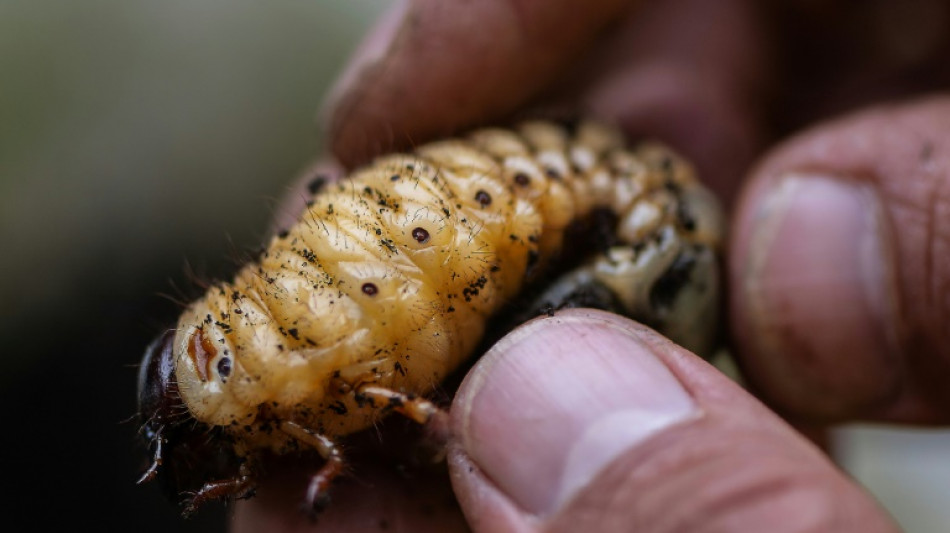
In Colombia, hungry beetle larvae combat trash buildup / Photo: © AFP

 Trump admin finalizes reversal of US fuel economy standards
 US says no China arms sale plans after envoy cites Trump offer

 Dozens kidnapped in two weekend attacks in northern Nigeria

 Next stop the world: Pathirage wins Asian Games javelin gold

 Aster Launches Perpetual Grid Trading 2.0 with Up to 140,000 $ASTER Liquidity Mining Campaign

 Seoul says North Korean mines 'highly suspected' as cause of DMZ blast

 Russia pummels Kyiv in latest deadly daytime attack

 Wartime Ukraine works to keep its railways on track

 Boy among 3 dead in migrant Channel crossing accident: French authorities

 SGFX Creates a Standout Brand Experience at Forex Expo Dubai 2026

 Pope urges Europe to help combat 'deceit and lies' in international ties

 Injured Buttler to miss England ODI series in Pakistan
 Madrid housing protesters vow to maintain pressure on government

 In kayaks or waist-deep in floodwater, shoppers return to Bangkok markets

 UK police probes Iran link to air base bomb scare: media

 Eala blasts into Asian Games quarters in just 55 minutes

 Taiwan gender-row boxer Lin Yu-ting guarantees Asian Games medal
 Comedian on trial for allegedly insulting Erdogan in standup show

 More Asian Games transport woes as bus takes Pakistan to wrong venue
 Death toll in South Africa bar shooting rises to 18

 Aide to Venezuelan opposition leader returns from exile

 Messi and Alcaraz love it, now padel takes step closer to Olympics

 Tolls mount in Thailand, Myanmar floods

 Why India's opposition wants top poll official out

 PU Prime Strengthens UAE Momentum with Strong Showing at Forex Expo Dubai 2026

In the far-flung Colombian highlands, beetles are the secret weapon in an innovative project to combat the ever-growing problem of trash buildup.
Here, larvae of the enormous rhinoceros beetle eat through piles of organic garbage that would otherwise end up in polluting landfills.
But that's not all. The larvae poop is gathered and sold as fertilizer, and when the beetles reach adulthood, they are sold as pets to clients as far afield as Japan.
"The beetles have the answer" to rubbish disposal, said environmental and health engineer German Viasus, who runs the project in Colombia's central Boyaca region.
The concept is simple, cheap and, Viasus believes, an example that would be easy to replicate elsewhere in the world.
Each week, his facility in the city of Tunja receives about 15 tons of waste generated by some 40,000 inhabitants of neighboring municipalities.
It is piled up as food for the voracious larvae, which can grow to the length of a human hand.
Other larvae are held in tanks where they consume leachate -- a fluid produced by organic waste decomposition that can be damaging to ecosystems.
- 'Cutting edge' -
Official Colombian estimates are that the South American country produces some 32,000 tons of garbage every day -- more than 2,600 school buses -- about half of it organic.
Worldwide, some 11.2 billion tons of trash are generated each year, according to the UN.
With the landfill in Tunja fast approaching its end date, Viasus's larvae offer an alternative solution to a major headache.
The engineer stumbled on the idea by chance when in 2000, after a similar project using earthworms had failed, he found scarab beetle larvae feasting on the contents of a garbage bag.
The ones he has today are all descendents of those first foundlings.
The larvae live for about four months before starting their metamorphosis and acquiring their characteristic hard shells. The beetles have a lifespan ranging from a few months to about three years.
At this point, Viasus sells them to clients in countries including Germany, Canada, France, the United States and Japan -- where they are a popular pet.
Some find homes in Colombia, where many see them as good luck charms.
To avoid the fees associated with payments in yen, euros and dollars, Viasus teamed up with crypto wiz Carmelo Campos to develop a digital currency called Kmushicoin after the Japanese name for a horned beetle.
Today in Tunja, but also cities such as Bogota and Medellin, a handful of businesses accept the currency as payment.
"The world is so polluted, we are suffocating with this junk," electronics vendor Jefferson Bastidas told AFP in Tunja, saying he joined the initiative to aid the environment and place his business at the "cutting edge of technology."
C.Meier--BTB


