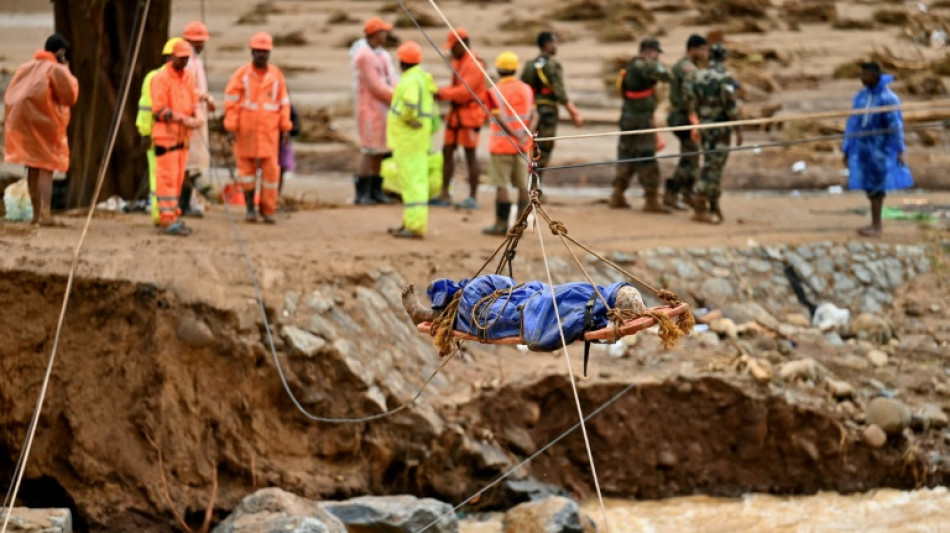
Climate change fuelled deadly India landslides, say scientists / Photo: © AFP

 Trump admin finalizes reversal of US fuel economy standards

 US says no China arms sale plans after envoy cites Trump offer

 Dozens kidnapped in two weekend attacks in northern Nigeria

 Next stop the world: Pathirage wins Asian Games javelin gold

 Aster Launches Perpetual Grid Trading 2.0 with Up to 140,000 $ASTER Liquidity Mining Campaign

 Seoul says North Korean mines 'highly suspected' as cause of DMZ blast

 Russia pummels Kyiv in latest deadly daytime attack

 Wartime Ukraine works to keep its railways on track

 Boy among 3 dead in migrant Channel crossing accident: French authorities

 SGFX Creates a Standout Brand Experience at Forex Expo Dubai 2026

 Pope urges Europe to help combat 'deceit and lies' in international ties

 Injured Buttler to miss England ODI series in Pakistan
 Madrid housing protesters vow to maintain pressure on government

 In kayaks or waist-deep in floodwater, shoppers return to Bangkok markets

 UK police probes Iran link to air base bomb scare: media

 Eala blasts into Asian Games quarters in just 55 minutes

 Taiwan gender-row boxer Lin Yu-ting guarantees Asian Games medal

 Comedian on trial for allegedly insulting Erdogan in standup show

 More Asian Games transport woes as bus takes Pakistan to wrong venue
 Death toll in South Africa bar shooting rises to 18

 Aide to Venezuelan opposition leader returns from exile

 Messi and Alcaraz love it, now padel takes step closer to Olympics

 Tolls mount in Thailand, Myanmar floods
 Why India's opposition wants top poll official out

 PU Prime Strengthens UAE Momentum with Strong Showing at Forex Expo Dubai 2026

Climate change played a key factor in torrential rains in India that triggered catastrophic landslides killing at least 200 people last month, a group of scientists said Wednesday.
Monsoon rains battered the southern coastal state of Kerala and triggered landslides on July 30, burying homes and residents in Wayanad district under tonnes of rock and soil.
World Weather Attribution, a network of scientists who have pioneered peer-reviewed methods for assessing the possible role of climate change in specific extreme events, said the link between the intense rainfall and a warming planet was clear.
"The landslides... were triggered by a burst of rainfall that was made about 10 percent heavier by human-caused climate change," the WWA analysis by 24 scientists said, noting more than 140mm (5.5 inches) of rain fell in a single day.
"Before climate change, similar downpours in Kerala were incredibly rare," it said.
The scientists say higher temperatures due to fossil fuel emissions mean the atmosphere can hold more moisture, resulting in heavier rainfall.
It also said there had been a staggering 62 percent decrease in forest cover in the Wayanad region since 1950, "reducing slope stability" and increasing the landslide risk.
"The Wayanad landslides is another catastrophic example of climate change playing out in real time," said study member Mariam Zachariah, from Imperial College London.
Monsoon rains from June to September offer respite from the summer heat and are crucial for agriculture and replenishing water supplies, but they also bring regular destruction.
WWA said the rain that caused the landslides was the third heaviest one-day event on record in the area -- beaten only by storms in 2019 and in 1924 -- and warned worse will come without rapid change.
"One-day bursts of monsoon rainfall will continue to become even heavier, risking even deadlier landslides, until the world replaces fossil fuels with renewable sources of energy", researchers said.
India is the world's third-biggest emitter of greenhouse gases but has committed to achieve a net zero emissions economy by 2070 -- two decades after most of the industrialised West.
For now, it is overwhelmingly reliant on coal for power generation.
"These direct threats to people in India will continue to escalate as the climate warms and humans continue to regulate natural systems," said WWA scientist Arpita Mondal, from the Indian Institute of Technology.
P.Anderson--BTB


