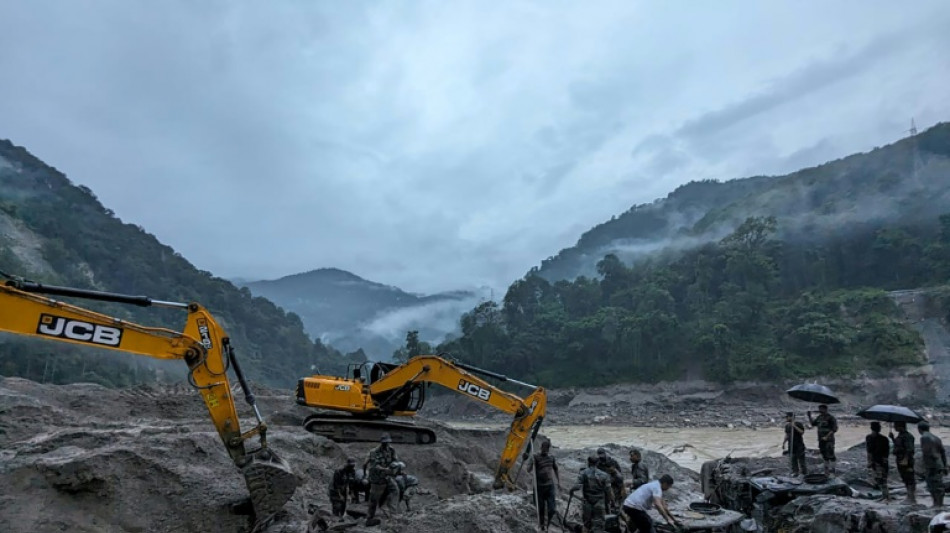
India launches flood warning systems at Himalayan glacial lakes / Photo: © India's Ministry of Defence/AFP/File

 SpaceX puts Starship megarocket in orbit for first time
 Iran denies link to suspected bomb plot at UK airbase used by US
 Ex-boss Mancini says City charges 'not my concern'

 Berlin Marathon winner Assefa finished race with torn Achilles

 Comedian convicted for Erdogan 'insult' but freed pending appeal

 French prosecutors seek two-year sentence for ex-minister Dati in graft case

 Eala makes fast start as weather and transport woes hit Asian Games

 Hurricane Polo approaches Mexico, threatens severe damage

 Energy markets rally after Trump rejects Iran truce offer
 Japanese convenience store enlists Lady Gaga to bolster recruitment

 Seoul summons Ukraine envoy in row over North Korean POWs

 Ireland 'raised awareness worldwide' in Israel game: Hallgrimsson

 Colombian police capture wife, daughter of Ecuador drug lord

 More Asian Games woes as bus takes Pakistan team to wrong venue

 Radio frequencies vital to Earth observation must be protected: UN
 Comedian on trial for insulting Erdogan in standup show

 Women's Fashion Week kicks off in Paris

 Pope arrives in French border city to speak on united Europe
 The wildfires choking Indonesia, sparking regional haze

 PU Prime Deepens Argentina Presence Through FX Expo Buenos Aires 2026

 Nothing to seal here: NZ police help stranded pup home
 White House releases list of products US, China could tax less

 'Pseudo-journalism': Partisan 'news' sites target US midterms

 'Currently impossible': North Korea defections in freefall

 Erasmus sizes up 'improved' Wallabies ahead of 2027 World Cup

India is setting up high-tech warning systems at nearly 200 Himalayan glacial lakes at risk of bursting their banks, a deadly threat exacerbated by climate change, disaster officials said Tuesday.
India's Himalayas contain at least 7,500 glacial lakes, many of which pose risks of dangerous flash floods.
Teams from India's National Disaster Management Authority (NDMA) are targeting 190 high-altitude lakes deemed to be the most dangerous in a mission slated to take three years.
"We have already made significant strides in mitigating risks", Safi Ahsan Rizvi, a senior NDMA official directing the mission, told AFP.
A glacial lake outburst flood (GLOF) is the sudden release of water that has collected in former glacier beds.
These lakes are formed by the retreat of glaciers, a naturally occurring phenomenon turbocharged by the warmer temperatures of human-caused climate change.
One expedition is currently working to install early warning systems around six high-risk lakes in the northeastern state of Sikkim, where at least 77 people died in such a flood in October 2023.
"We have done 20 lakes so far, and will complete 40 this summer," Rizvi said.
The project will also include "lowering lake levels" of accumulated water and ice slush in lakes.
Teams include experts from the army and multiple government agencies, including the Indian Space Research Organisation, geologists, hydrologists, computing engineers and weather specialists.
India's air force is also expected to join the mission later, flying heavy equipment into remote sites.
- 'Catastrophic impacts' -
The mission will cover the Himalayan regions in India, from Kashmir and Ladakh in the north to Arunachal Pradesh in the northeast, many in areas bordering China.
Climate change is driving the disappearance of glaciers, with half the Earth's 215,000 glaciers projected to melt by the end of the century, even if warming can be capped at 1.5 degrees Celsius above pre-industrial levels.
The volume of glacial lakes has jumped by 50 percent in 30 years, according to a 2020 study based on satellite data.
A study, published in Nature Communications, found that 15 million people live within 50 kilometres (31 miles) of a glacial lake and within one kilometre of potential flooding from a breach.
The risk was greatest in the "High Mountains Asia" region across 12 countries, including India, Pakistan, China and Nepal.
That is partly because more people live closer to glacial lakes in the region than in other parts of the world, making warning times even shorter.
Last month a glacial lake outburst in neighbouring Nepal's Everest region sent a devastating flood of frigid water through the village of Thame, sweeping away buildings.
However, residents were forewarned and there were no casualties.
The International Centre for Integrated Mountain Development (ICIMOD) said it was a clear example of the "catastrophic impacts" increasing global temperatures were having on people who had done the least to contribute to the greenhouse gases driving it.
L.Dubois--BTB


