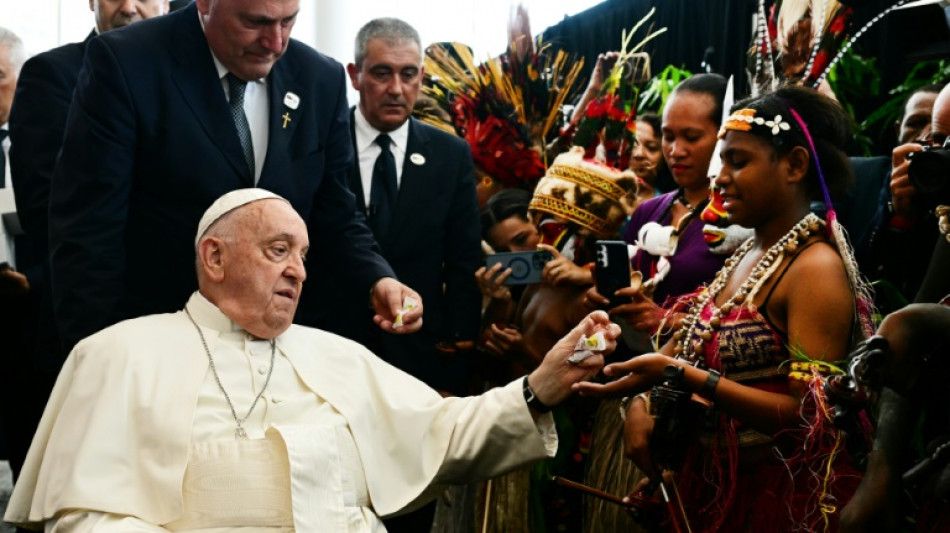
Pope tells Papua New Guinea leaders natural resources must benefit all / Photo: © AFP

 SpaceX puts Starship megarocket in orbit for first time
 Iran denies link to suspected bomb plot at UK airbase used by US
 Ex-boss Mancini says City charges 'not my concern'
 Berlin Marathon winner Assefa finished race with torn Achilles
 Comedian convicted for Erdogan 'insult' but freed pending appeal

 French prosecutors seek two-year sentence for ex-minister Dati in graft case
 Eala makes fast start as weather and transport woes hit Asian Games

 Hurricane Polo approaches Mexico, threatens severe damage
 Energy markets rally after Trump rejects Iran truce offer
 Japanese convenience store enlists Lady Gaga to bolster recruitment
 Seoul summons Ukraine envoy in row over North Korean POWs

 Ireland 'raised awareness worldwide' in Israel game: Hallgrimsson

 Colombian police capture wife, daughter of Ecuador drug lord
 More Asian Games woes as bus takes Pakistan team to wrong venue
 Radio frequencies vital to Earth observation must be protected: UN
 Comedian on trial for insulting Erdogan in standup show

 Women's Fashion Week kicks off in Paris

 Pope arrives in French border city to speak on united Europe
 The wildfires choking Indonesia, sparking regional haze
 PU Prime Deepens Argentina Presence Through FX Expo Buenos Aires 2026

 Nothing to seal here: NZ police help stranded pup home
 White House releases list of products US, China could tax less
 'Pseudo-journalism': Partisan 'news' sites target US midterms

 'Currently impossible': North Korea defections in freefall
 Erasmus sizes up 'improved' Wallabies ahead of 2027 World Cup
Pope Francis told Papua New Guinea's leaders Saturday that vast natural resources must benefit the "entire community", a politically charged call in a nation where many believe riches are being squandered or stolen.
Papua New Guinea has vast reserves of gold, copper, nickel, natural gas and timber that have drawn a string of multinational companies to invest.
But about one in four people live below the poverty line, and scarcely more than 10 percent of homes have electricity.
"These goods are destined by God for the entire community," the pontiff told a gathering of politicians, diplomats and business leaders on the first full day of a visit to the South Pacific nation.
The 87-year-old pope is on a marathon 12-day visit to the Asia-Pacific, stressing his determination to promote interfaith dialogue and visit nations seen as being on the periphery of world affairs.
His comments will heap pressure on Papua New Guinea's government and could embolden the country's millions of Catholics to demand economic reform.
The pope said that even if "outside experts and large international companies must be involved in the harnessing of these resources" they should not be the only ones to benefit.
"It is only right that the needs of local people are given due consideration when distributing the proceeds and employing workers, to improve their living conditions," he said.
It is a message that is sure to resonate with Catholics across swathes of Africa, Latin America and the rest of the world.
- 'Poverty hardly changed' -
For decades Papua New Guinea's Highlands have been dotted with vast Canadian, Australian and Chinese-run mines.
A $19 billion project led by ExxonMobil has produced tens of millions of tonnes of liquified natural gas since operations began in 2014.
Another multibillion-dollar gas project is being developed by TotalEnergies.
But economists have found little evidence that this is happening in Papua New Guinea.
A recent World Bank study showed that between 2009 and 2018, the country's gross domestic product per person grew by more than a third on the back of the resource boom.
But over the same period, the percentage of people living on less than $2 a day was virtually the same.
"Poverty hardly changed over that time," the report's authors said.
"Poor access to essential services also changed very little from their initial low base".
- 'Spiral of violence' -
Pope Francis also made an impassioned plea for Papua New Guinea leaders to help "stop the spiral" of tribal violence that has killed untold numbers of people and displaced tens of thousands more.
"It is my particular hope that tribal violence will come to an end," he said.
"It causes many victims, prevents people from living in peace and hinders development."
There are few reliable estimates about the number of people who have died during decades of tribal unrest between dozens of clans.
But UN agencies estimate that about 100,000 people have been displaced by the violence, which has intensified in recent years.
An influx of mercenaries and automatic weapons has made clashes much more deadly. Where bows, spears and clubs were once the weapons of choice, now tribesmen have a veritable armoury of SLR, AK-47, and M16 rifles.
The murders are often extremely violent, with victims hacked by machetes, burned, mutilated or tortured.
Civilians, including pregnant women and children, have been targeted in the past in a cycle of retaliatory violence.
Mercenaries roam the countryside offering to help tribes settle scores with their rivals in exchange for cash.
Papua New Guinea's stretched government has tried suppression, mediation, gun amnesties and a range of other strategies to control the violence, with little success.
But experts say the violence has little to do with ancient customs, and is more about the modern problems of a surging population, a breakdown in traditional rules of war, joblessness and the rising cost of living.
And there is growing concern that violence is spreading to other parts of the country.
In July, at least 27 people -- among them 11 children -- were massacred in Angoram District, not far from the northern coast.
L.Dubois--BTB


