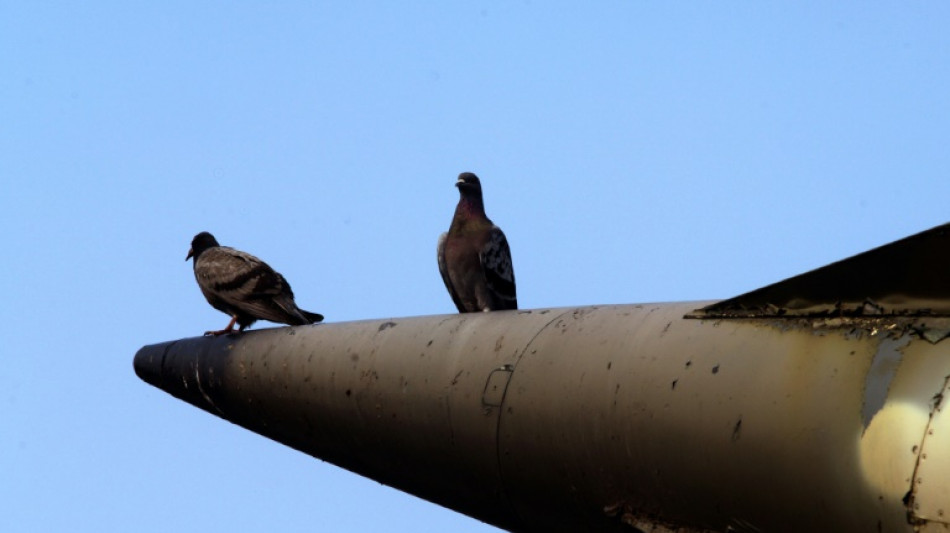
Backside breathing and pigeon bombers studies win Ig Nobel prizes / Photo: © AFP/File

 Pope urges Europe to help combat 'deceit and lies' in international ties

 Injured Buttler to miss England ODI series in Pakistan

 Madrid housing protesters vow to maintain pressure on government

 In kayaks or waist-deep in floodwater, shoppers return to Bangkok markets

 UK police probes Iran link to air base bomb scare: media

 Eala blasts into Asian Games quarters in just 55 minutes

 Taiwan gender-row boxer Lin Yu-ting guarantees Asian Games medal

 Comedian on trial for allegedly insulting Erdogan in standup show

 More Asian Games transport woes as bus takes Pakistan to wrong venue

 Death toll in South Africa bar shooting rises to 18

 Aide to Venezuelan opposition leader returns from exile
 Messi and Alcaraz love it, now padel takes step closer to Olympics

 Tolls mount in Thailand, Myanmar floods

 Why India's opposition wants top poll official out

 PU Prime Strengthens UAE Momentum with Strong Showing at Forex Expo Dubai 2026

 Eight dead in Thailand floods since mid-September

 Oil prices spike after Trump rejects Iran truce offer

 Taylor Swift sets new record at MTV VMAs

 Seoul seeks apology after Ukraine reveals transfer of North Korean POWs

 Messi on target again but Miami downed by Columbus

 In Washington's political cauldron, a fight over foie gras

 Flavio Bolsonaro: political heir in his father's shadow

 Ravens grab last-second win in Rio as Commanders stop Seahawks

 Scheffler makes sportsmanship stand over tee screamer

 Anthropic CEO Amodei to dine with Trump at White House

Mammals that can breathe through their backsides, homing pigeons that can guide missiles and sober worms that outpace drunk ones: these are some of the strange scientific discoveries that won this year's Ig Nobels, the quirky alternative to the Nobel prizes.
The annual awards "for achievements that first make people laugh, then make them think", were handed out at a rowdy ceremony at MIT in the United States on Thursday evening.
Here are the 10 winners of the 34th edition, held a month before the real Nobel prizes.
- Bad breath -
The physiology prize went to Japanese and US researchers for discovering that many mammals can breathe through their anuses.
They were inspired by loach fishes, which are capable of "intestinal air breathing", according to their 2021 study.
This can also be done by mice, pigs and rats, the researchers found, suggesting that guts could be repurposed as an "accessory breathing organ".
They even suggested this could be a way to deliver oxygen to patients when there is a ventilator shortage, such as during the Covid pandemic.
- Homing pigeon missiles -
The peace Ig Nobel went to the late US psychologist B.F. Skinner, for putting trained pigeons in the nose of missiles to guide them during World War II.
Project Pigeon was called off in 1944 despite a seemingly successful test on a target in New Jersey.
"Call it a crackpot idea if you will; it is one in which I have never lost faith," Skinner wrote in 1960.
- Plastic plant envy -
The botany prize was awarded for research which found that some real plants imitate the shapes of nearby plastic plants.
Prize-winner Felipe Yamashita of Germany's Bonn University said their hypothesis is that the Boquila plant they studied "has some sort of eye that can see".
"How they do that, we have no idea," he said to laughter at the ceremony.
"I need a job," he added.
- Flip off -
The probability prize was awarded to researchers who tossed 350,757 coins.
Inspired by a magician, the researchers found that the side facing upwards before being flipped won around 50.8 percent of the time.
Over 81 work days' worth of flipping, the team had to employ massage guns to soothe sore shoulders.
"It's fun to do some stupid stuff from time to time," lead researcher Frantisek Bartos told AFP about the effort last year.
- The true key to longevity -
The demography prize was awarded for detective work which discovered that many of the people famous for living the longest happened to live in places with "lousy birth-and-death recordkeeping," the Ig Nobel website said.
Australian researcher Saul Justin Newman read out a poem at the ceremony which concluded that the real way to longevity is to "move where birth certificates are rare, teach your kids pension fraud and start lying".
- Drunk worm race -
The chemistry prize went to a team which used a complex analysis called chromatography to separate drunk and sober worms.
The researchers demonstrated the study by re-enacting a race on stage between a sober worm that had been dyed red, and a blue worm they got drunk.
The sober worm won.
- Out of this whorl -
The anatomy prize went to a team of French and Chilean researchers which found that the hair whorls of most people swirl clockwise -- however in the southern hemisphere, counter-clockwise whorls are more common.
- Make placebos hurt -
The medicine Ig Nobel went to European researchers who demonstrated that fake medicine which causes painful side effects can work better than fake medicine that does not.
- Dead fish swimming -
The physics prize was awarded to US-based scientist James Liao for "demonstrating and explaining the swimming abilities of a dead trout".
"I discovered that a live fish moves more than a dead fish," Liao said as he accepted the prize.
- Scaredy cat on cow -
The biology prize went to the late US-based researchers Fordyce Ely and William E. Petersen for a particularly strange experiment in 1941.
They exploded a paper bag next to a cat that was standing on the back of a cow, to "explore how and when cows spew their milk".
M.Odermatt--BTB


