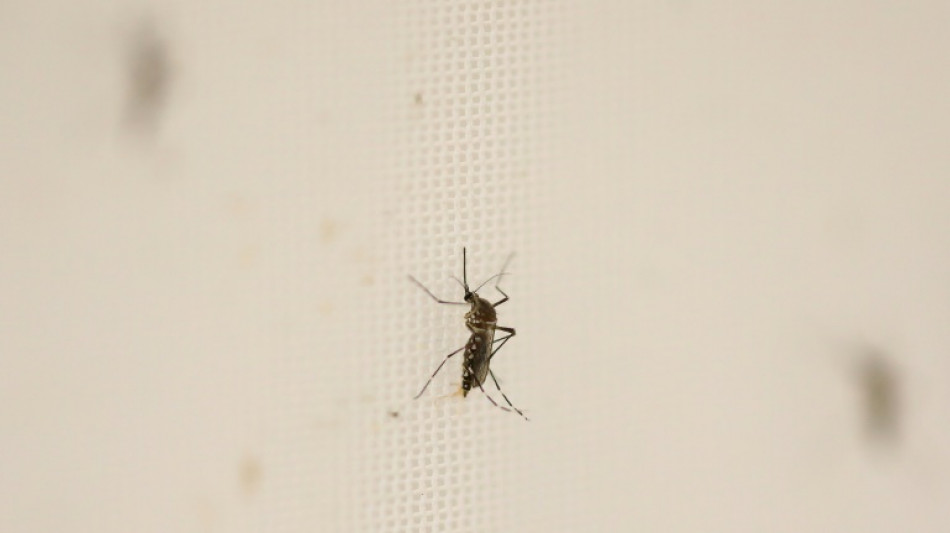
'Virus hunters' track threats to head off next pandemic / Photo: © AFP/File

 Pope urges Europe to help combat 'deceit and lies' in international ties

 Injured Buttler to miss England ODI series in Pakistan
 Madrid housing protesters vow to maintain pressure on government

 In kayaks or waist-deep in floodwater, shoppers return to Bangkok markets

 UK police probes Iran link to air base bomb scare: media

 Eala blasts into Asian Games quarters in just 55 minutes

 Taiwan gender-row boxer Lin Yu-ting guarantees Asian Games medal

 Comedian on trial for allegedly insulting Erdogan in standup show

 More Asian Games transport woes as bus takes Pakistan to wrong venue
 Death toll in South Africa bar shooting rises to 18
 Aide to Venezuelan opposition leader returns from exile

 Messi and Alcaraz love it, now padel takes step closer to Olympics

 Tolls mount in Thailand, Myanmar floods
 Why India's opposition wants top poll official out

 PU Prime Strengthens UAE Momentum with Strong Showing at Forex Expo Dubai 2026

 Eight dead in Thailand floods since mid-September

 Oil prices spike after Trump rejects Iran truce offer

 Taylor Swift sets new record at MTV VMAs

 Seoul seeks apology after Ukraine reveals transfer of North Korean POWs

 Messi on target again but Miami downed by Columbus

 In Washington's political cauldron, a fight over foie gras

 Flavio Bolsonaro: political heir in his father's shadow

 Ravens grab last-second win in Rio as Commanders stop Seahawks

 Scheffler makes sportsmanship stand over tee screamer

 Anthropic CEO Amodei to dine with Trump at White House

A global network of doctors and laboratories is working to pinpoint emerging viral threats, including many driven by climate change, in a bid to head off the world's next pandemic.
The coalition of self-described "virus hunters" has uncovered everything from an unusual tick-borne disease in Thailand to a surprise outbreak in Colombia of an infection spread by midges.
"The roster of things that we have to worry about, as we saw with Covid-19, is not static," said Gavin Cloherty, an infectious disease expert who heads the Abbott Pandemic Defense Coalition.
"We have to be very vigilant about how the bad guys that we know about are changing... But also if there's new kids on the block," he told AFP.
The coalition brings together doctors and scientists at universities and health institutions across the world, with funding from healthcare and medical devices giant Abbott.
By uncovering new threats, the coalition gives Abbott a potential headstart in designing the kinds of testing kits that were central to the Covid-19 response.
And its involvement gives the coalition deep pockets and the ability to detect and sequence but also respond to new viruses.
"When we find something, we're able to very quickly make diagnostic tests at industry level," Cloherty said.
"The idea is to ringfence an outbreak, so that we would be able to hopefully prevent a pandemic."
The coalition has sequenced approximately 13,000 samples since it began operating in 2021.
In Colombia, it found an outbreak of Oropouche, a virus spread by midges and mosquitoes, that had rarely been seen there before.
Phylogenetic work to trace the strain's family tree revealed it came from Peru or Ecuador, rather than Brazil, another hotspot.
"You can see where things are moving from. It's important from a public health perspective," said Cloherty.
- Difficult and costly -
More recently, the coalition worked with doctors in Thailand to reveal that a tick-bourne virus was behind a mysterious cluster of patient cases.
"At the time, we didn't know what virus caused this syndrome," explained Pakpoom Phoompoung, associate professor of infectious disease at Siriraj Hospital.
Testing and sequencing of samples that dated back as far as 2014 found many were positive for severe fever with thrombocytopenia syndrome (SFTSV).
"Less than 10 patients had (previously) been diagnosed with SFTSV in Thailand... we don't have PCR diagnosis, we don't have serology for this viral infection diagnosis," Pakpoom told AFP.
Diagnosing it "is difficult, labour intensive and also is costly".
And there is a growing need to track these threats as climate change expands the range of infectious disease globally.
The link between climate change and infectious disease is well-established and multi-faceted.
Warmer conditions allow vectors like mosquitoes to live in new locations, more rain creates more breeding pools, and extreme weather forces people into the open where they are more vulnerable to bites.
Human impact on the planet is also driving the spread and evolution of infectious disease in other ways: biodiversity loss forces viruses to evolve into new hosts, and can push animals into closer contact with humans.
- 'You have to be vigilant' -
Phylogenetic analysis of the SFTSV strain in Thailand gives a snapshot of the complex interplay.
It showed the virus had evolved from one tick with a smaller geographic range into the hardier Asian longhorned tick.
The analysis suggested its evolution was driven largely by pesticide use that reduced the numbers of the original tick host.
Once the virus evolved, it could spread further in part because Asian longhorned ticks can live on birds, which are travelling further and faster because of changing climate conditions.
"It's almost like they're an airline," said Cloherty.
Climate change's fingerprints are in everything from record outbreaks of dengue in Latin America and the Caribbean to the spread of West Nile Virus in the United States.
While the coalition grew from work that preceded the pandemic, the global spread of Covid-19 offered a potent reminder of the risks of infectious disease.
But Cloherty fears people are already forgetting those lessons.
"You have to be vigilant," he said.
"Something that happens in Bangkok could be happening in Boston tomorrow."
F.Pavlenko--BTB


