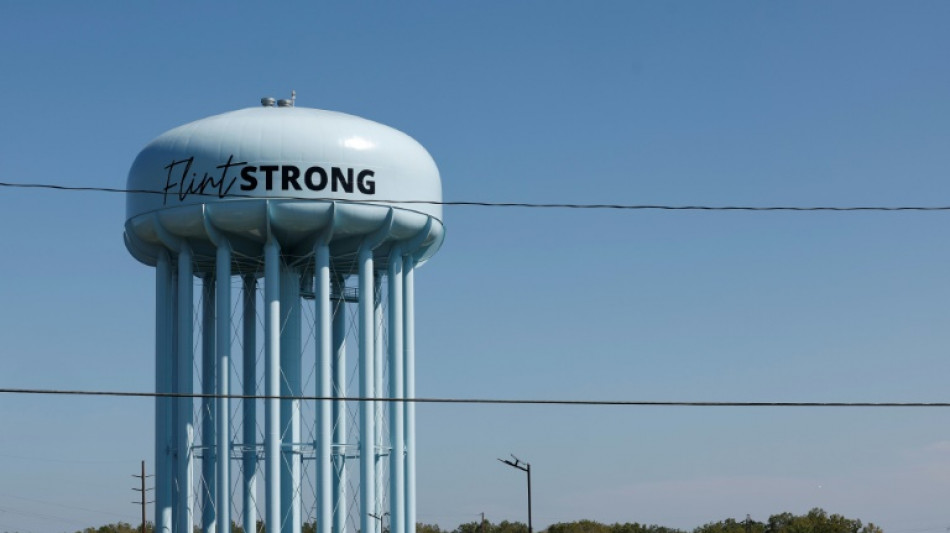
US city of Flint still reeling from water crisis, 10 years on / Photo: © AFP

 Pope urges Europe to help combat 'deceit and lies' in international ties

 Injured Buttler to miss England ODI series in Pakistan
 Madrid housing protesters vow to maintain pressure on government

 In kayaks or waist-deep in floodwater, shoppers return to Bangkok markets

 UK police probes Iran link to air base bomb scare: media

 Eala blasts into Asian Games quarters in just 55 minutes

 Taiwan gender-row boxer Lin Yu-ting guarantees Asian Games medal

 Comedian on trial for allegedly insulting Erdogan in standup show

 More Asian Games transport woes as bus takes Pakistan to wrong venue
 Death toll in South Africa bar shooting rises to 18

 Aide to Venezuelan opposition leader returns from exile

 Messi and Alcaraz love it, now padel takes step closer to Olympics

 Tolls mount in Thailand, Myanmar floods

 Why India's opposition wants top poll official out

 PU Prime Strengthens UAE Momentum with Strong Showing at Forex Expo Dubai 2026

 Eight dead in Thailand floods since mid-September

 Oil prices spike after Trump rejects Iran truce offer

 Taylor Swift sets new record at MTV VMAs
 Seoul seeks apology after Ukraine reveals transfer of North Korean POWs

 Messi on target again but Miami downed by Columbus

 In Washington's political cauldron, a fight over foie gras

 Flavio Bolsonaro: political heir in his father's shadow

 Ravens grab last-second win in Rio as Commanders stop Seahawks

 Scheffler makes sportsmanship stand over tee screamer

 Anthropic CEO Amodei to dine with Trump at White House

Turning her faucet on one day in 2014, Chanel McGee watched in disgust as a brownish trickle poured out.
Today, a strong musty smell lingers. Residents of the American city of Flint are still suffering the consequences of a historic water crisis, which is fuelling a lively rejection of politics -- and, by extension, the White House race.
For ten years, this mother of two from the Canadian border state of Michigan -- a key swing state in the November polls -- has consumed only bottled water.
"I started getting a little sick ... I drink bottled water now, I don't drink out of the faucet because I don't like the smell," the 47-year-old says in her kitchen, pierced by the scent of mildew.
A trap blackened with insects hangs over her sink. Even to wash, she says she buys water, which she pours into pots and heats on the stove.
"I want everything to change, I want the creek to be clean, I want everything to be clean, I just want it to be decent for us and the kids, so we could go ahead and live and not worry about this water and all that stuff going on ... I'm tired of it," McGee, who is unemployed, says.
"I'm not going to keep crying about it," she adds.
- 'They can drink it' -
The crisis she is living through began in 2014, when Michigan decided to change the water supply to the predominantly Black city of Flint as a cost-saving measure.
Instead of drawing from the region's lakes, one of the world's largest freshwater reserves, officials decided to draw from a polluted, acidic river, exposing its 100,000-strong population to severely lead-contaminated water for more than a year.
The health scandal had international repercussions, and -- among other issues -- caused learning disabilities in many children.
It saw a spike in cases of Legionnaires' disease, leading to the death of a dozen people and widespread mistrust of public officials.
Those same authorities have said that the vast majority of lead pipes have since been replaced and that the water is now safe to drink.
"They can drink it but I know I'm not going to," McGee tells AFP.
That distrust of authorities extends right to the top: she says she has no confidence in the two presidential candidates, both of whom are eyeing Michigan -- a coveted prize in the November election.
Her thoughts on Republican Donald Trump, who visited the state on Tuesday: "What is he going to do for us? Is he going to change something around here? Change the water? Change the city?"
And Democrat Kamala Harris? "I don't even know who that is," McGee replies with a shrug.
- 'Contaminated city' -
"No one seems to be concerned about a struggling city and the problems that they've had," agrees Dennis Robinson, leaning against the table of a yellow-brick diner.
The 69-year-old man, a lifelong resident of Flint, hasn't imbibed the city's water in years either. "You can only lie to me so long," he tells AFP.
An ex-employee of General Motors, the automaker founded in the city and for many years its main employer, Robinson says he has noticed learning problems in many of the children in his area, which he believes are linked to their exposure to lead.
The observation has been corroborated by several scientific studies.
"It creates a generation of people, a group of young folks that will be facing struggles, probably their entire life," says Robinson with a sigh.
A host of public and private initiatives have been launched to support these children and pull Flint, hit hard by the 2008 financial crisis, out of the doldrums.
More than a third of the population lives below the poverty line.
The city center, with its pretty art deco buildings, has benefited from major renovations.
But whole swathes of the city, with its condemned doorways and gutted front porches, bear witness to how far there is to go.
It also has to shake off its image as a "contaminated city."
Bri Gallinet, a waitress in an upmarket restaurant, describes the fear and panic when the crisis first hit -- but now, she says, visitors to the city make jokes about the water.
"Every time we cater a table, we'll put waters in front of them and they'll laugh and say, 'Is it safe?'" says the 35-year-old.
"My first response is, well I'm not trying to harm you," she says.
"It's kind of not funny. It hurts our feelings."
Y.Bouchard--BTB


