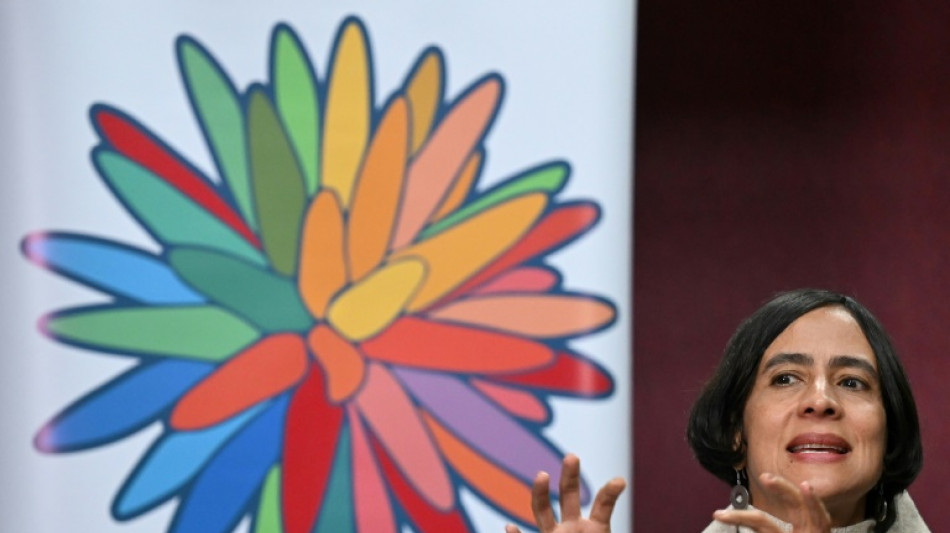
At COP16, Colombia seeks to lead by example on biodiversity / Photo: © AFP/File

 Pope urges Europe to help combat 'deceit and lies' in international ties

 Injured Buttler to miss England ODI series in Pakistan
 Madrid housing protesters vow to maintain pressure on government
 In kayaks or waist-deep in floodwater, shoppers return to Bangkok markets

 UK police probes Iran link to air base bomb scare: media
 Eala blasts into Asian Games quarters in just 55 minutes
 Taiwan gender-row boxer Lin Yu-ting guarantees Asian Games medal
 Comedian on trial for allegedly insulting Erdogan in standup show

 More Asian Games transport woes as bus takes Pakistan to wrong venue
 Death toll in South Africa bar shooting rises to 18
 Aide to Venezuelan opposition leader returns from exile

 Messi and Alcaraz love it, now padel takes step closer to Olympics

 Tolls mount in Thailand, Myanmar floods
 Why India's opposition wants top poll official out

 PU Prime Strengthens UAE Momentum with Strong Showing at Forex Expo Dubai 2026

 Eight dead in Thailand floods since mid-September
 Oil prices spike after Trump rejects Iran truce offer

 Taylor Swift sets new record at MTV VMAs
 Seoul seeks apology after Ukraine reveals transfer of North Korean POWs

 Messi on target again but Miami downed by Columbus

 In Washington's political cauldron, a fight over foie gras

 Flavio Bolsonaro: political heir in his father's shadow

 Ravens grab last-second win in Rio as Commanders stop Seahawks

 Scheffler makes sportsmanship stand over tee screamer

 Anthropic CEO Amodei to dine with Trump at White House

As one of the world's most biodiverse countries, Colombia is determined to lead by example when it hosts an upcoming UN summit to save nature, Environment Minister Susana Muhamad told AFP on Monday.
Set to run from October 21 to November 1 in the western city of Cali, the 16th Conference of the Parties (COP16) of the Convention on Biological Diversity offers a pivotal moment to assess global progress toward the ambitious goal of protecting 30 percent of Earth's land and oceans by 2030.
"We've created a platform to put biodiversity on top of the global political agenda," said Muhamad, noting that more than 100 ministers and 12 heads of state, including Brazil's President Luiz Inacio Lula da Silva and Mexico's incoming president Claudia Sheinbaum, are expected to attend.
"As a biodiverse country, we also see the potential for our country and our region: it's a Latin American moment," she added, speaking at the United Nations in New York.
Few countries can rival Colombia's vast diversity of species and ecosystems, from the Andean highlands to the Amazon rainforest. Colombia ranks first globally in bird and orchid species diversity and second in plants, butterflies, freshwater fish and amphibians.
Muhamad acknowledged Colombia's own environmental challenges, however.
Large areas of forest have been cleared for illicit coca plantations used in cocaine production, and deforestation surged after the 2016 peace deal with the FARC rebel group, as former fighters turned to unregulated farming and ranching.
"Although we can say we have a voice that has been very clear on the international arena, we cannot say that Colombia has its problem solved," said Muhamad.
The minister began her journey as an environmental advocate while at university, before turning to politics upon realizing "this is, at the end, a power struggle."
Colombia's war with rebel groups is not over, with some dissident factions continuing to reject the peace deal signed with FARC.
In July, the EMC faction issued a threat to the COP16 meeting, warning that it "will fail."
Despite this, Muhamad expressed confidence in the conference's security plan, coordinated by Colombia's defense ministry and the United Nations security office, which will mobilize more than 10,000 personnel to protect the event.
Peace negotiations with armed groups are also ongoing, she added, with some dissident groups having publicly supported the COP.
- Nature for peace? -
Indeed, COP16's theme is "peace with nature," and Muhamad suggested that the outcomes of COP16 could contribute to peace efforts by "empowering and mobilizing local communities in regions where the armed struggle is happening, especially confronting illicit economies."
By focusing on biodiversity protection and promoting initiatives such as sustainable agriculture, eco-tourism and conservation projects, these communities could find new, sustainable opportunities.
At the last biodiversity COP in Montreal two years ago, nations signed a landmark "30x30" pact aimed at halting biodiversity loss and restoring ecosystems.
This year, the focus is on implementing those promises, said Muhamad, with a key priority being the creation of a body that would allow Indigenous communities to directly access funds for conservation efforts.
Another goal is the activation of a new fund that will enable countries in the Global South to better share in the financial rewards from the use of DNA and genetic resources from their native species -- resources that have been widely used in products such as drugs and vaccines.
Finally, said Muhamad, she would call on developed countries to ramp up their nature financing.
Many wealthy nations have historically sacrificed their own biodiversity to exploit resources for economic gain.
In Montreal, they pledged to provide at least $30 billion annually by 2030 to support developing countries in preserving the world's remaining species.
So far, pledges to a new fund created for this purpose have reached around $400 million, with roughly half of that amount disbursed.
D.Schneider--BTB


