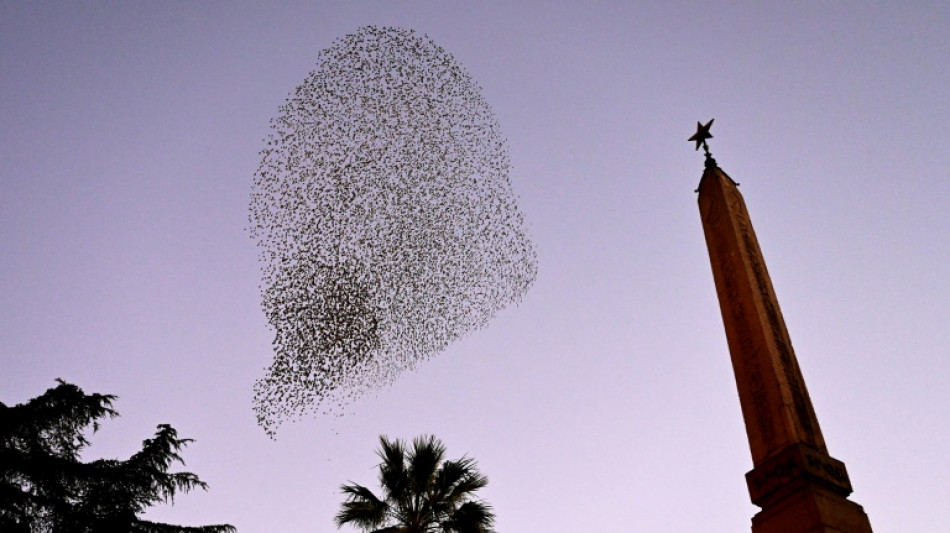
Magical but messy: Rome scares off its starlings / Photo: ©

 Man City chairman defiant over reported Premier League charges

 Germany ready to 'walk through fire' for Klopp, says Tah

 At least 16 killed in Russian and Ukrainian strikes

 Powerful storm pummels US Northeast

 Bangkok declares disaster after homes flooded, roads submerged by heavy rain

 Norris calls for errant Colapinto to be banned for causing Baku crash

 Russell finds himself again and prepares to heap pressure on Antonelli

 South Korea hold nerve to win Asian Games basketball gold

 Russell holds off Verstappen to claim imperious victory in Baku

 Russell holds off Verstappen to win Azerbaijan Grand Prix

 India's Kohli says 2027 ODI World Cup will be his last

 Huge crowds cheer Pope Leo along Champs-Elysees ahead of Paris mass

 Putellas wants to bring 'winning culture and mentality' to London City

 Rare Italian opera returns to Moscow after nearly 120-year hiatus

 Pope to celebrate giant Paris mass after 'peace' appeal

 Homes flooded, roads submerged: Bangkok declares disaster over heavy rains

 Ahead of Paris mass, pope urges life together in 'dignity and peace'

 Austria 'ghetto' language classes leave children to repeat school

 S.African women runners arm themselves after string of killings

 'I felt embarrassed': Japan eSports whizz-kid, 11, wins Games gold

 Indonesia fires threatens critically-endangered orangutan: IUCN

 Bangkok declares flood disaster across city

 'World records not enough': North Korea weightlifters target Olympic gold rush

 Iran proposes Hormuz plan, Trump reportedly refuses

 El Nino rewrites the menu in the world's top restaurants

As the sun sets over central Rome, five figures in white overalls move under the trees. They wave speakers emitting a mix of sharp cries, and the birds rise into the air.
Every winter, the skies over Italy's capital are filled with the mesmerising sight of thousands of starlings swooping and diving in unison.
But when they stop to rest on the trees, their droppings coat the pavements and cars below -- prompting the city authorities, every year, to try to scare them away.
"We act on their fear reflex by using their own alarm call," said Marianna Di Santo, clad head-to-toe in white protective clothing and heading towards the birds gathered in trees around Termini central train station.
"It's as if they were warning each other that this is a dangerous place and they should move away," said Di Santo, whose company, Fauna Urbis, is hired by the Rome authorities to disperse the starlings.
- Up to one million -
Between October and February every year, millions of starlings migrate from northern Europe to Italy in search of warmer temperatures for the winter.
Their synchronised ballets -- murmurations -- over the Eternal City's centuries-old churches, palaces and ruins entrances passers-by.
"I've never seen such a thing in my life. It's spectacular," said Spanish tourist Eva Osuna, taking out her phone to capture the magic.
The glossy dark-feathered birds, which measure up to 20 centimetres each, spend the day feeding in rural areas before heading back into town to sleep, explains ornithologist Francesca Manzia from Italy's League for Bird Protection (LIPU).
"In the city, the temperatures are higher and the light helps them find their way around, and protects them from predators," she told AFP.
Warmer temperatures in northern European caused by climate change have shortened the starlings' stay in Italy, but their sheer numbers make them a force to be reckoned with.
Between 500,000 and one million are believed to be in Rome this year, according to one expert.
Naturally "gregarious", according to Manzia, they stick together at night, creating collective dormitories in the trees.
She insisted the starlings "do not carry diseases" but pose problems "because of their droppings, which make the roads slippery and smell very strong".
- In their nature -
Such is the problem that, even on a clear day, it is not uncommon to see Romans walking along tree-lined streets with umbrellas as protection against the birds.
City authorities use sounds and also lights not to chase the birds out of the city, but to split them up into smaller, more manageable groups.
Sounds are "the most simply and effective" way of moving the birds on, said Valentina de Tommaso from Fauna Urbis.
She works two or three times a week near Termini, which -- with its lights and shelter from the wind -- is a "comfortable" place for the birds to rest.
"We play recordings for about 10 minutes, with breaks in between so they do not get used to the noise" -- a tactic that aims to be annoying but harmless, she said.
The piercing noise draws a small crowd, some of them approving, others less so.
"They pose lots of problems. Walking around under flocks of starlings is not really ideal," said Francesco Fusco, a 55-year-old engineer.
"It's in their nature. We are not going to make them wear nappies!" he said, laughing.
L.Dubois--BTB