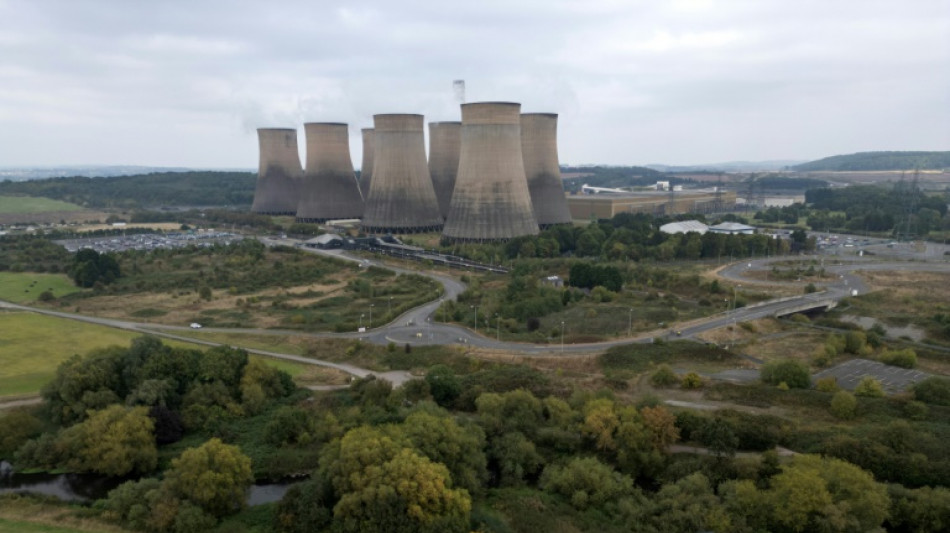
Britain's last coal-fired power station closes / Photo: © AFP/File

 Pope urges Europe to help combat 'deceit and lies' in international ties

 Injured Buttler to miss England ODI series in Pakistan

 Madrid housing protesters vow to maintain pressure on government

 In kayaks or waist-deep in floodwater, shoppers return to Bangkok markets

 UK police probes Iran link to air base bomb scare: media

 Eala blasts into Asian Games quarters in just 55 minutes
 Taiwan gender-row boxer Lin Yu-ting guarantees Asian Games medal

 Comedian on trial for allegedly insulting Erdogan in standup show

 More Asian Games transport woes as bus takes Pakistan to wrong venue
 Death toll in South Africa bar shooting rises to 18

 Aide to Venezuelan opposition leader returns from exile

 Messi and Alcaraz love it, now padel takes step closer to Olympics
 Tolls mount in Thailand, Myanmar floods

 Why India's opposition wants top poll official out

 PU Prime Strengthens UAE Momentum with Strong Showing at Forex Expo Dubai 2026
 Eight dead in Thailand floods since mid-September

 Oil prices spike after Trump rejects Iran truce offer

 Taylor Swift sets new record at MTV VMAs
 Seoul seeks apology after Ukraine reveals transfer of North Korean POWs

 Messi on target again but Miami downed by Columbus

 In Washington's political cauldron, a fight over foie gras

 Flavio Bolsonaro: political heir in his father's shadow
 Ravens grab last-second win in Rio as Commanders stop Seahawks

 Scheffler makes sportsmanship stand over tee screamer

 Anthropic CEO Amodei to dine with Trump at White House

The UK's last coal-fired power station will officially close its doors on Monday, making Britain the first G7 country to end its reliance on the fossil fuel to produce electricity.
The closure of Ratcliffe-on-Soar, a power plant that has dominated the surrounding central England landscape for nearly 60 years, marks a symbolic step in the UK's ambition to decarbonise electricity by 2030, and become carbon neutral by 2050.
"The era of coal might be ending, but a new age of good energy jobs for our country is just beginning," Energy Minister Michael Shanks said in a statement.
The owner of the Ratcliffe-on-Soar factory, Uniper said the site will be put into a two-year decommissioning period beginning in October.
The 350 Uniper employees and contractors that work at the site, will either be redeployed to other roles within the company or leave the business within three redundancy windows before the end of 2026, Uniper told AFP.
In its place will be a new development -- a "carbon-free technology and energy hub", the company said.
It marks the end of Britain's 140-year dependence on coal as it becomes the first in the G7 of rich nations to do away entirely with coal power electricity.
Italy plans to do so by next year, France in 2027, Canada in 2030 and Germany in 2038. Japan and the United States have no set dates.
"Britain has set an example the rest of the world must follow", said Doug Parr, policy director at Greenpeace UK.
"There are further battles to be had to phase out oil and gas, fulfilling the promise by all countries at COP28 to transition away from fossil fuels," he added.
- 'In the history books' -
The polluting fossil fuel played a vital part in British economic history, powering the Industrial Revolution of the 18th and 19th centuries that made the country a global superpower.
Even into the 1980s, it still represented 70 percent of the country's electricity mix before its share declined in the 1990s as the government began to implement stricter regulations to tackle pollution.
In the last decade the fall has been even sharper, slumping to 38 percent in 2013, 5.0 percent in 2018 then just 1.0 percent last year.
"Coal was the backbone of the UK’s power generation for over a century, but its place is now in the history books," said Friends of the Earth energy campaigner, Tony Bosworth.
"The priority now is to move away from gas as well, by developing as fast as possible the UK’s huge homegrown renewable energy potential and delivering the economic boost that will bring," he added.
In 2023, a third of electricity production was made up of natural gas while a quarter came from wind power and 13 percent from nuclear power, according to electricity operator National Grid ESO.
The new Labour government has plans to further decarbonise the energy mix.
It launched its flagship green energy plan after its election win in July, with the creation of a publicly owned body to invest in offshore wind, tidal power and nuclear power.
In recent years, Ratcliffe-on-Soar, which had the potential to power two million homes, was only used when big spikes in electricity use were expected, such as during a cold snap in 2022 or the 2023 heatwave.
Its last delivery of 1,650 tonnes of coal at the start of this summer barely supplied 500,000 homes for eight hours.
The history of Britain's reliance on coal dates back to 1882, when the world's first coal-fired power station was built in central London.
O.Lorenz--BTB


