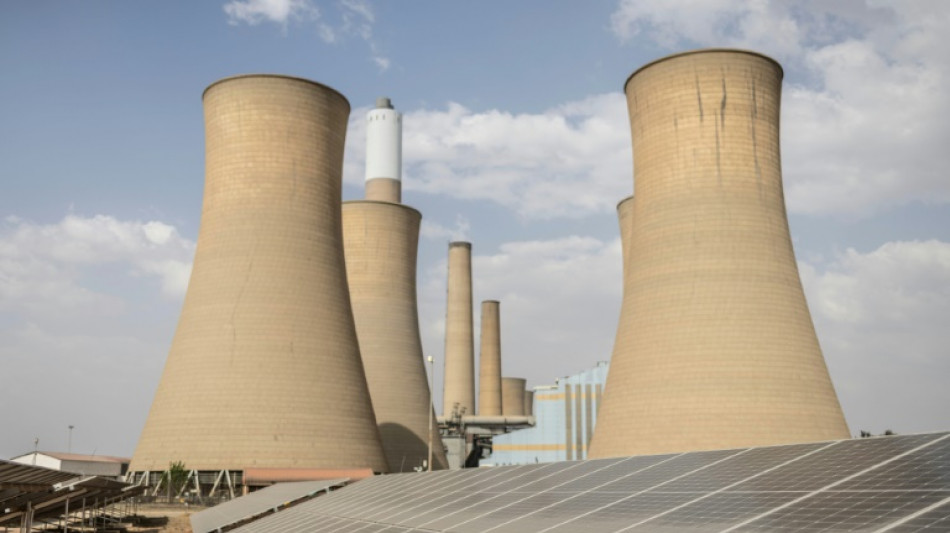
S. Africa offers a lesson on how not to shut down a coal plant / Photo: © AFP

 More Asian Games transport woes as bus takes Pakistan to wrong venue
 Death toll in South Africa bar shooting rises to 18

 Aide to Venezuelan opposition leader returns from exile

 Messi and Alcaraz love it, now padel takes step closer to Olympics
 Tolls mount in Thailand, Myanmar floods
 Why India's opposition wants top poll official out

 PU Prime Strengthens UAE Momentum with Strong Showing at Forex Expo Dubai 2026

 Eight dead in Thailand floods since mid-September

 Oil prices spike after Trump rejects Iran truce offer

 Taylor Swift sets new record at MTV VMAs
 Seoul seeks apology after Ukraine reveals transfer of North Korean POWs
 Messi on target again but Miami downed by Columbus

 In Washington's political cauldron, a fight over foie gras

 Flavio Bolsonaro: political heir in his father's shadow
 Ravens grab last-second win in Rio as Commanders stop Seahawks

 USA rallies to capture 11th consecutive Presidents Cup

 Phillies clinch, Astros wrap up division on final day of MLB season

 Commanders hand champion Seahawks their first loss

 Dupont scores twice to send Toulouse top of Top 14

 Ireland beat Israel but no handshakes due to war in Gaza

 Tense standoff over flashpoint N.Ireland parade lasts into night

 Stunned McNulty wins 'miracle' road race world title

 Re-released 'Avengers: Endgame' snaps-up N. America box office lead

 American McNulty wins shock road race world title

 Serbia's President Aleksandar Vucic announces resignation

The cold corridors of South Africa's once-mighty Komati coal-fired power plant have been quiet since its shutdown in 2022 in what was trumpeted as a pioneering project in the world's transition to green energy.
Two years later, plans to repurpose the country's oldest coal power plant have amounted to little in a process that offers caution and lessons for countries intending to reduce their reliance on fossil fuels and switch to renewables.
Jobs have been lost and construction for wind and solar energy generation has yet to start, with only a few small green projects underway.
"We cannot construct anything. We cannot remove anything from the site," acting general manager Theven Pillay told AFP at the 63-year-old plant embedded in the coal belt in Mpumalanga province, where the air hangs thick with smog.
Poor planning and delays in paperwork to authorise the full decommissioning of the plant have been the main culprits for the standstill, he said. "We should have done things earlier. So we would consider it is not a success."
Before it turned off the switches in October 2022, the plant fed 121 megawatts into South Africa's chronically undersupplied and erratic electricity grid.
The transition plan -- which won $497 million in funding from the World Bank -- envisions the generation of 150 megawatts via solar and 70 megawatts from wind, with capacity for 150 megawatts of battery storage.
Workers are to be reskilled and the plant's infrastructure, including its massive cooling towers, repurposed.
But much of this is still a long way off. "They effectively just shut down the coal plant and left the people to deal with the outcomes," said deputy energy and electricity minister Samantha Graham.
- Disgruntled -
Coal provides 80 percent of South Africa's power and the country is among the world's top 12 largest greenhouse gas emitters. Coal is also a bedrock of its economy, employing around 90,000 people.
South Africa was the first country in the world to form a Just Energy Transition Partnership (JETP) with international funders to move off dirty power generation, already receiving $13.6 billion in total in grants and loans, Neil Cole of the JETP presidential committee told AFP.
Komati is the first coal plant scheduled for decommissioning, with five of the remaining 14 ones meant to follow by 2030.
It had directly employed 393 people, the state energy firm Eskom that owns the plant told AFP. Only 162 remain on site as others volunteered for transfer or accepted payouts.
The plant had been the main provider of employment in the small town, where the quiet streets are pitted with chunks of coal. Today, several houses are vacant as workers from other provinces headed home after losing their jobs.
"Our jobs ending traumatised us a lot as a community," said Sizwe Shandu, 35, who had been contracted as a boilermaker at the plant since 2008.
The shutdown had been unexpected and left his family scrambling to make ends meet, he said. With South Africa's unemployment rate topping 33 percent, Shandu now relies on government social grants to buy food and electricity.
Pillay admitted that many people in the town of Komati had a "disgruntled view" of the transition. One of the mistakes was that coal jobs were closed before new jobs were created, he said. People from the town did not always have the skills required for the emerging jobs.
Eskom has said it plans to eventually create 363 permanent jobs and 2,733 temporary jobs at Komati.
One of the green projects underway combines raising fish alongside vegetable patches supported by solar panels.
Seven people, from a planned 21, have been trained to work on this aquaponics scheme, including Bheki Nkabinde, 37.
"Eskom has helped me big time in terms of getting this opportunity because now I've got an income, I can be able to support my family," he told AFP, as he walked among his spinach, tomatoes, parsley and spring onions.
The facility is also turning invasive plants into pellets that are an alternative fuel to coal and assembling mobile micro power grids fixed to containers. A coal milling workshop has been turned into a welding training room.
- Mistakes and lessons -
The missteps at Komati are lessons for other coal-fired power plants marked for shutdown, Pillay said. For example, some now plan to start up green energy projects parallel to the phasing out of fumes.
But the country is "not going to be pushed into making a decision around how quickly or how slowly we do the Just Energy Transition based on international expectations", said Graham.
South Africa has seven percent renewable energy in its mix, up from one percent a decade ago, she said. And it will continue mining and exporting coal, with Eskom estimating that there are almost 200 years of supply still in the ground.
The goal is to have a "good energy mix that's sustainable and stable", Graham said.
Since South Africa's JETP was announced, Indonesia, Vietnam and Senegal have struck similar deals, but there has been little progress towards actually closing coal plants under the mechanism.
Among the criticisms is that it offers largely market-rate lending terms, raising the threat of debt repayment problems for recipients.
J.Fankhauser--BTB