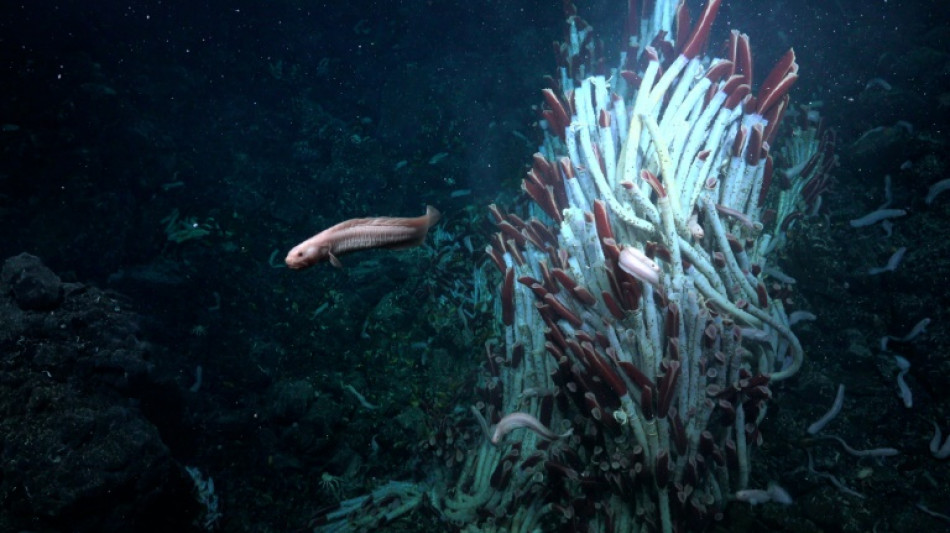
Worms and snails handle the pressure 2,500m below the Pacific surface / Photo: © Schmidt Ocean Institute/AFP

 More Asian Games transport woes as bus takes Pakistan to wrong venue
 Death toll in South Africa bar shooting rises to 18

 Aide to Venezuelan opposition leader returns from exile

 Messi and Alcaraz love it, now padel takes step closer to Olympics

 Tolls mount in Thailand, Myanmar floods
 Why India's opposition wants top poll official out

 PU Prime Strengthens UAE Momentum with Strong Showing at Forex Expo Dubai 2026

 Eight dead in Thailand floods since mid-September

 Oil prices spike after Trump rejects Iran truce offer

 Taylor Swift sets new record at MTV VMAs
 Seoul seeks apology after Ukraine reveals transfer of North Korean POWs

 Messi on target again but Miami downed by Columbus

 In Washington's political cauldron, a fight over foie gras

 Flavio Bolsonaro: political heir in his father's shadow

 Ravens grab last-second win in Rio as Commanders stop Seahawks

 USA rallies to capture 11th consecutive Presidents Cup

 Phillies clinch, Astros wrap up division on final day of MLB season

 Commanders hand champion Seahawks their first loss

 Dupont scores twice to send Toulouse top of Top 14

 Ireland beat Israel but no handshakes due to war in Gaza

 Tense standoff over flashpoint N.Ireland parade lasts into night

 Stunned McNulty wins 'miracle' road race world title

 Re-released 'Avengers: Endgame' snaps-up N. America box office lead

 American McNulty wins shock road race world title

 Serbia's President Aleksandar Vucic announces resignation

Giant worms found wriggling under the Pacific seabed have unveiled a thriving ecosystem in a fiercely hostile environment, according to a study published by Nature.
The team found the booming community 2,515 metres (8,250 feet) below the surface just off the coast of central America.
An underwater oasis has been created under a chain of mountains that run from north-to-south in the Pacific. In this part of the chain, two tectonic plates are moving away from each other, opening up hydrothermal vents that let out water heated by magma and loaded with chemical compounds.
The seabed zone was first discovered in the 1970s. But the latest research found tube worms and molluscs that thrive despite water pressure 250 times greater than at the surface and the total darkness.
The inhabitants of the animal Atlantis live off the nutrients produced by bacteria on the seabed.
Scientists are now trying to understand how the tube worm larvae get around so quickly to colonise new areas around the vents created after each underwater eruption.
- Underwater zoo -
One theory is that the larvae get under the crust with cold deep-sea water where it mixes with the hotter water created by earthquakes and eruptions and "and then they get spilled out at the surface and settle", said Monika Bright, a marine biology professor at the University of Vienna and co-author of the Nature study.
The scientists used a remote-controlled submarine, with its own digger for lifting rocks, to collect samples and sea floor images.
"While trying to collect the rocks we discovered that there are cavities below," Bright told AFP.
The cavities hid an underwater zoo of adult worms, limpets in shells, polychaetes, or bristle worms, and marine snails.
Bright said the team's work showed that "unexpected discoveries" can be made even at places that have been studied for more than 30 years, "probably just because nobody was thinking to look into the crust for animals before."
The cavities are about 10 centimetres (four inches) deep and worms up to 41cm long were found.
Bright said the conditions were similar to those at the surface where tube worms live. "The temperatures we measured were up to 25 degrees Celsius, oxygen was present and also toxic hydrogen sulphide in moderate concentrations."
The study said "larvae can disperse in cavities to potentially colonize lava cracks and the seafloor, or even settle and grow to adults and thereby proliferate" in the shallow vents.
Bright said the researchers believe the animals might not go down very far because the temperature rises, there is less oxygen and higher concentrations of hydrogen sulphide the deeper they go.
"It is important to know who lives there and to be able to protect them from deep-sea mining," said Bright. "This fauna is unique and should be protected."
O.Krause--BTB



