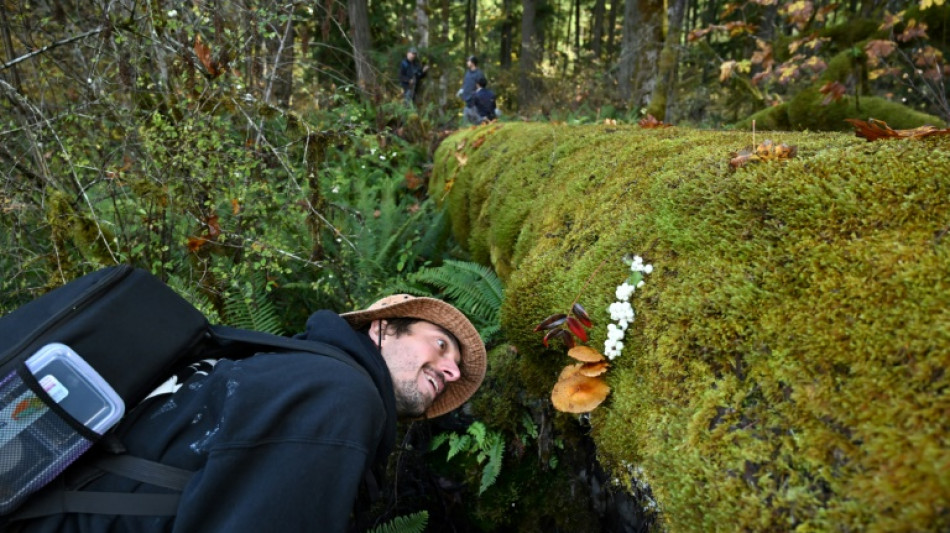
Fungi finding: mushroom hunters seek new species and recognition / Photo: © AFP

 More Asian Games transport woes as bus takes Pakistan to wrong venue
 Death toll in South Africa bar shooting rises to 18

 Aide to Venezuelan opposition leader returns from exile

 Messi and Alcaraz love it, now padel takes step closer to Olympics

 Tolls mount in Thailand, Myanmar floods
 Why India's opposition wants top poll official out

 PU Prime Strengthens UAE Momentum with Strong Showing at Forex Expo Dubai 2026

 Eight dead in Thailand floods since mid-September

 Oil prices spike after Trump rejects Iran truce offer

 Taylor Swift sets new record at MTV VMAs
 Seoul seeks apology after Ukraine reveals transfer of North Korean POWs

 Messi on target again but Miami downed by Columbus

 In Washington's political cauldron, a fight over foie gras

 Flavio Bolsonaro: political heir in his father's shadow

 Ravens grab last-second win in Rio as Commanders stop Seahawks

 USA rallies to capture 11th consecutive Presidents Cup

 Phillies clinch, Astros wrap up division on final day of MLB season

 Commanders hand champion Seahawks their first loss

 Dupont scores twice to send Toulouse top of Top 14

 Ireland beat Israel but no handshakes due to war in Gaza

 Tense standoff over flashpoint N.Ireland parade lasts into night

 Stunned McNulty wins 'miracle' road race world title

 Re-released 'Avengers: Endgame' snaps-up N. America box office lead

 American McNulty wins shock road race world title

 Serbia's President Aleksandar Vucic announces resignation

You can't walk very far through a forest in this part of the United States without stumbling upon a mushroom, an eruption from a vast fungal kingdom that all life depends on, but about which we know very little.
Some are tall and thin with a helmet top, others are great flourishes of brain-like folds; some seem like they should be sheltering fairies in a storybook.
Many look like they could be delicious in the hands of a skilled chef; others... decidedly not.
But the dozens of species that enthusiasts and experts collected on a recent morning represent just a tiny fraction of life that is neither flora nor fauna.
"Mushrooms are not plants," said Amy Honan, who teaches mycology and fungal ecology at Oregon University.
"Fungi are more closely related to animals than they are to plants."
Plants make their own food through photosynthesis, but mushrooms have to eat something else.
"They spit out different enzymes, so they break down their food outside of their body, and they slurp it up like a smoothie," Honan said.
- 'Essential' -
Of the at least 2.5 million species of fungus thought to exist on Earth, scientists have described around 150,000 -- six percent -- Honan told AFP during a field trip near Port Angeles in Washington state.
Compared with what we know about plants and animals, that's practically nothing.
"We know about 98 percent of the vertebrates that are on the planet," she said. "We know about 85 percent of plants that exist on the planet. We know about 20 percent of invertebrates."
This paucity of fungal knowledge is troubling because of the vital -- and largely unseen -- role that they play.
Fungi evolved before plants and created the conditions to allow vegetation to move from the sea to the land.
"Fungi are essential for all terrestrial ecosystems. They confer all kinds of benefits to plants, from salt tolerance, heavy metal tolerance, disease resistance," Honan said.
"Basically, without fungi... plants would not exist. We need plants for oxygen, so the world would not exist in its current state."
It would also be chock-full of dead things.
"Fungi break down all dead organic material, so they recycle all that carbon and other nutrients," facilitating the life cycle of plants and animals.
- COP16 focus -
There is a burgeoning awareness of the importance of fungi, whose role is set to come up for discussion at the UN Convention on Biological Diversity COP16 meeting in Colombia, which kicks off on Monday.
The Guardian newspaper reported last week that a joint proposal by Chile and the United Kingdom could see fungi recognised as "an independent kingdom of life in legislation, policies and agreements, in order to advance their conservation and to adopt concrete measures that allow for maintaining their benefits to ecosystems and people."
Greater protections would be good news, said mycologist Graham Steinruck, who, along with Honan, is leading a study into fungal biodiversity at a site that was underwater until the removal of a dam a few years ago.
As part of the Olympic Peninsula Fungi Festival, he and Honan have taken participants out into the field to show them how to find species of mushroom, and how to record what they are seeing.
"I think the more fungi that we go out and discover and document not only tells us about our biodiversity, but also can tell us about ways we can steward the land better," Steinruck said.
Knowing more about these mysterious organisms could also bring benefits to lots of areas of human life.
Mushrooms can help us "heal ourselves, and maybe even potentially (help) other things like industries," he said.
For participants on the mushroom hunt, the opportunity to find new fungal life was eye-opening.
Naomi Ruelle had traveled from New York with her mushroom-enthusiast partner, and was taking part in her first organized hunt.
"I've learned so much," she beamed, showing off a collection that included a huge, fleshy shelf-like specimen, yellow parasol-style mushrooms and spindly stalked fungi that had found root in a dead pine cone.
"It was so interesting to see the different species. They're obviously going to take them to the lab and I'm kind of curious to understand a bit more about them."
O.Bulka--BTB



