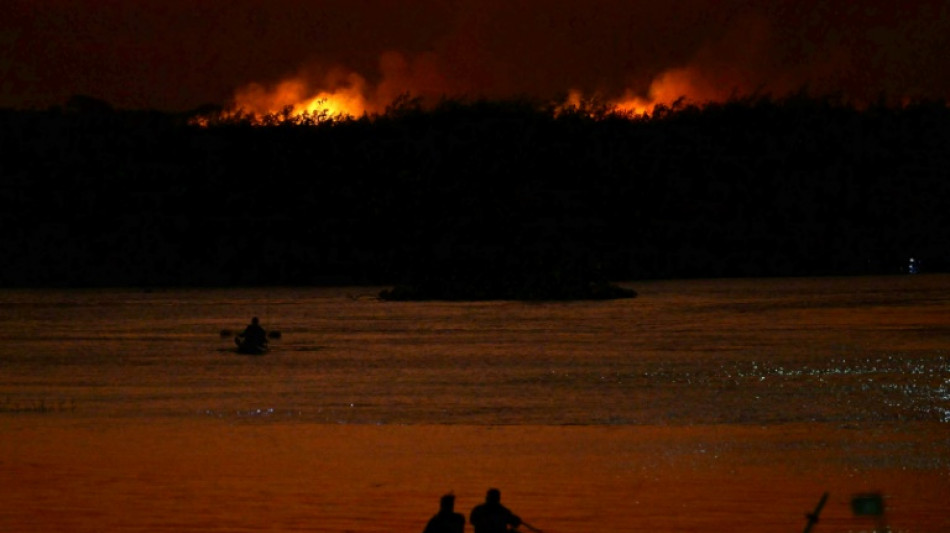
World already 'paying terrible price' for climate inaction: Guterres / Photo: © AFP

 More Asian Games transport woes as bus takes Pakistan to wrong venue
 Death toll in South Africa bar shooting rises to 18
 Aide to Venezuelan opposition leader returns from exile

 Messi and Alcaraz love it, now padel takes step closer to Olympics

 Tolls mount in Thailand, Myanmar floods

 Why India's opposition wants top poll official out

 PU Prime Strengthens UAE Momentum with Strong Showing at Forex Expo Dubai 2026

 Eight dead in Thailand floods since mid-September

 Oil prices spike after Trump rejects Iran truce offer

 Taylor Swift sets new record at MTV VMAs
 Seoul seeks apology after Ukraine reveals transfer of North Korean POWs

 Messi on target again but Miami downed by Columbus

 In Washington's political cauldron, a fight over foie gras
 Flavio Bolsonaro: political heir in his father's shadow

 Ravens grab last-second win in Rio as Commanders stop Seahawks

 USA rallies to capture 11th consecutive Presidents Cup

 Phillies clinch, Astros wrap up division on final day of MLB season

 Commanders hand champion Seahawks their first loss

 Dupont scores twice to send Toulouse top of Top 14

 Ireland beat Israel but no handshakes due to war in Gaza

 Tense standoff over flashpoint N.Ireland parade lasts into night

 Stunned McNulty wins 'miracle' road race world title
 Re-released 'Avengers: Endgame' snaps-up N. America box office lead

 American McNulty wins shock road race world title
 Serbia's President Aleksandar Vucic announces resignation
Humanity is 'paying a terrible price' for inaction on global warming, with time running out to correct the course and avoid climate disaster, UN Secretary General Antonio Guterres said Thursday.
A new report by the UN Environment Programme (UNEP) says the next decade is critical in the fight against climate change or any hope of limiting global warming to 1.5 degrees Celsius will be lost.
The current pace of climate action would result in a catastrophic 3.1C of warming this century, UNEP said in its latest Emissions Gap report.
And even if all existing pledges to cut emissions were enacted as promised, global temperatures would soar 2.6C above pre-industrial levels -- a still devastating scenario for humanity.
"Either leaders bridge the emissions gap, or we plunge headlong into climate disaster, with the poorest and most vulnerable suffering the most," said Guterres.
"Around the world, people are paying a terrible price."
The call to action, just weeks before the UN COP29 climate summit, follows a streak of destructive and deadly extreme weather in a year expected to be the hottest in recorded history.
The world's poorest have been particularly hard hit, with typhoons and heatwaves in Asia and the Caribbean, floods in Africa, and droughts and wildfires in Latin America.
- 'Out of time' -
UNEP's latest projections blow well past 1.5C, which nations agreed in Paris in 2015 was the safer bet to minimise the worst consequences of a warming planet.
Guterres said wealthy G20 economies in particular would need to show far more ambition in the next round of climate pledges, known as NDCs, which are due in early 2025.
These commitments, which detail how a country will reduce emissions across their economies, were "our best last chance to change course", said David King of the Climate Crisis Advisory Group.
"To avoid a scenario in which humanity will struggle to survive intact, nations must use the window of opportunity over the coming year," said King, who chairs the expert consortium.
The 1.5C limit was "still technically possible", UNEP said -- but only with enormous reductions by 2035 in heat-trapping gases caused primarily by burning fossil fuels.
Rather than declining, emissions are still rising, hitting a new record high last year.
Guterres said the world was "playing with fire".
"But there can be no more playing for time. We're out of time," he said.
Keeping 1.5C on track would require a collective effort "only ever seen following a global conflict", UNEP said.
Without pulling together "on a scale and pace never seen before... the 1.5C goal will soon be dead," said UNEP executive director Inger Andersen.
To have a hope of meeting that goal, emissions must be slashed 42 percent by 2030 and 57 percent by 2035, UNEP added.
- 'Not too late' -
The world's 20 largest economies were responsible for nearly 80 percent of global emissions in 2023. The bottom 47 countries accounted for three percent.
"These reports are an historical litany of negligence from the world's leaders to tackle the climate crisis with the urgency it demands, but it's not too late to take corrective action," said Tracy Carty from Greenpeace International.
The United States was historically the biggest polluter, accounting for 20 percent of global emissions since 1850, when the burning of fossil fuels for energy began in earnest.
The European Union and China accounted for 12 percent each, UNEP said.
UNEP said advances in solar and wind, two proven and cost-effective technologies, could deliver a steep fall in emissions but investment in such carbon-cutting solutions needed to rise six-fold to meet 1.5C.
The scale of that challenge means a temporary breach of 1.5C is increasingly being seen as inevitable by scientists and policymakers.
But a recent study found that even exceeding 1.5C before bringing warming back down -- a scenario known as an "overshoot" -- could cause irreversible consequences for the planet.
I.Meyer--BTB



