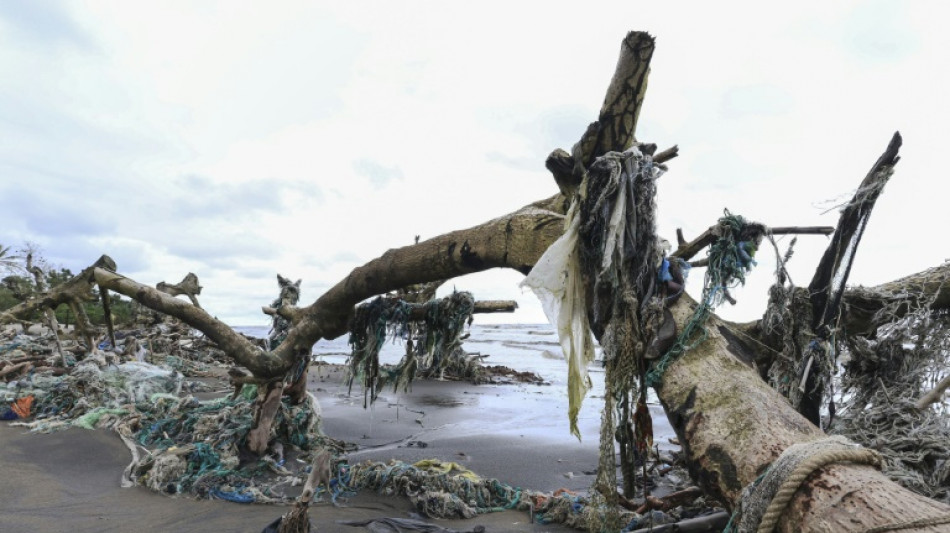
The growing scourge of plastic pollution: in numbers / Photo: © AFP

 Messi and Alcaraz love it, now padel takes step closer to Olympics

 Tolls mount in Thailand, Myanmar floods

 Why India's opposition wants top poll official out

 PU Prime Strengthens UAE Momentum with Strong Showing at Forex Expo Dubai 2026

 Eight dead in Thailand floods since mid-September

 Oil prices spike after Trump rejects Iran truce offer

 Taylor Swift sets new record at MTV VMAs

 Seoul seeks apology after Ukraine reveals transfer of North Korean POWs

 Messi on target again but Miami downed by Columbus

 In Washington's political cauldron, a fight over foie gras

 Flavio Bolsonaro: political heir in his father's shadow

 Ravens grab last-second win in Rio as Commanders stop Seahawks

 USA rallies to capture 11th consecutive Presidents Cup

 Phillies clinch, Astros wrap up division on final day of MLB season

 Commanders hand champion Seahawks their first loss

 Dupont scores twice to send Toulouse top of Top 14

 Ireland beat Israel but no handshakes due to war in Gaza

 Tense standoff over flashpoint N.Ireland parade lasts into night

 Stunned McNulty wins 'miracle' road race world title

 Re-released 'Avengers: Endgame' snaps-up N. America box office lead

 American McNulty wins shock road race world title

 Serbia's President Aleksandar Vucic announces resignation

 Tuchel urges Bellingham to play with 'rage'

 Russian strikes on Ukraine kill 8

 Bavuma, Miller hit centuries as South Africa clinch series

Nations could agree in December on a world-first treaty to reduce the amount of plastic leaking into the environment which, if nothing is done, is forecast to triple by 2060.
How did we get here? And what are the impacts on the environment and the climate?
- Plastic boom -
Global production of synthetic polymers -- which form the building blocks of plastic -- has increased 230-fold since the 1950s, says the Organization for Economic Cooperation and Development (OECD).
Total production doubled between 2000 and 2019 to 460 million tons, faster than commodities like steel, aluminium or cement.
By 2060, if left unchecked, that figure will have almost tripled to 1.2 billion tons, according to the OECD.
The growth in plastic production has mainly occurred in the United States, the Middle East and China.
- Demand -
The Covid-19 pandemic and the economic crises that followed have had two notable -- and opposing -- impacts on plastic consumption.
The first is a surge in consumption of single-use plastics in healthcare, food retail and e-commerce.
The second is a decline in sectors affected by inflation and the global economic downturn such as the automotive and construction industries.
- Trash problem -
The sheer volume of plastic garbage produced around the globe has more than doubled in 20 years, from 156 million tonnes in 2000 to 353 million tonnes in 2019.
It is expected to almost triple to just over one billion tonnes by 2060.
More than two-thirds of this trash is made up of objects with a lifespan of less than five years like plastic packaging, consumer products and textiles.
In 2019, 22 million tonnes of plastic found its way into the environment, including six million tonnes in rivers, lakes and oceans, according to the OECD.
Plastics account for "at least 85 percent of total marine litter", according to the United Nations Environment Programme (UNEP).
The majority of the world's plastic trash is caused by poor waste management, with other lesser sources including littering, the abrasion of car tyres, and microplastics.
By 2060, the OECD predicts the volume of waste in the environment will double to 44 million tonnes, mostly larger plastics but also tiny particles that have been detected in blood and breast milk.
Just nine percent of the world's plastic waste is recycled; 19 percent is burned; and nearly 50 percent ends up in controlled landfills.
The remaining 22 percent is abandoned in illegal dumps, burned in the open air or released into the environment, putting human health at great risk.
- 'It's everywhere' -
The impact on the environment, climate and human health is getting worse, the OECD says.
The plastic that accumulates in the environment is non-biodegradable, takes hundreds of years to decompose and breaks down into tiny microscopic particles.
They "asphyxiate marine species, have a negative impact on soils, poison groundwater", and can have serious repercussions on health, according to UNEP.
"Plastic particles are everywhere, in tap water, in drinking water, in groundwater", adds Greenpeace.
Plastics also bear a significant carbon footprint.
In 2019, plastics generated 1.8 billion tonnes of planet-warming greenhouse gases, or 3.4 percent of the global total, said the OECD and UNEP.
Around 90 percent of these emissions came from the production and processing of plastics, which are derived from crude oil and natural gas, according to the OECD and UNEP.
D.Schneider--BTB



