Not enough time in universe for monkeys to pen Shakespeare: study / Photo: © AFP

 Messi and Alcaraz love it, now padel takes step closer to Olympics

 Tolls mount in Thailand, Myanmar floods

 Why India's opposition wants top poll official out

 PU Prime Strengthens UAE Momentum with Strong Showing at Forex Expo Dubai 2026

 Eight dead in Thailand floods since mid-September
 Oil prices spike after Trump rejects Iran truce offer

 Taylor Swift sets new record at MTV VMAs

 Seoul seeks apology after Ukraine reveals transfer of North Korean POWs

 Messi on target again but Miami downed by Columbus
 In Washington's political cauldron, a fight over foie gras

 Flavio Bolsonaro: political heir in his father's shadow

 Ravens grab last-second win in Rio as Commanders stop Seahawks

 USA rallies to capture 11th consecutive Presidents Cup

 Phillies clinch, Astros wrap up division on final day of MLB season

 Commanders hand champion Seahawks their first loss

 Dupont scores twice to send Toulouse top of Top 14

 Ireland beat Israel but no handshakes due to war in Gaza

 Tense standoff over flashpoint N.Ireland parade lasts into night

 Stunned McNulty wins 'miracle' road race world title

 Re-released 'Avengers: Endgame' snaps-up N. America box office lead

 American McNulty wins shock road race world title

 Serbia's President Aleksandar Vucic announces resignation

 Tuchel urges Bellingham to play with 'rage'

 Russian strikes on Ukraine kill 8

 Bavuma, Miller hit centuries as South Africa clinch series

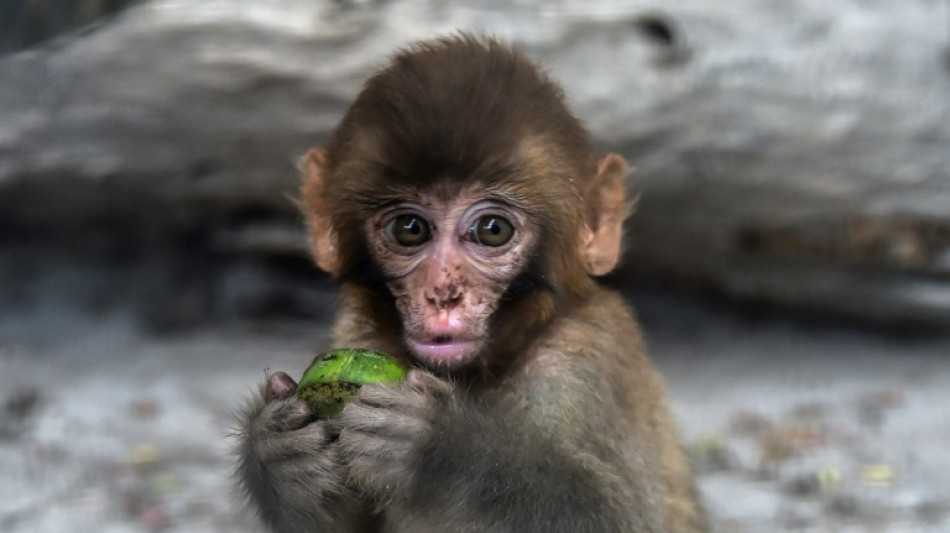
If a monkey types randomly at a keyboard for long enough, it will eventually write the complete works of Shakespeare.
This thought experiment has long been used to express how an infinite amount of time makes something that is incredibly unlikely -- but still technically possible -- become probable.
But two Australian mathematicians have deemed the old adage misleading, working out that even if all the chimpanzees in the world were given the entire lifespan of the universe, they would "almost certainly" never pen the works of the bard.
The "infinite monkey theorem" has been around for more than a century, though its origin remains unclear. It is commonly attributed to either French mathematician Emile Borel or British anthropologist Thomas Huxley, and some even think the general idea dates back to Aristotle.
For a light-hearted but peer-reviewed study published earlier this week, the two mathematicians set out to determine what happens if generous yet finite limits were placed on the monkey typists.
Their calculations were based on a monkey spending around 30 years typing one key a second at a keyboard with 30 keys -- the letters of the English language plus some common punctuation.
The "heat death" of the universe was assumed to take place in around a googol of years -- that is a one followed by 100 zeroes.
Other more practical considerations -- such as what the monkeys would eat, or how they would survive the Sun engulfing Earth in a few billion years -- were set aside.
- Monkey labour falls short -
There was only around a five percent chance that a single monkey would randomly write the word "banana" in their lifetime, according to the study in the journal Franklin Open.
Shakespeare's canon includes 884,647 words -- none of them banana.
To broaden out the experiment, the mathematicians turned to chimpanzees, the closest relative of humans.
There are currently around 200,000 chimps on Earth, and the study presumed this population would remain stable until the end of time.
Even this massive monkey workforce fell very, very short.
"It's not even like one in a million," study co-author Stephen Woodcock of the University of Technology Sydney told New Scientist.
"If every atom in the universe was a universe in itself, it still wouldn't happen."
And even if many more chimps who typed much quicker were added to the equation, it was still not plausible "that monkey labour will ever be a viable tool for developing written works of anything beyond the trivial," the authors wrote in the study.
The study concluded by saying that Shakespeare himself may have inadvertently given an answer as to whether "monkey labour could meaningfully be a replacement for human endeavour as a source of scholarship or creativity".
"To quote Hamlet, Act 3, Scene 3, Line 87: 'No'."
K.Thomson--BTB



