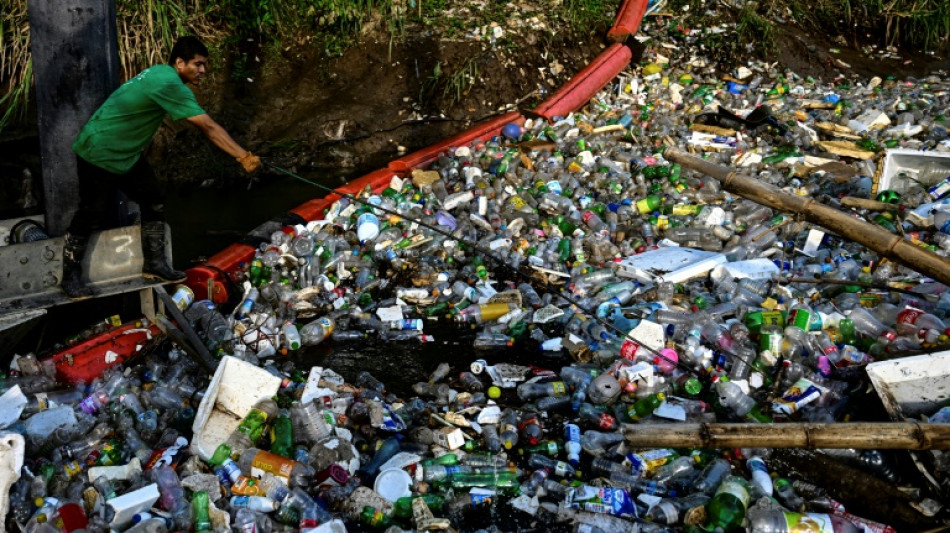
'Moment of truth' for world-first plastic pollution treaty / Photo: © AFP/File

 Nothing to seal here: NZ police help stranded pup home
 White House releases list of products US, China could tax less
 'Pseudo-journalism': Partisan 'news' sites target US midterms

 'Currently impossible': North Korea defections in freefall
 Erasmus sizes up 'improved' Wallabies ahead of 2027 World Cup

 Scandal-weary Brazilians to vote as Lula faces Bolsonaro son
 SpaceX aims to put Starship in orbit for the first time
 Pope to speak on united Europe from French border town

 Scheffler makes sportsmanship stand over tee screamer

 Anthropic CEO Amodei to dine with Trump at White House

 Dupont scores twice to send Toulouse to Top 14 summit

 Greece stun Klopp's Germany as Ireland show sorrow for Gaza

 Ramos fires holders Portugal to Nations League win in Norway

 Greece hand Klopp first defeat as Germany manager

 Pope promises French sex abuse victims to prevent further harm

 UK village on edge over threats to air base in terror alert

 Two giant pandas, emblems of China soft diplomacy, arrive in US

 Aleksandar Vucic: from Milosevic minister to long-serving Serbian statesman

 Trump expects new Iran talks despite rejecting deal offer

 Xavi gets first win as Netherlands boss, Denmark beat Wales

 Madrid housing protest camp enters second night as PM vows action

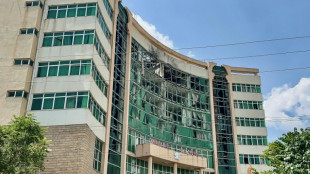 Tigray TV station hit by drone, rebels advance in north Ethiopia

 Banton hundred paves way for England ODI series win over Sri Lanka
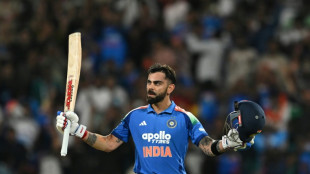 Milestone man Kohli powers India to big ODI win over West Indies

 Swiss reject plan to toughen neutrality

Plastic pollution litters our seas, our air and even our bodies, but negotiators face an uphill battle next week to agree on the world's first treaty aimed at ending the problem.
Countries will have a week in South Korea's Busan from Monday to round off two years of negotiations.
They remain deeply divided on whether the deal should limit plastic production and certain chemicals, and even if the treaty should be adopted by majority vote or consensus.
The talks are a "moment of truth", UN Environment Programme chief Inger Andersen warned this month.
"Busan can and must mark the end of the negotiations," she insisted, in a nod to growing speculation that the process could be extended.
She acknowledged that serious differences remain, urging "more convergence" on the most difficult areas.
"Everyone wants an end to plastic pollution," she said.
"Now it is up to member states to deliver."
There is little dispute about the scale of the problem.
In 2019, the world produced around 460 million tonnes of plastic, a figure that has doubled since 2000, according to the Organisation for Economic Co-operation and Development.
Plastic production is expected to triple by 2060.
- Fault-line -
More than 90 percent of plastic is not recycled, with over 20 million tonnes leaking into the environment, often after just a few minutes of use.
Microplastics have been found in the deepest parts of the ocean, the world's highest mountain peaks and just about every part of the human body.
Plastic also accounts for around three percent of global emissions, mostly linked to its production from fossil fuels.
The main fault-line in talks is where to tackle the problem.
Some countries, including the so-called High Ambition Coalition (HAC) that groups many African, Asian and European nations, want to discuss the entire "lifecycle" of plastics.
That means limiting production, redesigning products for reuse and recycling, and addressing waste.
On the other side are countries, largely oil producers like Saudi Arabia and Russia, who want a downstream focus on waste alone.
The HAC wants binding global targets on reducing production and warned ahead of the Busan talks that "vested interests" should not be allowed to hamper a deal.
The divisions have stymied four previous rounds of talks, producing an unwieldy document of over 70 pages.
The diplomat chairing the talks has produced an alternative document intended to synthesise the views of delegations and move negotiations forward.
- 'Expectations are high' -
It is a more manageable 17 pages, and highlights areas of agreement, including the need to promote reusability.
However, it leaves the thorniest issues largely unaddressed.
A European diplomat, speaking on condition of anonymity, warned the document was "not ambitious enough" on a range of subjects.
The assessment from the Center for International Environmental Law was blunter: "The text would deliver an ineffective and useless treaty and it would fail to adequately address the plastic crisis."
Key to any agreement will be the United States and China, neither of which have openly sided with either bloc.
Earlier this year, Washington raised hopes among environmentalists by signalling support for some limits on production, a position that is reportedly now being rowed back.
The election of Donald Trump has also raised questions about how ambitious the US delegation will be, and whether negotiators should even bother seeking US support if a treaty is unlikely to be ratified by Washington.
Some plastic producers are pushing governments to focus on waste management and reusability, warning production caps would cause "unintended consequences".
But others back a deal with global standards, including on "sustainable" production levels.
"Expectations are high ahead of Busan," said Eirik Lindebjerg, global plastics policy lead at conservation group WWF.
An "overwhelming majority" of countries already back binding rules across the plastic lifecycle, he told AFP.
"It is now up to the leaders of those countries to deliver the treaty the world needs and not let a handful of unwilling countries or industry interests stop this."
O.Bulka--BTB



