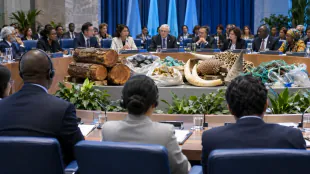
Climate-threatened nations stage protest at COP29 over contentious deal / Photo: © AFP

 China's Factory Activity Contracts as Export Orders Weaken

 US Retail Sales and Fed Minutes Set Up a Critical Test for Consumers

 Oil Heads for Second Weekly Loss as Supply Surplus Emerges
 Four Mainland Universities Join Scheme for Hong Kong DSE Admissions from 2027
 Canada Signals Openness to Chinese Automakers if US Trade Talks Fail

 Canada Expands Asian Trade Push as US Negotiations Resume

 US Jobless Claims Rise to 200,000 but Layoffs Remain Historically Low

 Euro-Area Growth Slows to 0.4% While Employment Stalls
 US Wholesale Inflation Eases Monthly but Hits a Four-Year Annual High
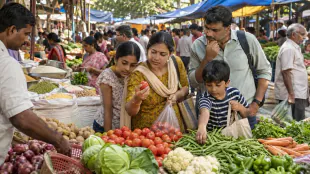
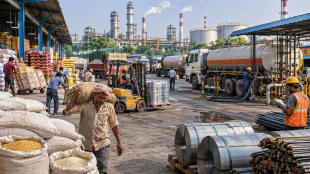 India's Wholesale Inflation Jumps to 12.29% as Fuel Costs Surge
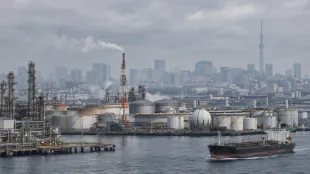 Japan's Economy Edges Into Contraction as Costly Oil Weighs on Demand

 Helen Haines Discharged from Hospital Following Attack That Cost Her Both Legs

 River Medway Reveals Financial Struggles Before 'Drag Race' Windfall

 OBI Pharma Signs Collaboration and License Agreement with Novartis
The world's most climate-imperilled nations stormed out of consultations in protest at the deadlocked UN COP29 conference Saturday, as simmering tensions over a hard-fought finance deal erupted into the open.
Diplomats from small island nations threatened by rising seas and impoverished African states angrily filed out of a meeting with summit hosts Azerbaijan over a final deal being thrashed out in a Baku sports stadium.
"We've just walked out. We came here to this COP for a fair deal. We feel that we haven't been heard," said Cedric Schuster, the Samoan chairman of the Alliance of Small Island States (AOSIS).
An unpublished version of the final text circulating in Baku, and seen by AFP, proposes that rich nations raise to $300 billion a year by 2035 their commitment to poorer countries to fight climate change.
COP29 hosts Azerbaijan intended to put a final draft before 198 nations for adoption or rejection on Saturday evening, a full day after the marathon summit officially ended.
But, in a statement, AOSIS said it had "removed" itself from the climate finance discussions, demanding an "inclusive" process.
"If this cannot be the case, it becomes very difficult for us to continue our involvement here at COP29," it said.
Sierra Leone's climate minister Jiwoh Abdulai, whose country is among the world's poorest, said the draft was "effectively a suicide pact for the rest of the world".
An earlier offer from rich nations of $250 billion was slammed as offensively low by developing countries, who have demanded much higher sums to build resilience against climate change and cut emissions.
UK Energy Secretary Ed Miliband said the revised offer of $300 billion was "a significant scaling up" of the existing pledge by developed nations, which also count the United States, European Union and Japan among their ranks.
At sunset, a final text still proved elusive, as harried diplomats ran to-and-fro in the stadium near the Caspian Sea searching for common ground.
"Hopefully this is the storm before the calm," said US climate envoy John Podesta in the corridors as somebody shouted "shame" in his direction.
Earlier, the EU's climate commissioner Wopke Hoekstra said negotiators were not out of the woods yet.
"We're doing everything we can on each of the axes to build bridges and to make this into a success. But it is iffy whether we will succeed," he said.
- 'Ripped off' -
Ali Mohamed, the Kenyan chair of the African Group of Negotiators, told AFP: "No deal is better than a bad deal."
"What we are not up for is going backwards or standing still," he said. "We might as well just have stayed at home then."
The revised offer from rich countries came with conditions in other parts of the broader climate deal under discussion in Azerbaijan.
The EU in particular wants an annual review on global efforts to phase out fossil fuels, which are the main drivers of global warming.
This has run into opposition from Saudi Arabia, which has sought to water down a landmark pledge to transition away from oil, gas and coal made at COP28 last year.
"We will not allow the most vulnerable, especially the small island states, to be ripped off by the new, few rich fossil fuel emitters," said German Foreign Minister Annalena Baerbock.
Wealthy nations counter that it is politically unrealistic to expect more in direct government funding.
The US earlier this month elected former president Donald Trump, a sceptic of both climate change and foreign assistance, and a number of other Western countries have seen right-wing backlashes against the green agenda.
A coalition of more than 300 activist groups accused historic polluters most responsible for climate change of skirting their obligation, and urged developing nations to stand firm.
The draft deal posits a larger overall target of $1.3 trillion per year to cope with rising temperatures and disasters, but most would come from private sources.
Even $300 billion would be a step up from the $100 billion now provided by wealthy nations under a commitment set to expire.
A group of developing countries had demanded at least $500 billion, with some saying that increases were less than met the eye due to inflation.
Experts commissioned by the United Nations to assess the needs of developing countries said $250 billion was "too low" and by 2035 rich nations should be providing at least $390 billion.
The US and EU have wanted newly wealthy emerging economies like China -- the world's largest emitter -- to chip in.
China, which remains classified as a developing nation under the UN framework, provides climate assistance but wants to keep doing so on its own voluntary terms.
M.Odermatt--BTB