US 'disappointed' after plastic pollution talks collapse: White House / Photo: © AFP

 Brazil Faces Debt and Inflation Test as Lula Prepares Fourth Term
 Chinese Drug Ribupatide Shows Greater Weight Loss Than Wegovy in Clinical Trial
 US Mortgage Rate Falls for Fourth Week but Remains Above 7%

 Italy Raises 2026 Growth View but Warns Energy Will Keep Inflation High

 UK Economy Grows 0.7% in Third Quarter as Services Lead Expansion
 India's Retail Inflation Reaches 6.09% as Food Prices Accelerate
 China's October Activity Data Reveal a Weak Start to the Fourth Quarter
 Thomas Tuchel Refuses to Name England Number One Goalkeeper After James Trafford's Display

 Qatar's Amir and Venezuelan Acting President Discuss Energy Cooperation

 Russell Brand’s Wife Reads Prison Letter Denying Guilt; Fellow Inmate Questions Faith

 Alouettes and Elks Set for 113th Grey Cup Showdown
The US government said Tuesday it was "disappointed" after nations negotiating a global treaty to curb plastic waste failed to reach a deal, blaming a "small group" of countries and producers for blocking progress.
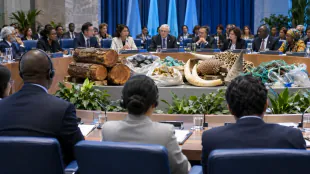
Delegates from nearly 200 nations debated for a week in South Korea on how to stop millions of tonnes of plastic waste from entering the environment each year.
The talks were meant to end with the world's first accord on cutting plastic pollution after nearly two years of discussions, but concluded without an agreement -- except to extend talks.
"The United States is disappointed in the lack of a legally binding international agreement fit to meet the moment on addressing plastic pollution," National Security Council spokesman Sean Savett said in a statement on Tuesday.
"A small group of countries and producers stood in the way of progress to protect their profits and perpetuate an inadequate status quo," it said.
Plastic pollution is so ubiquitous that microplastics have been found on the highest mountain peak, in the deepest ocean trench and scattered throughout almost every part of the human body.
Delegations seeking an ambitious treaty earlier warned that a handful of countries was steadfastly blocking progress.
A draft text released Sunday afternoon after multiple delays included a wide range of options, reflecting ongoing disagreement.
The talks' chair Luis Vayas Valdivieso said late Sunday that more time was needed for negotiations.
Countries including oil-producing nations like Russia and Saudi Arabia have pushed back against curbs on production of plastics.
Iran said there was a "huge gap" between parties, while Russia warned that agreeing on a treaty was "being hampered by ambitions on the part of certain parties that are too high."
Divisions between nations are so deep that they have not yet agreed on how any decision will be adopted -- by consensus or majority vote.
Environmental groups have warned that another round of talks could be similarly hamstrung if ambitious countries were not willing to push for a vote.
The world's top two plastic producers -- China and the United States -- have stayed relatively quiet about their positions in public.
H.Seidel--BTB