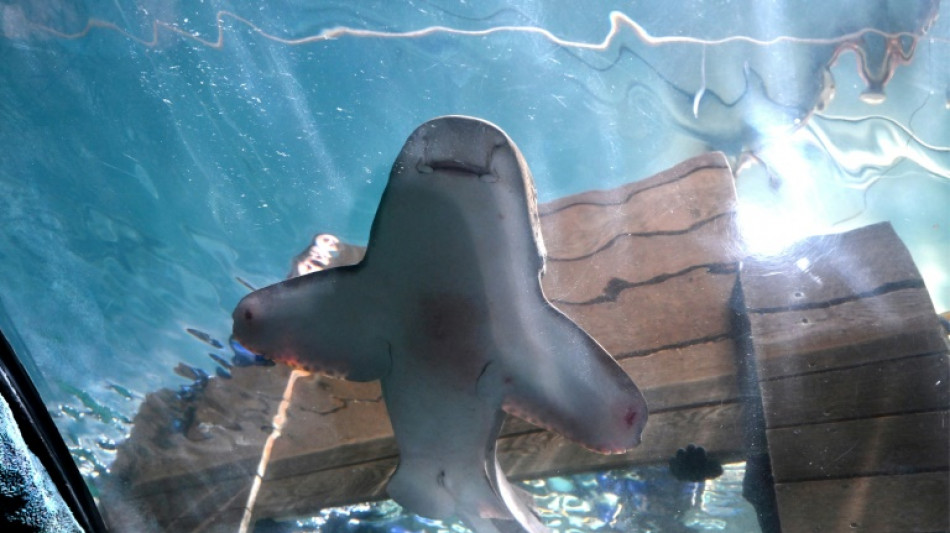
Scientists artificially inseminate leopard sharks to boost diversity / Photo: © AFP

 Oil prices spike after Trump rejects Iran truce offer

 Taylor Swift sets new record at MTV VMAs

 Seoul seeks apology after Ukraine reveals transfer of North Korean POWs

 Messi on target again but Miami downed by Columbus

 In Washington's political cauldron, a fight over foie gras

 Flavio Bolsonaro: political heir in his father's shadow

 Ravens grab last-second win in Rio as Commanders stop Seahawks

 USA rallies to capture 11th consecutive Presidents Cup

 Phillies clinch, Astros wrap up division on final day of MLB season

 Commanders hand champion Seahawks their first loss

 Dupont scores twice to send Toulouse top of Top 14

 Ireland beat Israel but no handshakes due to war in Gaza

 Tense standoff over flashpoint N.Ireland parade lasts into night

 Stunned McNulty wins 'miracle' road race world title

 Re-released 'Avengers: Endgame' snaps-up N. America box office lead

 American McNulty wins shock road race world title

 Serbia's President Aleksandar Vucic announces resignation

 Tuchel urges Bellingham to play with 'rage'

 Russian strikes on Ukraine kill 8

 Bavuma, Miller hit centuries as South Africa clinch series

 Spain bring in Le Normand for injured Garcia

 UK Labour party meets buoyed by Burnham but seeking concrete plans

 Nor'easter lashes US east with punishing rain and wind

 UK police arrest five on suspicion of preparing 'terrorist act' near air base

 Washington denounces Iran's truce proposal as 'cynical'

A black-and-cream leopard shark enters a hypnotic-like state of relaxation as scientists at Sydney Aquarium carefully roll her onto her back in a small pool.
The shark, named Zimba, is one of the first captive leopard sharks in the world to be artificially inseminated with the sperm of wild sharks in an attempt to build populations around the world.
If the process is successful, Zimba's shark pups will be sent to the Raja Ampat region in Indonesia, where the local population is on the brink of extinction due to unsustainable fishing practices and habitat destruction.
Artificial insemination allows sharks that would never normally interact to breed and increase genetic diversity, said SEA LIFE Australia and New Zealand regional coordinator Laura Simmons.
Simmons hopes that eventually the leopard shark population will be "genetically viable and capable of maintaining a self-sustaining population in the wild".
That could take years, she told AFP, but "this is one step closer to where we need to be".
The procedure is one part of a larger worldwide leopard shark breeding programme, known as StAR, that involves more than 60 conservation groups, aquariums and government agencies.
Globally, about 37 percent of oceanic shark and ray species, including the leopard shark, are now listed as either endangered or critically endangered by the International Union for Conservation of Nature, a global database for threatened species.
- 'Species belongs outside' -
Australia's leopard shark populations remain plentiful and of least concern, and scientists hope they can help bolster the numbers in other regions.
Back at the Sydney Aquarium pool, Ocean Park Hong Kong's chief veterinarian Paolo Martelli inserts a metal tube filled with the sperm of wild leopard sharks into Zimba's underside.
The shark is still in a natural state called tonic immobility -- a relaxed condition that allows scientists to work without getting injured.
The whole process takes a matter of minutes and everyone claps and cheers once it is over. Zimba is flipped back onto her stomach and swims around the pool as if nothing happened.
Martelli is using a technique he developed and has successfully used on other species, but this is the first time it has been used on leopard sharks.
"It's not straightforward," he said.
Martelli and his team collected the sperm of wild leopard sharks off the coast of Queensland -- which has a large shark population -- and brought the precious cargo to Sydney.
Only three of four samples taken survived the journey.
"This species belongs in outside habitats, not in a museum," Martelli said.
But as the shark's habitat declines, scientists must give a "helping hand" in protecting and conserving this valuable species, he added.
"It is safe to say that sharks have suffered a lot in the last century."
T.Bondarenko--BTB



