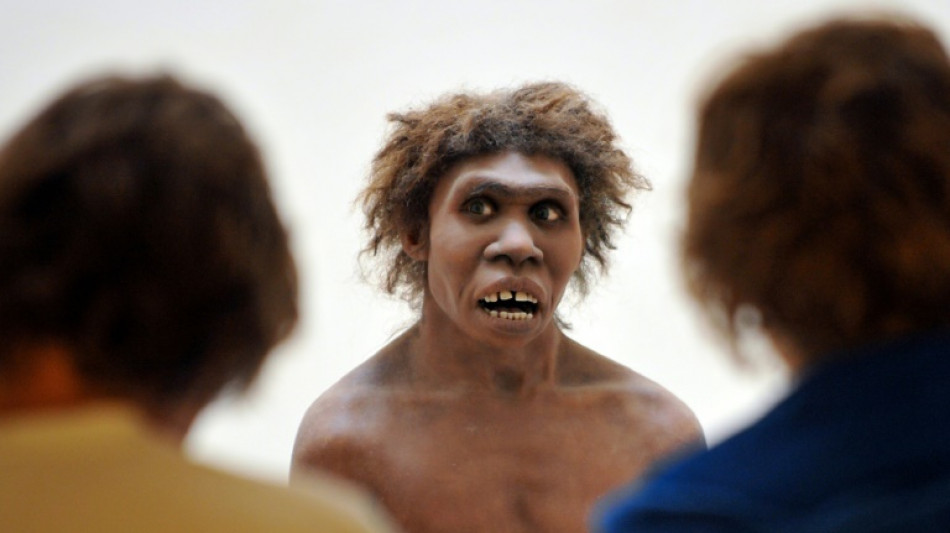
Homo erectus, not sapiens, first humans to survive desert: study / Photo: © AFP/File

 Oil prices spike after Trump rejects Iran truce offer

 Taylor Swift sets new record at MTV VMAs
 Seoul seeks apology after Ukraine reveals transfer of North Korean POWs

 Messi on target again but Miami downed by Columbus

 In Washington's political cauldron, a fight over foie gras

 Flavio Bolsonaro: political heir in his father's shadow

 Ravens grab last-second win in Rio as Commanders stop Seahawks

 USA rallies to capture 11th consecutive Presidents Cup

 Phillies clinch, Astros wrap up division on final day of MLB season

 Commanders hand champion Seahawks their first loss

 Dupont scores twice to send Toulouse top of Top 14

 Ireland beat Israel but no handshakes due to war in Gaza

 Tense standoff over flashpoint N.Ireland parade lasts into night

 Stunned McNulty wins 'miracle' road race world title

 Re-released 'Avengers: Endgame' snaps-up N. America box office lead

 American McNulty wins shock road race world title

 Serbia's President Aleksandar Vucic announces resignation

 Tuchel urges Bellingham to play with 'rage'

 Russian strikes on Ukraine kill 8

 Bavuma, Miller hit centuries as South Africa clinch series

 Spain bring in Le Normand for injured Garcia

 UK Labour party meets buoyed by Burnham but seeking concrete plans

 Nor'easter lashes US east with punishing rain and wind

 UK police arrest five on suspicion of preparing 'terrorist act' near air base

 Washington denounces Iran's truce proposal as 'cynical'

Our ancestor Homo erectus was able to survive punishingly hot and dry desert more than a million years ago, according to a new study that casts doubt on the idea that Homo sapiens were the first humans capable of living in such hostile terrain.
The moment when the first members of the extended human family called hominins adapted to life in desert or tropical forests marks "a turning point in the history of human survival and expansion in extreme environments," lead study author Julio Mercader Florin of the University of Calgary told AFP.
Scientists have long thought that only Homo sapiens, who first appeared around 300,000 years ago, were capable of living sustainably in such inhospitable regions.
The first hominins to have split off from the other great apes were believed to be limited to less hostile ecosystems, such as forest, grasslands and wetlands.
One of the world's most important prehistoric sites, Olduvai Gorge in modern-day Tanzania, was thought to home to those easier types of landscapes.
But this steep ravine in East Africa's Great Rift Valley, which has played a key role in the understanding of human evolution, was actually a desert steppe, according to the study published in the journal Communications Earth & Environment on Thursday.
After collecting archaeological, geological and palaeoclimatic data, the international team of researchers were able to reconstruct the gorge's ecosystem over the years.
Fossilised pollen of the Ephedra shrub -- which commonly lives in arid areas -- as well as traces of past wildfires and signs in the soil show there was an extreme drought in the area between one and 1.2 million years ago.
- Homo erectus: underestimated? -
Evidence collected from the Engaji Nanyori site in the gorge suggests that Homo erectus adapted to this hostile environment "by focusing on ecological focal points such as river confluences where water and food resources were more predictable", Mercader Florin said.
"Their ability to repeatedly exploit these focal points... and adapt their behaviours to extreme environments demonstrates a higher level of resilience and strategic planning than previously assumed."
Specialised tools found at the site, such as hand axes, scrapers and cleavers, showed that Homo erectus had also worked out how to process animal carcasses.
The bones of animals such as cows, hippopotamuses, crocodiles and antelopes also had cut marks, indicating they had been skinned and had their bone marrow extracted.
"This suggests they optimised their resource use to adapt to the challenges of arid environments, where resources were scarce and needed to be exploited fully," Mercader Florin said.
"Our findings show that Homo erectus was capable of surviving long term in extreme environments characterised by low density of food resources, navigational challenges, very low/very high plant life, temperature/humidity extremes, and the need for high mobility," he added.
"This adaptability expands Homo erectus's potential range into the Saharo-Sindian region across Africa and into similar environments in Asia."
O.Lorenz--BTB



