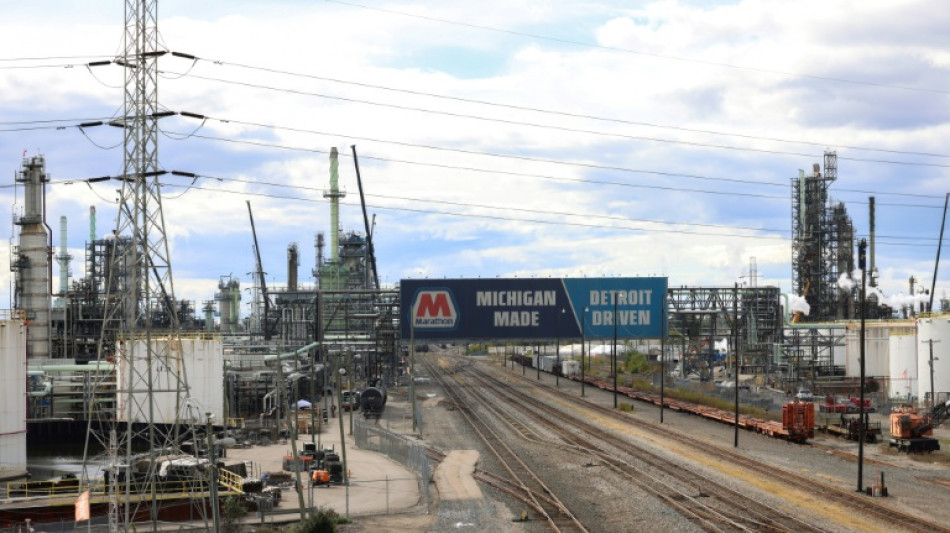
Trump push to 'drill, baby, drill' may hit industry roadblock / Photo: © AFP

 Messi on target again but Miami downed by Columbus

 In Washington's political cauldron, a fight over foie gras

 Flavio Bolsonaro: political heir in his father's shadow

 Ravens grab last-second win in Rio as Commanders stop Seahawks

 USA rallies to capture 11th consecutive Presidents Cup

 Phillies clinch, Astros wrap up division on final day of MLB season

 Commanders hand champion Seahawks their first loss

 Dupont scores twice to send Toulouse top of Top 14

 Ireland beat Israel but no handshakes due to war in Gaza

 Tense standoff over flashpoint N.Ireland parade lasts into night

 Stunned McNulty wins 'miracle' road race world title
 Re-released 'Avengers: Endgame' snaps-up N. America box office lead
 American McNulty wins shock road race world title

 Serbia's President Aleksandar Vucic announces resignation

 Tuchel urges Bellingham to play with 'rage'

 Russian strikes on Ukraine kill 8

 Bavuma, Miller hit centuries as South Africa clinch series

 Spain bring in Le Normand for injured Garcia

 UK Labour party meets buoyed by Burnham but seeking concrete plans

 Nor'easter lashes US east with punishing rain and wind

 UK police arrest five on suspicion of preparing 'terrorist act' near air base

 Washington denounces Iran's truce proposal as 'cynical'

 Armani sprinkles glitter on discreet elegance at Milan show

 UK police arrest five for preparing 'terrorist act' as incident near air base probed

 อเล็กซ์ โบดี และศาสตราจารย์ ดร. ดีเทอร์ ลาซิก ลงนามสัญญาสำหรับ ALPHA WHEY และ BODI เครื่องดื่มให้พลังงาน

President Donald Trump wants to boost US oil production, pledging to bring costs down as he returned to office this week -- but analysts warn his efforts could be hampered by the industry itself.
Taking aim at an "inflation crisis" which he said was driven by rising energy prices, Trump vowed: "Today I will also declare a national energy emergency. We will drill, baby, drill."
"We will be a rich nation again. And it is that liquid gold under our feet that will help to do it," he pledged in his inaugural address on Monday.
While the United States is the world's leading crude oil producer, the US president wants to boost oil and gas production to lower costs, fill strategic reserves and "export American energy all over the world."
In declaring a national energy emergency, Trump reversed some drilling bans, including in a protected area in Alaska.
"It's hard to reconcile the notion that we have an energy emergency, when the US produced 13.2 million barrels per day of crude oil in 2024," said analyst Stewart Glickman of CFRA.
This was "more than any other country."
The US Energy Information Administration also estimates that US production will hit 13.5 million barrels a day this year, "which would imply yet another annual record," Glickman told AFP.
- Economic interest -
But analysts say the prospect of oversupply and worries about global demand currently could make US producers reluctant to step on the accelerator -- to prevent crude prices from falling too much.
US oil companies will likely "act in their own interest" economically, and drill when they expect it to be profitable, said Andrew Lipow, president of Lipow Oil Associates.
That will depend on the price of oil, he added, alongside the return on capital.
Some oil majors are already cautious about global supply.
"We are seeing record levels of demand for oil, record levels for demand for products coming out of our refineries," said ExxonMobil CEO Darren Woods on CNBC in November.
"But we also see a lot of supply in the world right now," he said, adding that much of it comes from the United States.
Woods recounted how, after the merger of Exxon and Mobil in 1999, the group owned 45 refineries.
But when he took the helm in 2017, it only had 22 refineries, he told CNBC.
Trump's strategy has also puzzled analysts considering the Organization of the Petroleum Exporting Countries and its allies (OPEC+) has 5.8 million barrels per day of unused capacity, said Robert Yawger of Mizuho Americas.
Eight members of OPEC+, including Saudi Arabia and Russia, have planned to gradually reverse production cuts of 2.2 million barrels per day since last year.
- Profitability -
The new US administration "has to justify increases in production by the bottom line. It has to be cost-effective," said Yawger.
"They're not going to repeat the problem that we've done in the past, and that's just oversupply the market and kill the golden goose," he added.
The emergence of shale oil and gas at the turn of the 2010s disrupted the American oil industry.
Concerned about the rise of the United States, Saudi Arabia decided to retaliate by flooding the oil market, causing the price of a barrel of West Texas Intermediate (WTI), the American benchmark, to fall to $26 in 2016.
A part of the shale oil industry shuttered, and surviving players vowed to manage their growth and finances more effectively.
"Misguided, irrational energy policies are done," said Jeff Eshelman, president of the Independent Petroleum Association of America, said in response to Trump's announcements.
"America's vast resources will be unleashed responsibly," he added.
S.Keller--BTB



