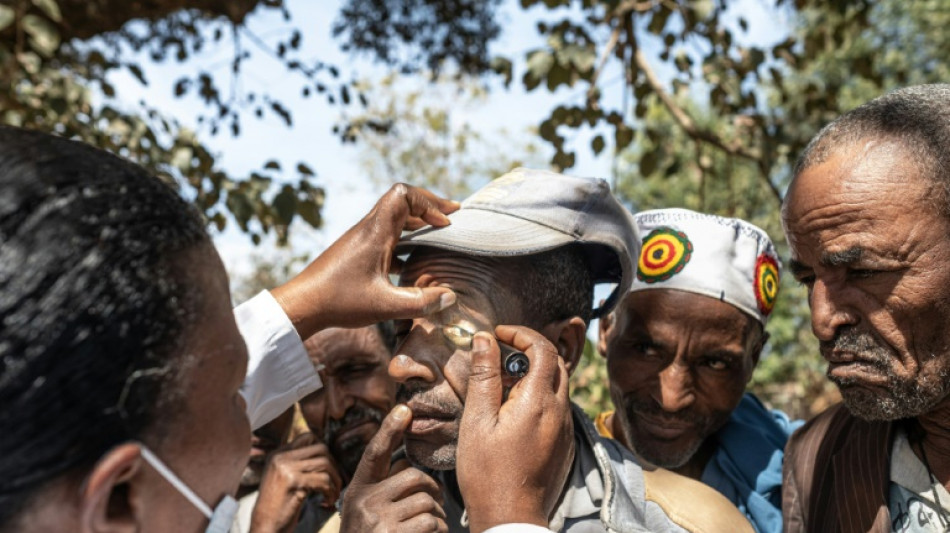
'I rip out my lashes to ease pain': Eye disease afflicts Ethiopia / Photo: © AFP

 Messi on target again but Miami downed by Columbus

 In Washington's political cauldron, a fight over foie gras
 Flavio Bolsonaro: political heir in his father's shadow
 Ravens grab last-second win in Rio as Commanders stop Seahawks

 USA rallies to capture 11th consecutive Presidents Cup

 Phillies clinch, Astros wrap up division on final day of MLB season

 Commanders hand champion Seahawks their first loss

 Dupont scores twice to send Toulouse top of Top 14

 Ireland beat Israel but no handshakes due to war in Gaza

 Tense standoff over flashpoint N.Ireland parade lasts into night

 Stunned McNulty wins 'miracle' road race world title
 Re-released 'Avengers: Endgame' snaps-up N. America box office lead

 American McNulty wins shock road race world title

 Serbia's President Aleksandar Vucic announces resignation

 Tuchel urges Bellingham to play with 'rage'

 Russian strikes on Ukraine kill 8
 Bavuma, Miller hit centuries as South Africa clinch series
 Spain bring in Le Normand for injured Garcia
 UK Labour party meets buoyed by Burnham but seeking concrete plans

 Nor'easter lashes US east with punishing rain and wind

 UK police arrest five on suspicion of preparing 'terrorist act' near air base
 Washington denounces Iran's truce proposal as 'cynical'

 Armani sprinkles glitter on discreet elegance at Milan show

 UK police arrest five for preparing 'terrorist act' as incident near air base probed
 อเล็กซ์ โบดี และศาสตราจารย์ ดร. ดีเทอร์ ลาซิก ลงนามสัญญาสำหรับ ALPHA WHEY และ BODI เครื่องดื่มให้พลังงาน

Scheicho Scheifa is haunted by the fear of going blind.
A disease called trachoma has turned his eyelids inwards, causing his eyelashes to scar his corneas so badly that one has already turned opaque.
The 35-year-old farmer and baker, who blinks frequently and suffers in sunshine, said the pain is so fierce he has now "stopped working entirely".
He has been mostly bound to his home in the small village of Asano, around 100 kilometres (60 miles) from Ethiopia's capital, Addis Ababa.
"Recently, I learned that the surface of my eye is wounded, and the left eye is severely damaged. The pain affects my ability to work and perform daily tasks," the father-of-two told AFP.
"Each time it flares up, I rip out my lashes to ease the pain," he added.
"The fear of going blind worries me whenever the pain strikes."
Trachoma is caused by infection with the bacterium Chlamydia trachomatis, which is spread through contact with the eyes or nose of infected people.
Flies that have touched infected people's eyes or noses can also transmit the disease.
- Two million blinded -
Women are blinded up to four times as often as men -- normally between the ages of 30 to 40 -- most likely because they are in more regular contact with children, the main reservoir of the disease.
According to the World Health Organization (WHO), trachoma is "hyperendemic in many of the poorest and most rural areas" of the world, and Africa is the most affected continent.
Around 103 million people worldwide live in the endemic areas for the disease, nearly half in Ethiopia.
Despite being in pain since childhood, Scheicho was initially reticent to undergo surgery -- which involves cutting into his eyelids and rotating the eyelashes away from his cornea -- since this had not improved his mother's condition.
He was finally convinced by Gizachew Abebe, an ophthalmologist and member of the Germany-based charity Christian Blind Mission.
The NGO has sought to inform "the community and patients to take care of their personal hygiene... a very important point to prevent trachoma", Gizachew said.
"You need to wash your face with clean water," he told a gathering of dozens of people in a small village near Asano.
That is not easy for this rural community, which is a three-hour walk to the nearest river and shares water with livestock.
- 'Hard to cut' -
The charity is working on improving access to clean water, and uses loudspeakers in markets in Butajira, the region's biggest town, to urge people to get tested for trachoma.
The least advanced cases can be treated with antibiotics or creams but more serious cases like Scheicho's require surgery.
He finally went under the knife in a small health centre without electricity in Asano, during AFP's visit.
After administering a local anaesthetic, Sister Tadelech made an incision on his upper eyelid.
"It is hard to cut," the ophthalmologist said.
But half an hour later, the operation was successfully completed.
"I feel better," a groggy Scheicho managed afterwards.
By the end of last year, 21 countries including Togo and Ghana, had eliminated trachoma as a public health problem, according to the WHO.
In Ethiopia, it could be possible to minimise the disease but "we will not eradicate" it until "people's standard of living" improves, Gizachew said.
M.Ouellet--BTB



