First major chunk breaks off world's biggest iceberg / Photo: © NASA/AFP

 Messi on target again but Miami downed by Columbus

 In Washington's political cauldron, a fight over foie gras

 Flavio Bolsonaro: political heir in his father's shadow

 Ravens grab last-second win in Rio as Commanders stop Seahawks

 USA rallies to capture 11th consecutive Presidents Cup

 Phillies clinch, Astros wrap up division on final day of MLB season

 Commanders hand champion Seahawks their first loss

 Dupont scores twice to send Toulouse top of Top 14

 Ireland beat Israel but no handshakes due to war in Gaza

 Tense standoff over flashpoint N.Ireland parade lasts into night

 Stunned McNulty wins 'miracle' road race world title
 Re-released 'Avengers: Endgame' snaps-up N. America box office lead

 American McNulty wins shock road race world title

 Serbia's President Aleksandar Vucic announces resignation

 Tuchel urges Bellingham to play with 'rage'

 Russian strikes on Ukraine kill 8

 Bavuma, Miller hit centuries as South Africa clinch series

 Spain bring in Le Normand for injured Garcia

 UK Labour party meets buoyed by Burnham but seeking concrete plans

 Nor'easter lashes US east with punishing rain and wind

 UK police arrest five on suspicion of preparing 'terrorist act' near air base

 Washington denounces Iran's truce proposal as 'cynical'

 Armani sprinkles glitter on discreet elegance at Milan show

 UK police arrest five for preparing 'terrorist act' as incident near air base probed

 อเล็กซ์ โบดี และศาสตราจารย์ ดร. ดีเทอร์ ลาซิก ลงนามสัญญาสำหรับ ALPHA WHEY และ BODI เครื่องดื่มให้พลังงาน

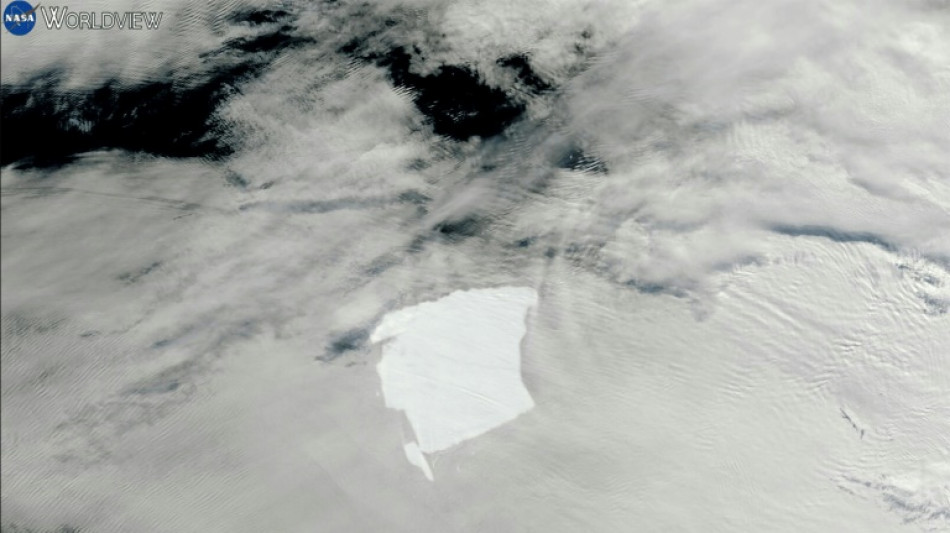
An enormous chunk has broken off the world's largest iceberg, in a possible first sign the behemoth from Antarctica could be crumbling, scientists told AFP on Friday.
The colossal iceberg -- which is more than twice the size of Greater London and weighs nearly one trillion tonnes -- had largely stayed intact since it started slowly moving north in 2020.
It has been drifting toward the remote island of South Georgia in the South Atlantic, raising the prospect it could run aground in shallower water and disrupt feeding for baby penguins and seals.
But a chunk about 19 kilometres (12 miles) long has cleaved off, said Andrew Meijers from the British Antarctic Survey, who encountered the iceberg in late 2023 and has tracked its fate via satellite ever since.
"This is definitely the first significant clear slice of the iceberg that's appeared," the physical oceanographer told AFP.
Soledad Tiranti, a glaciologist currently on an Argentinian exploration voyage in the Antarctic, also told AFP that a section had "broken" away.
The jagged piece has an area of roughly 80 square kilometres (31 square miles) -- huge in its own right, but just a fraction of the approximately 3360 square kilometres that remained.
Meijers said icebergs were full of deep fractures, and although this monumental specimen had shrunk over time and lost a much smaller piece, it had "held together pretty nicely".
"This is a sign that those rifts in it are starting to break up," he said.
In the past, other mega-icebergs had fallen apart "relatively quickly over the course of several weeks" once they started losing big pieces, he said.
It was hard to say if this was "a loose tooth just waiting to come out" or evidence of a much bigger change underway.
"I'm sorry to say but it's not really an exact science how these things fall apart... it's really hard to say if this is going to blow apart now, or it's going to hang together for longer," Meijers said.
Known as A23a, the world's biggest and oldest iceberg calved from the Antarctic shelf in 1986.
It remained stuck for over 30 years before finally breaking free in 2020, its lumbering journey north sometimes delayed by ocean forces that kept it spinning in place.
This monster block of freshwater was being whisked along by the world's most powerful ocean "jet stream" -- the Antarctic Circumpolar Current.
Meijers said its trajectory toward South Georgia, a crucial feeding ground for seals and penguins, would unlikely change because it had lost this chunk.
But should it collapse further it would pose "much less of a threat for wildlife" because foraging animals could manoeuvre unimpeded between the smaller chunks to find food, he added.
Icebergs had grounded there in the past and caused significant mortality to penguin chicks and seal pups.
Tiranti said the iceberg was expected to keep plodding its way north but its exact course depended greatly on how local currents influenced its movements.
burs-np/yad
K.Thomson--BTB