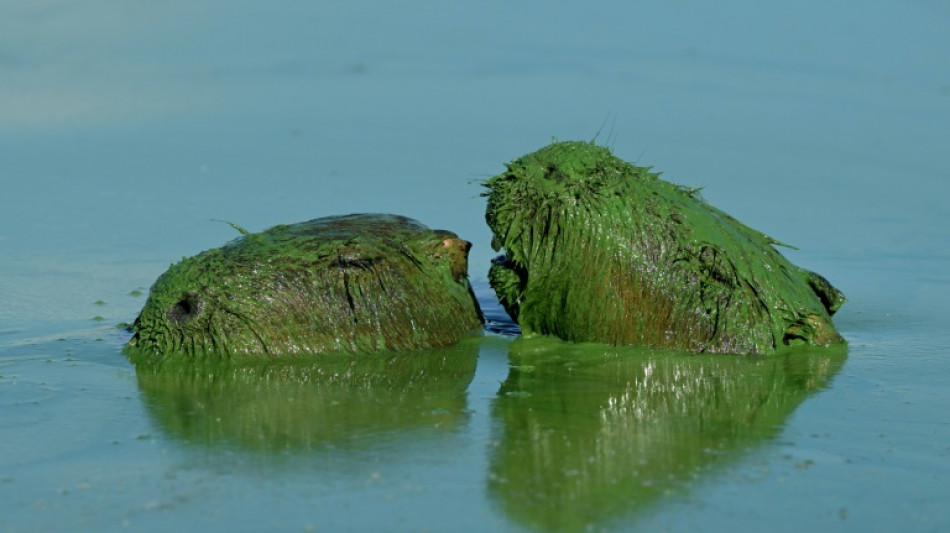
Argentina's giant rodents dyed Hulk green by algae / Photo: © AFP

 How to Watch the Rugby League World Cup Final on 7plus for Free

 Kayla Harrison Defeats Amanda Nunes via Submission at UFC 334

 GTA 6 Advertising Strategy and Disc Version Controversy

 From First Date to Wedding Day: How a TV Quote Sparked a Lifetime Commitment

 Malta Stuns Sweden with Late Penalty Comeback in Rugby Europe Trophy

 BingX: Major Announcement of Far-Reaching Significance

 Élan Opens as Late-Night Wine Bar in Honolulu

First a river ran blood red. Now Argentina's beloved giant rodent, the capybara, has been coated in Hulk-green slime as pollution turns the country's waterways traffic light colours.
The capybara, also known as a carpincho or chiguire, is the world's largest rodent, measuring up to 1.35 meters (4 feet four inches) in length and weighing up to 80 kilograms (176 pounds).
An AFP photographer snapped several of the tufty creatures that had been stained pea green along the Uruguay River north of Buenos Aires on Thursday where a rotten smell hangs in the air and dead fish lay strewn on the banks.
Each year, bacteria cause a thick greenish layer to coat the shores around the Salto Grande hydroelectric dam, on Argentina's border with Uruguay. The phenomenon has increased in intensity in recent years.
These cyanobacteria "are photosynthetic organisms that perform an important function in the ecosystem," Diego Frau, a biologist at the National Institute of Limnology told AFP.
But in high concentrations they can be destructive and toxic, he said.
High temperatures and high levels of nutrients in the water, partly driven by livestock farming, causes the algae to spread.
Climate change is causing the green tide, which can last for several weeks, to become "increasingly recurrent," damaging ecosystems, he said.
In people, mild exposure to the bacteria can cause skin conditions or "flu-like symptoms" such as diarrhea, vomiting and headaches, Martin Novoa, a biologist at the Faculty of Food Sciences at the National University of Entre Rios, told AFP.
Prolonged exposure can lead to liver and nervous system complications, he added.
At least 15 municipalities in Buenos Aires province have issued health alerts over the bacteria.
The outbreak comes a week after a stream running through a town near Buenos Aires turned blood red and emitted a foul smell.
The stream flows through an area of textile and hide processing factories.
Residents accused factories of dumping waste in the river.
Environmental officials are studying the cause of the discoloration, which lasted a few hours.
O.Bulka--BTB