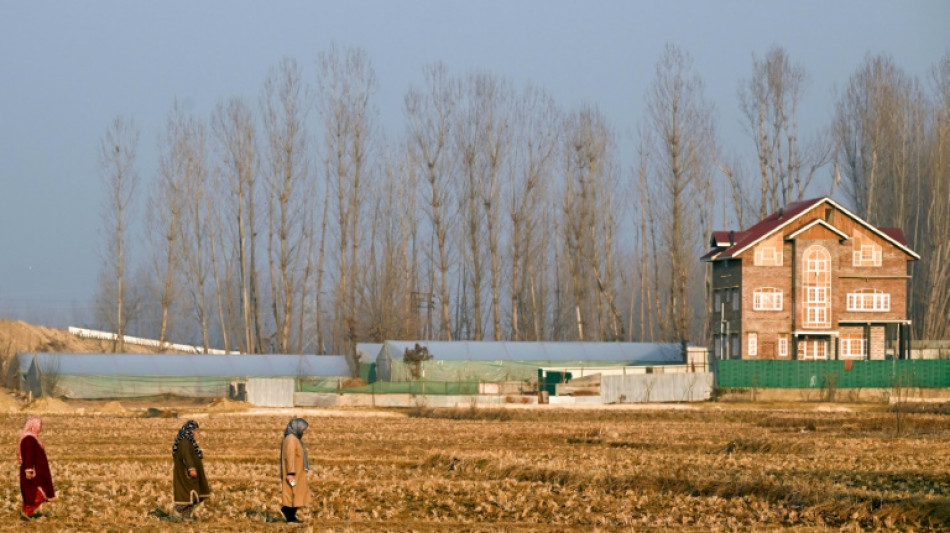
India's infrastructure push engulfs Kashmir farmers' land / Photo: © AFP

 Scheffler makes sportsmanship stand over tee screamer

 Anthropic CEO Amodei to dine with Trump at White House

 Dupont scores twice to send Toulouse to Top 14 summit

 Greece stun Klopp's Germany as Ireland show sorrow for Gaza

 Ramos fires holders Portugal to Nations League win in Norway

 Greece hand Klopp first defeat as Germany manager

 Pope promises French sex abuse victims to prevent further harm

 UK village on edge over threats to air base in terror alert

 Two giant pandas, emblems of China soft diplomacy, arrive in US

 Aleksandar Vucic: from Milosevic minister to long-serving Serbian statesman

 Trump expects new Iran talks despite rejecting deal offer

 Xavi gets first win as Netherlands boss, Denmark beat Wales

 Madrid housing protest camp enters second night as PM vows action

 Tigray TV station hit by drone, rebels advance in north Ethiopia

 Banton hundred paves way for England ODI series win over Sri Lanka

 Milestone man Kohli powers India to big ODI win over West Indies

 Swiss reject plan to toughen neutrality

 Fitzpatrick closes out fourth win of year at French Open

 Zverev stars as Team Europe win Laver Cup

 UK PM urges 'calm' as thousands block flashpoint N.Ireland parade

 China's Yan one and done after golden Asian Games throw

 Kiss praises Wallabies' composure after wild Test finish

 एलेक्स बोडी और प्रो. डॉ. डायटर लाज़िक ने ALPHA WHEY और BODI एनर्जी ड्रिंक के लिए एक अनुबंध पर हस्ताक्षर किए

 Alex Bodi a prof. dr. Dieter Lazik podepsali smlouvu týkající se produktů ALPHA WHEY a BODI Energetický nápoj

 Banton takes England to 355-7 in Sri Lanka ODI decider

Farmers in Indian-administered Kashmir say a major government infrastructure drive is taking their deeply cherished land, fearing it spearheads a push to "Hinduise" the disputed Muslim-majority territory.
Musadiq Hussain said that police "destroyed" his rice crop when a large chunk of his smallholding was expropriated to make way for a four-lane, 60-kilometre (40-mile) highway around the key city of Srinagar.
"It has affected my sense of who I am and my self-respect," said 41-year-old Hussain, adding he can no longer can grow enough rice and vegetables to feed his family.
"I feel like my mind is shrinking, just like my land."
Hussain's land was taken in 2018 but the process has intensified in recent years.
The road, along with other highways and railways, is also swallowing swathes of orchards prized for their almonds, apples and other fruit in the Himalayan region, split between India and Pakistan since 1947.
Prime Minister Narendra Modi's Hindu-nationalist government, which imposed direct rule in 2019, says that the multi-billion-dollar drive is bringing a "new era of peace" and "unprecedented development".
New Delhi says it will boost trade and tourism, while also bolstering military access across the restive territory and to strategic border zones with Pakistan and China.
- 'Settler colonial land grab' -
Authorities say construction within 500 metres (yards) on either side of the highway around Srinagar is banned.
But last year, authorities unveiled plans to build more than 20 "satellite townships" along the route, with drawings showing highrise developments it called a "Pearl in the Paradise".
Kashmiri political parties are demanding to know who the housing is for, accusing Modi's government of wanting to change Kashmir's demographic makeup to create a Hindu majority -- something the authorities do not comment on.
Goldie Osuri, who studies Indian policies in Kashmir at Britain's University of Warwick, uses a phrase often associated with Israel's occupation of the West Bank to describe the situation: a "settler colonial land grab".
"Kashmiri farmers... are being dispossessed of their land and livelihoods in the name of Indian development as 'a gift' for Kashmir," Osuri told AFP.
She called the project a bid to "'Hinduise' Kashmir at the expense of Kashmiri Muslims".
After New Delhi ended Kashmir's constitutionally enshrined partial autonomy in 2019, land laws also changed.
That allowed all Indians to buy land in Kashmir for the first time.
Thousands of acres of "state lands" were added to registers to attract outside businesses.
"This is a land grab in plain sight," said Waheed Ur Rehman Para, a member of Kashmir's local assembly.
Many say that has undermined previous land reforms that granted ownership or farming rights to hundreds of thousands of people.
It worries Kashmiri leaders.
"We want this land to remain ours", Modi critic Omar Abdullah, Kashmir's chief minister, told a rally last month. "Without it, what do we truly possess?"
But Siddiq Wahid, a historian at India's Shiv Nadar University, said that the region's political parties showed "no intent to unite, only to pull each other down".
"In this lazy politics lies the chief worry for us all", he said.
- 'Where will we go?' -
More than half a million Indian soldiers are in Indian-administered Kashmir, battling rebels who want independence or to be part of Pakistan.
Tens of thousands of people have been killed in the conflict since 1989 in the territory of some 12 million people.
Police have also seized land and properties --- including orchards, commercial buildings and homes -- of people with alleged links to rebel groups.
Exact figures for the total area requisitioned are not public. Landowners say that the compensation offered is sometimes too low, and some are suing the government.
In December, government authorities ordered the transfer of more than 600 acres (240 hectares) of orchards for a new university campus for the National Institute of Technology.
It sparked furious protests from the hundreds of families who depend on the almond and apple trees.
Elsewhere, in the village of Dirhama, farmers are angry at their land being requisitioned for a new train station, serving a 40-kilometre railway to an important Hindu shrine.
Standing in a field as snow fell, apple farmer Mohammad Ramzan said there was no room for a railway line.
"Where is the space? We all have our small patches of land. Where will we go?" asked the 78-year-old.
The plan has struck a nerve in Kashmir, where land and identity are deeply intertwined.
"This self-sustenance has ensured Kashmiri survival despite decades of curfews, strikes and uprisings," said Osuri.
Mohammad Shafi, a 61-year-old farmer, asked: "What is this development for when my family will be landless?"
B.Shevchenko--BTB



