Golden eagle soars again after rescue in Tunisia / Photo: © AFP

 St Francis School Leads €60,000 EU Project to Transform Early Childhood Education

 South Africa's Universal Health Coverage Depends on Tackling Poverty and Inequality

 Rare Siberian Rubythroat Dies in UK Garden After Cat Attack

 Go Kyung-pyo Drunk Driving Incident Prompts Heavy Editing Across Multiple TV Shows

 KFF Health News Reporters Discuss ACA Enrollment Challenges, Rising Costs, and Measles Risks

 Alberta Unveils New High School Graduation Requirements to Increase Student Choice

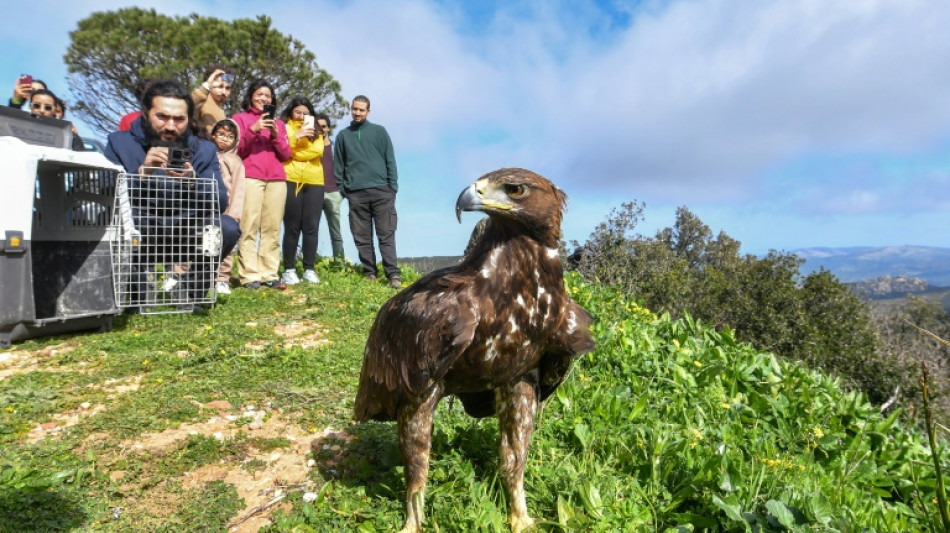
Aquila, a rescued golden eagle, was grounded after captors in Tunisia clipped his wings, but after months of rehabilitation he was set free -- a rare success story in a country where wildlife is threatened by climate change and human activity.
"ResQ," a programme launched two years ago by the Tunisian Wildlife Association (ATVS), has given Aquila a second chance as birds and other animals increasingly fall victim to poaching, habitat loss and extreme weather.
Run by about 40 conservationists -- mainly young students but also professionals -- the initiative rescues injured animals and raises awareness of wildlife in the North African country.
"When we rescue these birds, their wings are often cut, and they're in terrible shape," said Ridha Ouni, who looked after Aquila and heads the Tunisian Ornithology Association.
"It's heartbreaking to see such noble creatures treated this way."
The golden eagle, scientific name Aquila chrysaetos, is protected under Tunisian law and listed as a threatened species by the International Union for Conservation of Nature.
Despite that, it is often illegally hunted and trapped, while droughts and other climate-related changes shrink its habitat, according to IUCN.
- 'Exceptional' -
Aquila was seized from a private owner in July 2024 in the semi-desert region of Gabes, before being transferred to Ouni's rehabilitation centre on his farm in Sidi Thabet.
The farm also shelters a dozen rescued falcons, harriers and kites -- many with clipped wings -- as we as fennec foxes and wolves.
More than 200 animals have passed through the makeshift rehab centre, said Ouni, who added that releasing Aquila from the peak of Mount Sidi Zid gave him the best chance of survival.
"Now it's migration season, the best time to release him," said the self-taught conservationist now in his 60s, watching as the bird took flight.
For Jamila Bouayed, the 32-year-old director of ATVS, the moment was deeply moving: "rehabilitating a wild animal and returning it to nature is exceptional."
Maha Clostio, a 27-year-old Tunisian-American veterinary student, was also part of the effort.
"We were in the south to release a fennec fox" when Aquila was found, she recalled. "He was dehydrated, had injuries on his talons, and was a little sick."
- 'Long road ahead' -
With only around 50 breeding pairs of golden eagles left in Tunisia, according to Ouni, the group hopes efforts will help preserve the population.
Habib Rekik, an IT specialist and ResQ coordinator, films releases and other activities on his action camera.
"There's a long way to go," he said. "Few people here know these animals are protected by law, that they belong in nature, and not in cages or gardens."
"We must also boycott poachers who fuel an illegal trade," he added, referring to people who catch birds of prey and use them for profit.
In Sidi Bou Said, a picturesque village overlooking the Mediterranean north of Tunis, tourists are often seen posing for photos with falcons in exchange of money to handlers.
"If you want to see a bird of prey -- animals we revere in Arab culture -- watch documentaries or go out in nature," said Rekik.
On social media, the group's outreach is growing.
But with conservation costs high and with government funding for non-governmental organisations, ResQ relies entirely on private donations and crowdfunding.
Its next goal is to renovate Ouni's aviaries and establish an environmental education centre to inspire future conservationists.
G.Schulte--BTB