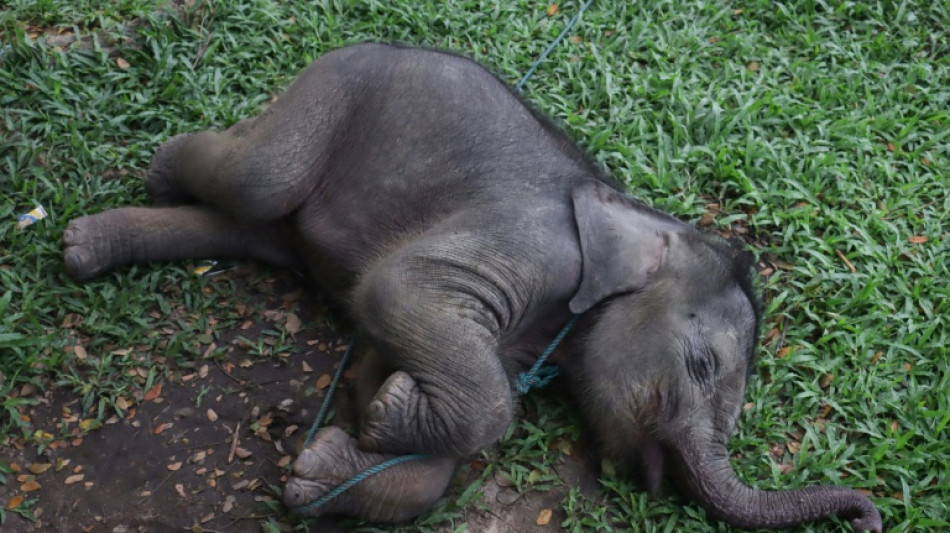
Baby elephant separated from mother rescued in Indonesia / Photo: © AFP

 From First Date to Wedding Day: How a TV Quote Sparked a Lifetime Commitment

 Malta Stuns Sweden with Late Penalty Comeback in Rugby Europe Trophy
 BingX: Major Announcement of Far-Reaching Significance

 Élan Opens as Late-Night Wine Bar in Honolulu

 Shiv Sena (UBT) Criticizes NCP Merger Talks as 'Ridiculous Laughing Stock'

 Dell Announces AI-Integrated PC Lineup for 2026 with Wi-Fi 7 Support

Indonesian authorities rescued a critically endangered baby Sumatran elephant after it became separated from its mother at a palm oil plantation, a local official said on Tuesday.
Sumatran elephants are on the brink of extinction with only about 2,400-2,800 left in the world, according to the World Wide Fund for Nature.
The two-month-old male calf was found at an oil palm plantation in Riau province on the western island of Sumatra on Monday after residents alerted authorities, local conservation agency official Ujang Holisudin told AFP.
"We suspect this elephant was left behind by his group or his mother," Ujang said, adding that the calf was alone when authorities found him.
The baby elephant is in good health after medical checks and was brought to the conservation agency's elephant training centre near the provincial capital Pekanbaru, he said.
Authorities were monitoring for elephant herds near the area to see if the calf could be reunited with its family.
"It is our hope that the group can be found and we can reunite (the calf). That is our hope," Ujang said.
Elephant populations are threatened by rampant poaching for their tusks, which are prized in the illegal wildlife trade.
The Southeast Asian nation is battling wildlife crime and several cases of elephant poisoning have been reported in recent years.
Deforestation has also reduced their natural habitat and brought them into increasing conflict with humans.
T.Bondarenko--BTB