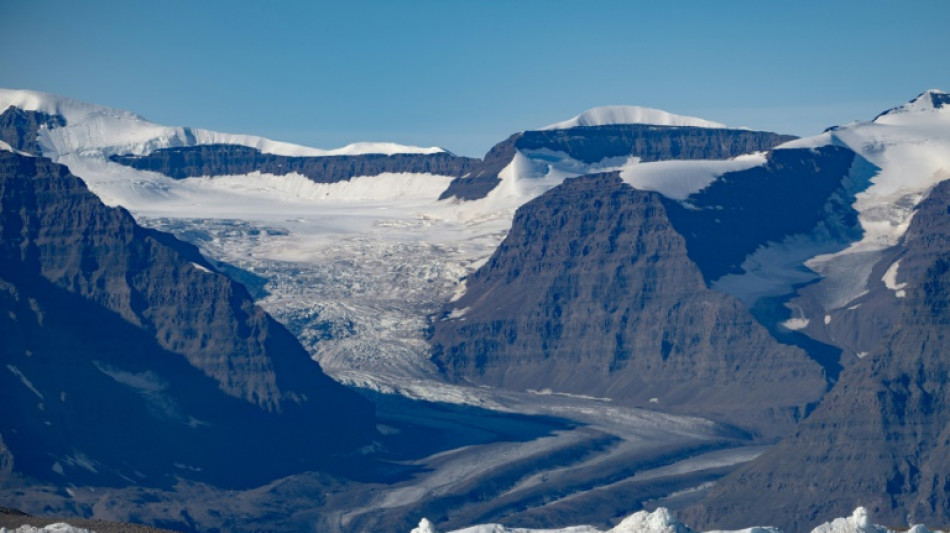
World's glacier mass shrank again in 2024, says UN / Photo: © AFP/File

 Commanders hand champion Seahawks their first loss

 Dupont scores twice to send Toulouse top of Top 14

 Ireland beat Israel but no handshakes due to war in Gaza

 Tense standoff over flashpoint N.Ireland parade lasts into night

 Stunned McNulty wins 'miracle' road race world title

 Re-released 'Avengers: Endgame' snaps-up N. America box office lead

 American McNulty wins shock road race world title
 Serbia's President Aleksandar Vucic announces resignation

 Tuchel urges Bellingham to play with 'rage'

 Russian strikes on Ukraine kill 8

 Bavuma, Miller hit centuries as South Africa clinch series

 Spain bring in Le Normand for injured Garcia

 UK Labour party meets buoyed by Burnham but seeking concrete plans

 Nor'easter lashes US east with punishing rain and wind

 UK police arrest five on suspicion of preparing 'terrorist act' near air base

 Washington denounces Iran's truce proposal as 'cynical'

 Armani sprinkles glitter on discreet elegance at Milan show

 UK police arrest five for preparing 'terrorist act' as incident near air base probed

 อเล็กซ์ โบดี และศาสตราจารย์ ดร. ดีเทอร์ ลาซิก ลงนามสัญญาสำหรับ ALPHA WHEY และ BODI เครื่องดื่มให้พลังงาน

 China teen blows away the field for record-setting gold at 'sad' Games

 Alex Bodi och prof. dr. Dieter Lazik tecknar avtal om ALPHA WHEY och BODI Energidryck

 Alex Bodi i prof. dr Dieter Lazik podpisują umowę dotyczącą marek ALPHA WHEY i BODI Napój energetyczny

 Ο Alex Bodi και ο καθηγητής Δρ. Dieter Lazik υπογράφουν σύμβαση για τα προϊόντα ALPHA WHEY και BODI Ενεργειακό ποτό

 アレックス・ボディ氏とディーター・ラジク教授が「ALPHA WHEY」および「BODI エナジードリンク」に関する契約を締結

 Housing protesters dig in for long stay in Madrid square

All 19 of the world's glacier regions experienced a net loss of mass in 2024 for the third consecutive year, the United Nations said on Friday, warning that saving the planet's glaciers was now a matter of "survival".
Five of the last six years have seen the most rapid glacier retreat on record, the UN's World Meteorological Organization weather, climate and water agency said, on the inaugural World Day for Glaciers.
"Preservation of glaciers is a not just an environmental, economic and societal necessity: it's a matter of survival," said WMO chief Celeste Saulo.
Beyond the continental ice sheets of Greenland and Antarctica, more than 275,000 glaciers worldwide cover approximately 700,000 square kilometres, said the WMO.
But they are rapidly shrinking due to climate change.
"The 2024 hydrological year marked the third year in a row in which all 19 glacier regions experienced a net mass loss," the WMO added.
Together, they lost 450 billion tonnes of mass, the agency said, citing new data from the Swiss-based World Glacier Monitoring Service (WGMS).
It was the fourth worst year on record, with the worst being in 2023.
- Huge loss over 50 years -
"From 2022-2024, we saw the largest three-year loss of glaciers on record," said Saulo.
Glacier mass loss last year was relatively moderate in regions such as the Canadian Arctic and the peripheral glaciers of Greenland -- but glaciers in Scandinavia, Norway's Svalbard archipelago and North Asia experienced their worst year on record.
Based on a compilation of worldwide observations, the WGMS estimates that glaciers -- separate from the continental ice sheets in Greenland and Antarctica -- have lost more than 9,000 billion tonnes since records began in 1975.
"This is equivalent to a huge ice block of the size of Germany with a thickness of 25 metres," said WGMS director Michael Zemp.
At current rates of melting, many glaciers in western Canada and the United States, Scandinavia, central Europe, the Caucasus, New Zealand "will not survive the 21st century", said the WMO.
The agency said that together with ice sheets, glaciers store around 70 percent of the world's freshwater resources, with high mountain regions acting like the world's water towers. If they disappear, that would threaten water supplies for millions of people downstream.
- 'Ignoring the problem' -
For the UN, the only possible response is to combat global warming by reducing greenhouse gas emissions.
"We can negotiate many things in the end, but we cannot negotiate physical laws like the melting point of ice," said Stefan Uhlenbrook, the WMO's water and cryosphere director.
He declined to comment on the return to office in January of US President Donald Trump, a climate change sceptic who has pulled the United States out of the landmark 2015 Paris climate accords.
However, Uhlenbrook said that "ignoring the problem" of climate change "is maybe convenient for a short period of time", but "that will not help us to get closer to a solution".
For the inaugural World Day for Glaciers, the WGMS named a US glacier as its first Glacier of the Year.
The South Cascade Glacier in Washington state has been monitored continuously since 1952 and provides one of the longest uninterrupted records of glaciological mass balance in the western hemisphere.
M.Odermatt--BTB



