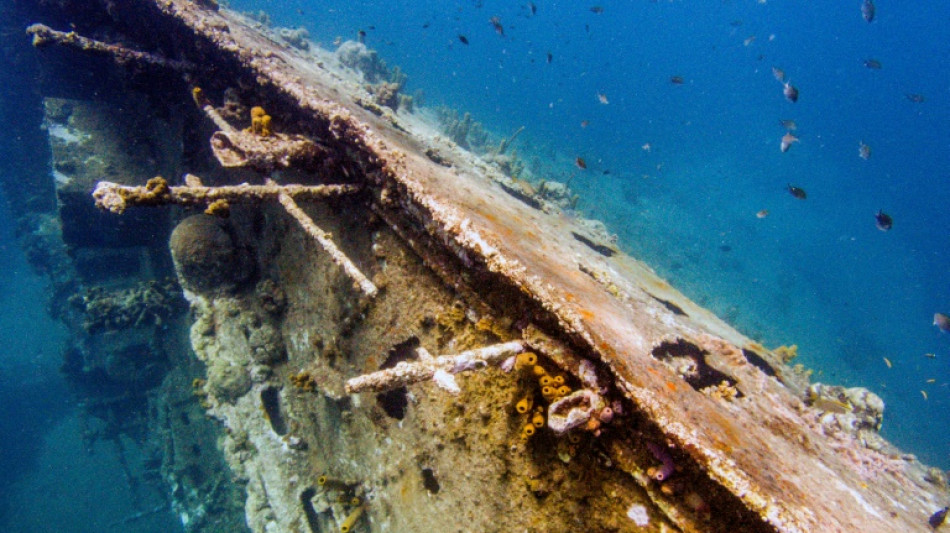
Protecting undersea cultural heritage in spotlight at mining code talks / Photo: © AFP/File

 Commanders hand champion Seahawks their first loss

 Dupont scores twice to send Toulouse top of Top 14

 Ireland beat Israel but no handshakes due to war in Gaza

 Tense standoff over flashpoint N.Ireland parade lasts into night

 Stunned McNulty wins 'miracle' road race world title

 Re-released 'Avengers: Endgame' snaps-up N. America box office lead

 American McNulty wins shock road race world title

 Serbia's President Aleksandar Vucic announces resignation

 Tuchel urges Bellingham to play with 'rage'

 Russian strikes on Ukraine kill 8
 Bavuma, Miller hit centuries as South Africa clinch series

 Spain bring in Le Normand for injured Garcia

 UK Labour party meets buoyed by Burnham but seeking concrete plans

 Nor'easter lashes US east with punishing rain and wind

 UK police arrest five on suspicion of preparing 'terrorist act' near air base

 Washington denounces Iran's truce proposal as 'cynical'

 Armani sprinkles glitter on discreet elegance at Milan show

 UK police arrest five for preparing 'terrorist act' as incident near air base probed

 อเล็กซ์ โบดี และศาสตราจารย์ ดร. ดีเทอร์ ลาซิก ลงนามสัญญาสำหรับ ALPHA WHEY และ BODI เครื่องดื่มให้พลังงาน

 China teen blows away the field for record-setting gold at 'sad' Games

 Alex Bodi och prof. dr. Dieter Lazik tecknar avtal om ALPHA WHEY och BODI Energidryck

 Alex Bodi i prof. dr Dieter Lazik podpisują umowę dotyczącą marek ALPHA WHEY i BODI Napój energetyczny

 Ο Alex Bodi και ο καθηγητής Δρ. Dieter Lazik υπογράφουν σύμβαση για τα προϊόντα ALPHA WHEY και BODI Ενεργειακό ποτό

 アレックス・ボディ氏とディーター・ラジク教授が「ALPHA WHEY」および「BODI エナジードリンク」に関する契約を締結

 Housing protesters dig in for long stay in Madrid square

The world's oceans harbor a cultural heritage of sunken ships, remains of those lost in the transatlantic slave trade and Indigenous islanders' spiritual ties to the sea that must be protected, NGOs and native peoples say.
They are pushing at a meeting in Jamaica of the International Seabed Authority (ISA) -- an organization established under the UN Convention on the Law of the Sea -- for such protection to be enshrined in a mining code that is being negotiated to govern the exploitation of sea beds in international waters.
"Our ancestors traveled the oceans for thousands of years, passing on information from generation to generation," said Hinano Murphy of the Tetiaroa Society, a Polynesian conservation group.
"We are the children of the people of the ocean," Murphy told AFP, insisting this heritage must be treated as something sacred.
Scientists and defenders of the oceans have long insisted that future industrial-level mining will threaten marine ecosystems.
But "the underwater cultural heritage is a living memory of the generations that came before us. Its protection must be a priority equal to the protection of marine biodiversity," Salim Lahsini, a representative of Morocco speaking on behalf of African countries, said during fierce debate over the mining code.
The draft of the code states that mining companies are supposed to notify the ISA if they come across human remains or archeological objects or sites.
Depending on how the talks conclude, such a find could trigger a suspension of the mining that led to the discovery, but there is no consensus on the details of how this will work.
"To define underwater cultural heritage as shipwrecks is very sad for me," said April Nishimura, a representative of a clan of the Gitxsan Indigenous people in Canada, who explained that her people feel linked to the ocean by the salmon that swim upriver.
- 'Intangible heritage' -
In this spirit, a group of countries led by Micronesia has proposed that underwater heritage be defined to include tangible things such as human remains, shipwrecks and their cargo as well as intangibles such as knowledge of traditional navigation techniques and spiritual practices linked to the sea.
As things stand now, technologies for mining metal deposits in the Pacific are the only ones that seem ready for industrial-scale use.
But the Atlantic could lure profit-seekers next, as it features a different kind of valuable deposits under the sea.
The ocean is the final resting place of shipwrecks, planes shot down during World War II and physical reminders of centuries of trade in slaves from Africa to the Americas.
"Many ships carrying enslaved persons sank during the passage. Many enslaved persons who died during the crossing had their bodies dumped into the ocean," said Lucas Lixinski, a professor of law at the University of New South Wales in Australia.
The slave trade, he said, "is an important story of underwater heritage and our ongoing connections to it."
While halting a mining job if a shipwreck is found seems simple in principle, protecting intangible parts of the undersea heritage is more tricky.
The mining code could protect this kind of treasure by establishing a "checkpoint" before the mining is undertaken, he said.
Indigenous communities and anthropologist would be asked if mining in a given area disturbs these cultural connections "in a way that would be too invasive or destructive," said Lixinski.
The working group led by Micronesia recommends the creation of a specialized committee, to include representatives of Indigenous peoples, to help the ISA decide on a given mining project.
There are already solutions for protecting tangible underwater heritage, said Charlotte Jarvis, a maritime archeologist who represents an NGO called The Ocean Foundation.
"We are trained to spot a shipwreck in seafloor data and we know the best way to collect that data. So getting good data ahead of time will be key," she told AFP.
I.Meyer--BTB



